In January 2026, the West Virginia Board of Education voted unanimously to take over Hancock County Schools↗ET. The superintendent was removed. The assistant superintendent was removed. A state-appointed replacement started that same afternoon. The district had been employing roughly 140 more people than its state aid formula funded, and it could not make payroll.
Hancock County was the seventh county school system the state board had intervened in during 2025, and the tenth in three years. As of March 2026, nine counties sit under either full state takeover or a declared state of emergency. Seven have been taken over outright: Hancock, Upshur↗ET, Logan↗ET, Mingo↗ET, Tyler↗ET, Nicholas↗ET, and Boone↗ET. Two more, Roane↗ET and Randolph↗ET, operate under states of emergency with deadlines to fix their finances.
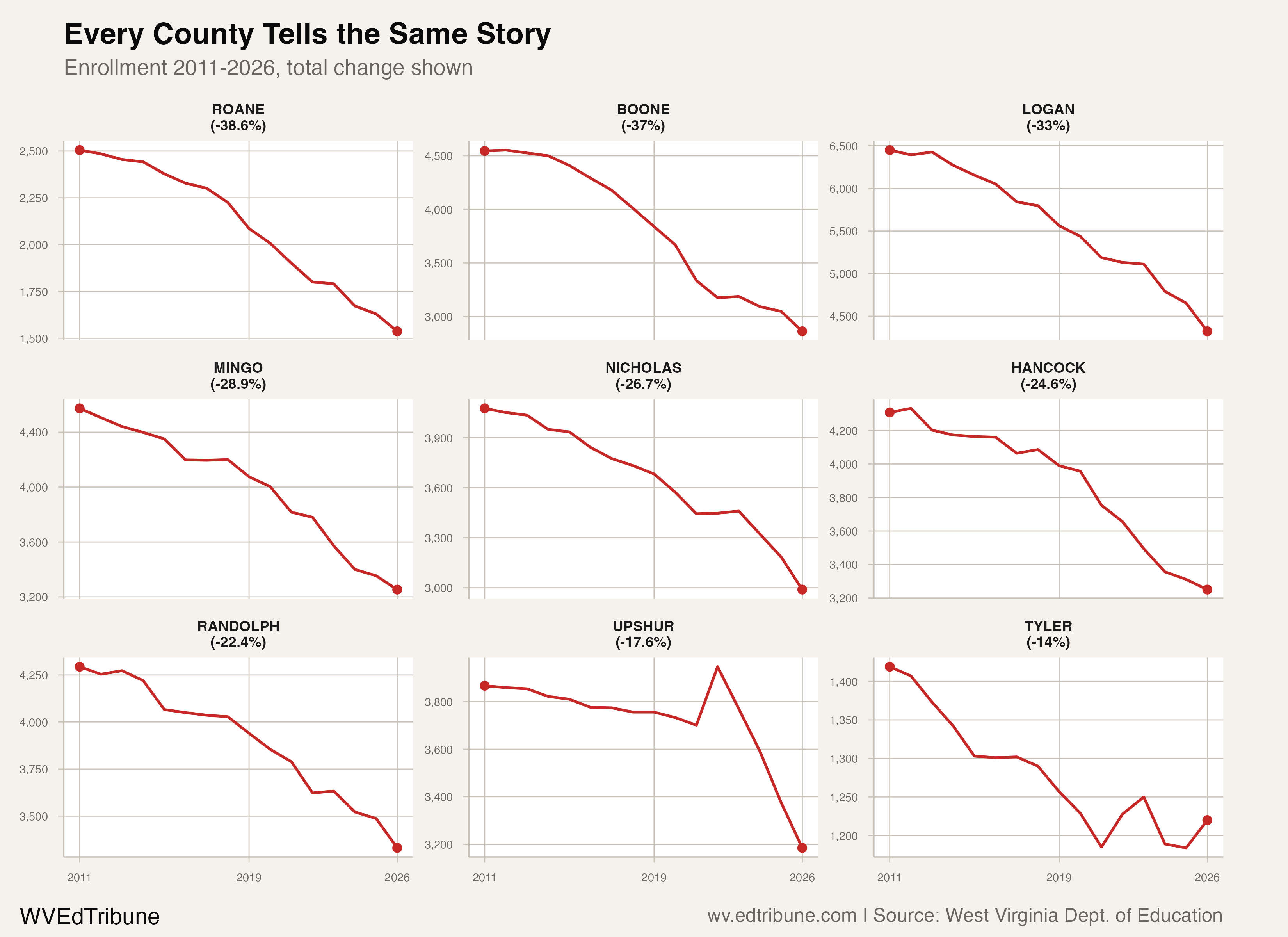
Every one of the nine has lost enrollment since 2011. The average decline across the group is 27.0%, compared to 20.8% for the state's other 46 counties.
The math that breaks a county
West Virginia's Public School Support Program distributes state aid primarily on a per-pupil basis. When students leave, the funding follows. But costs do not shrink at the same rate. A county that loses 100 students still heats the same buildings, still employs bus drivers on the same routes, still owes debt service on the same bonds. The gap between what a county receives and what it costs to operate widens with each departing student.
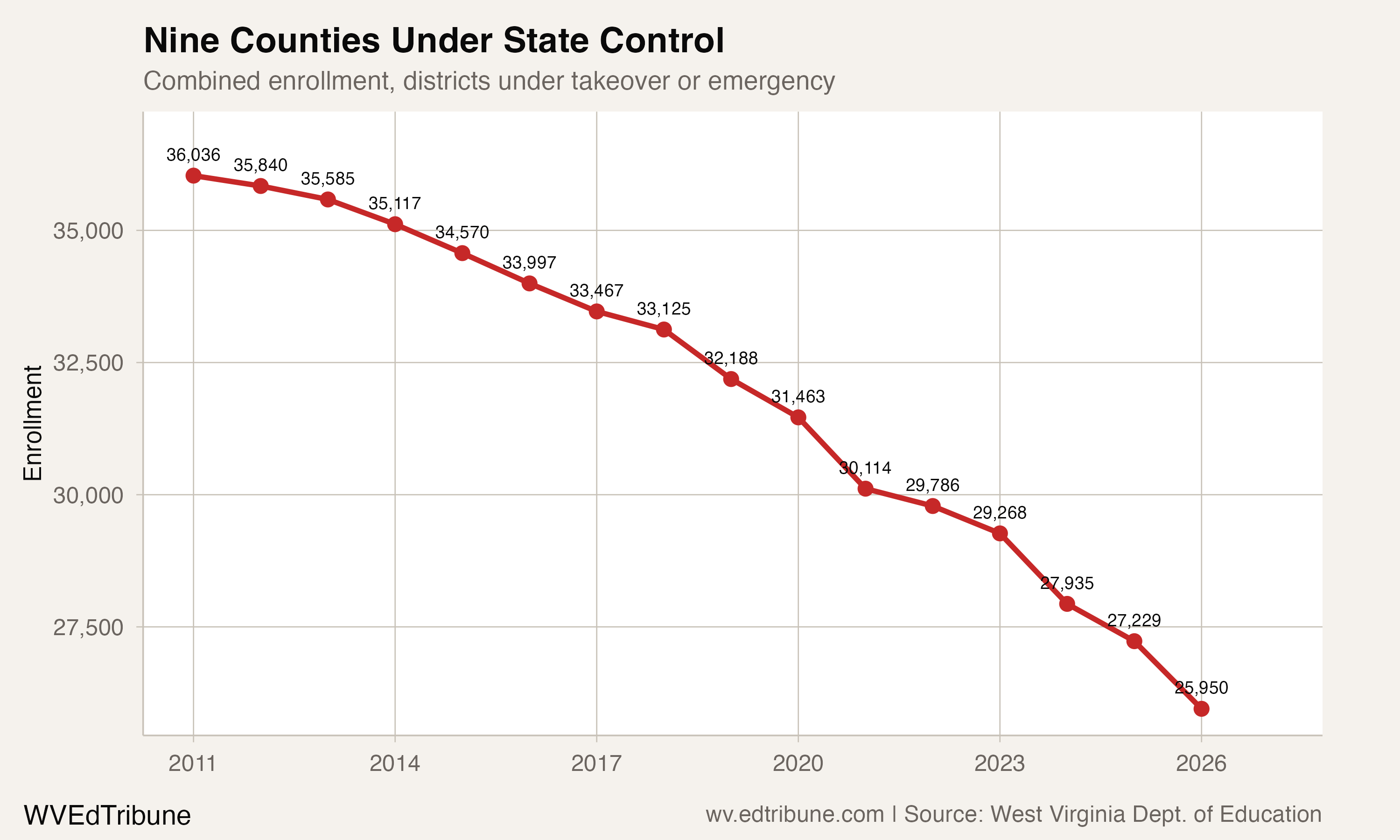
The nine intervention counties collectively enrolled 36,036 students in 2010-11. By 2025-26, that number had fallen to 25,950, a loss of 10,086 students, or 28.0%. The state as a whole declined 18.6% over the same period, from 282,130 to 229,646.
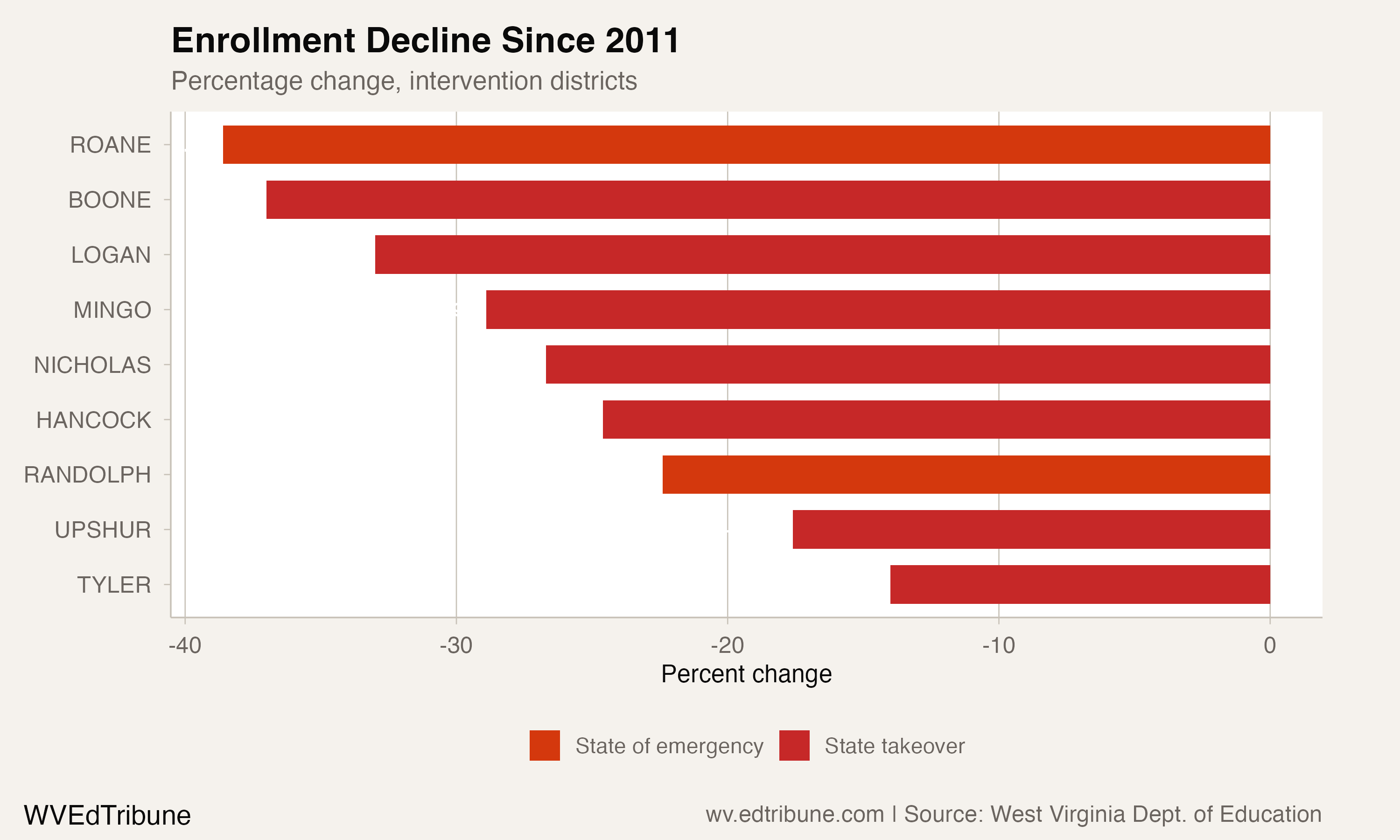
The steepest losses are concentrated in southern coalfield and rural counties. Roane has declined 38.6% since 2011, from 2,505 to 1,537 students. Boone fell 37.0%, from 4,545 to 2,862. Logan, once the largest of the group at 6,449 students, now enrolls 4,323, a 33.0% decline. Eight of the nine hit all-time enrollment lows in 2025-26.
The Hancock County case
Hancock County's financial crisis became the most visible of the nine. State Board President Paul Hardesty called it "total malfeasance of the administration." State officials discovered the district had bypassed the mandatory West Virginia Education Information System, managing finances via manual spreadsheets that obscured its actual deficit. Three consecutive audits had shown no major concerns.
The enrollment trajectory, though, had been visible for years. Hancock County enrolled 4,308 students in 2010-11. By 2025-26, it enrolled 3,250, a loss of 1,058 students, or 24.6%, over 15 years. That translates to roughly 70 fewer students per year, each carrying state aid dollars out the door.
The legislature responded with HB 4575, designating $8 million in surplus revenue for an emergency relief fund. The state Senate moved slowly on the bill, with senators questioning whether a one-time infusion could solve a structural problem.
Building half-empty
Roane County's emergency declaration in July 2025 illustrated a different version of the same problem. The state board's accountability office found a $2.5 million deficit for fiscal year 2025 and a projected $2.9 million deficit for fiscal year 2026. The county posted the lowest building utilization rate in the state at 45%, meaning its school buildings were, on average, less than half full.
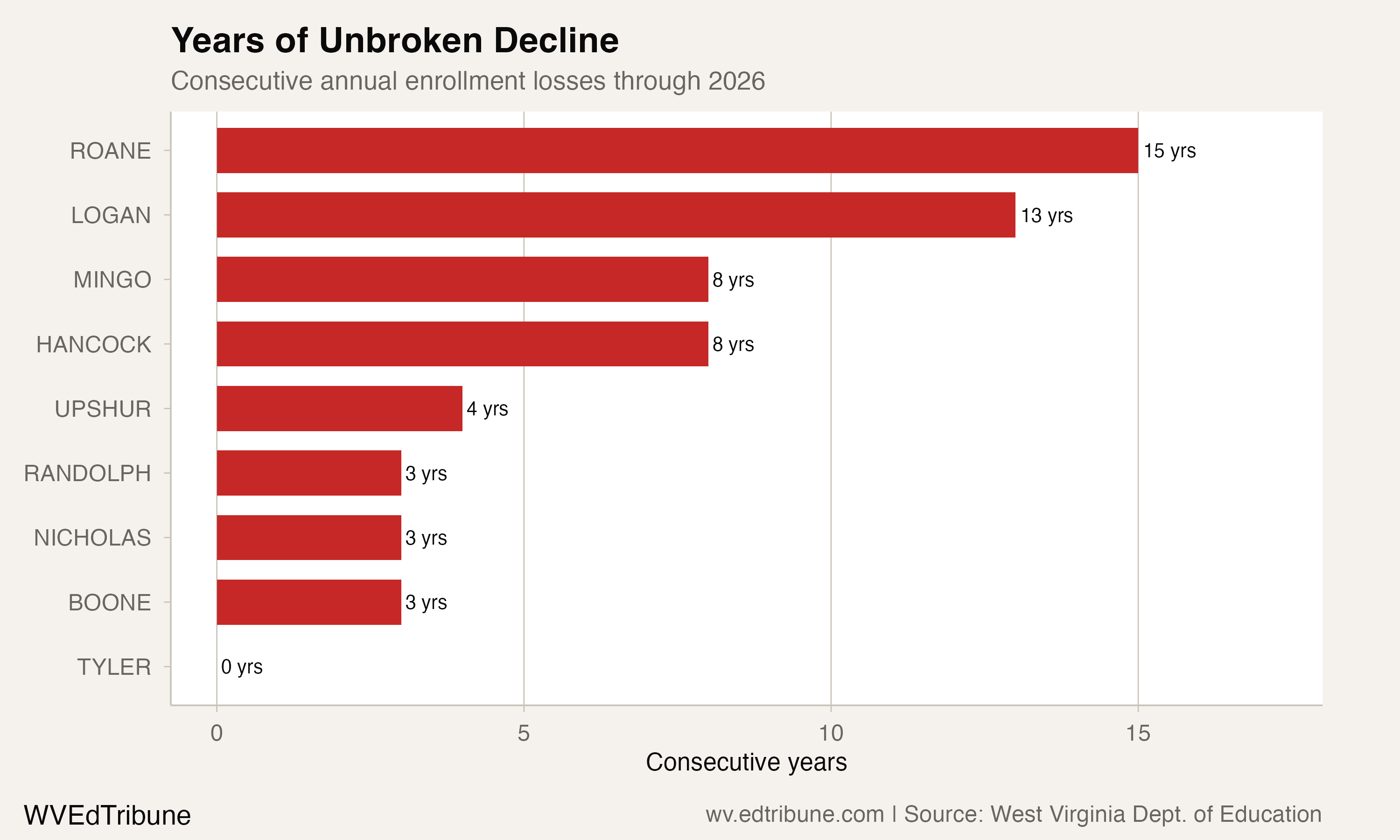
Roane's enrollment tells the story behind the number. The county has declined for 15 consecutive years, the longest active streak among the intervention counties. It enrolled 2,505 students in 2010-11 and 1,537 in 2025-26, a loss of 968 students, or 38.6%. The county had already been shrinking before the pandemic: it lost 419 students between 2011 and 2019, then another 549 between 2019 and 2026.
The gap widens every year
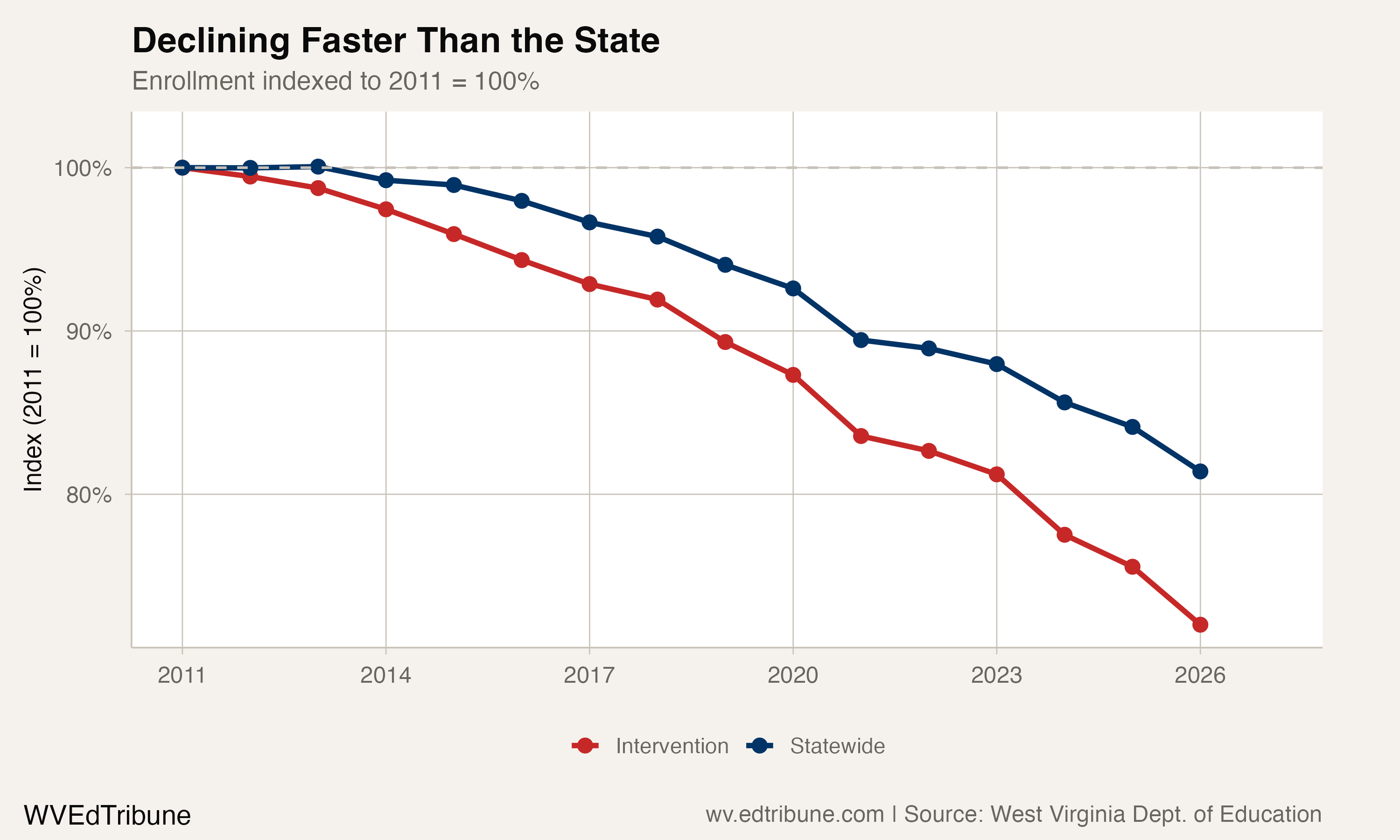
Indexed to 2011, the nine intervention counties have fallen to 72.0% of their starting enrollment. The state as a whole has fallen to 81.4%. The gap between the two lines has grown in every year since 2014.
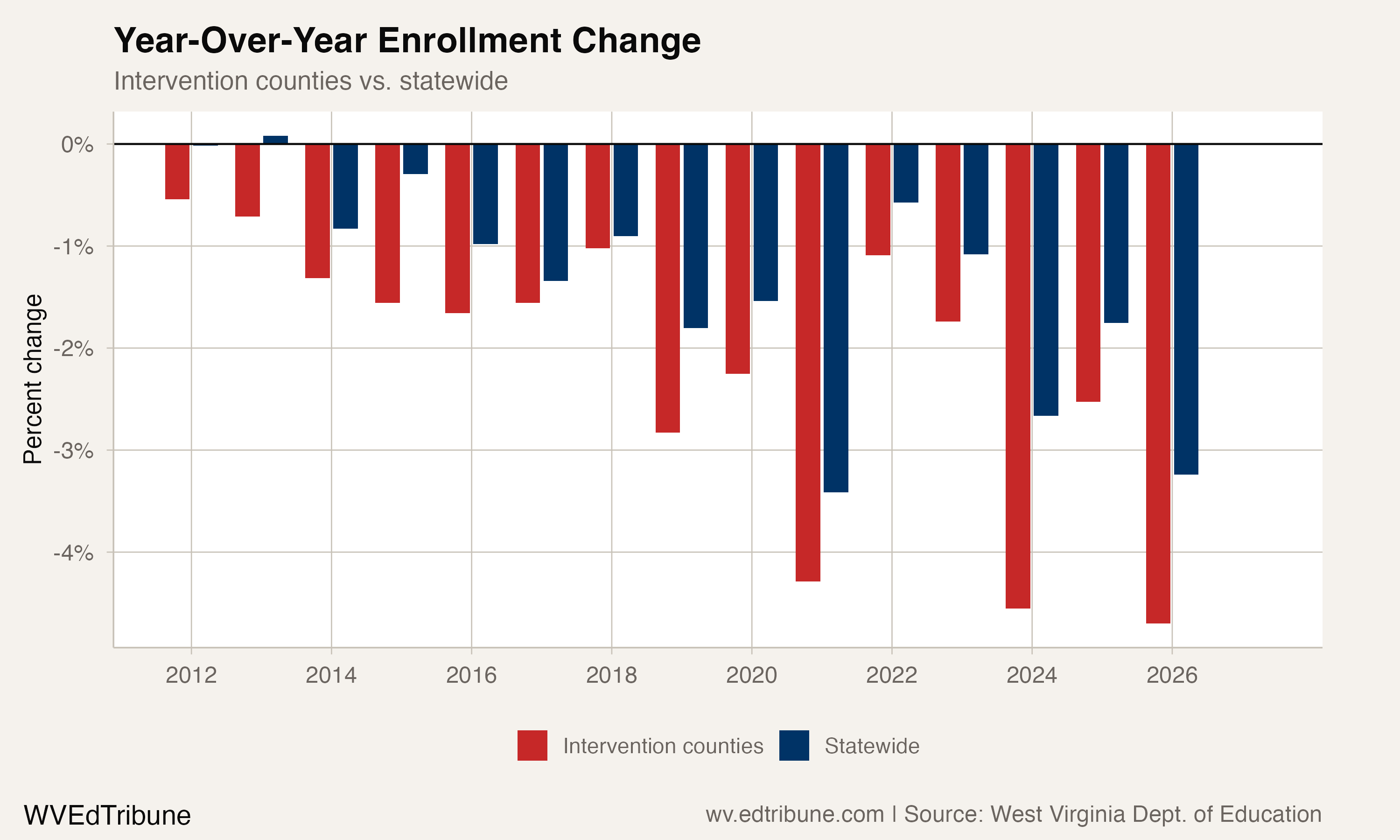
The year-over-year pattern makes it harder to dismiss as a one-time shock. In every year since 2014, the intervention counties have declined faster than the state as a whole. In 2026, the gap was stark: the intervention counties lost 4.7% of their enrollment while the state overall declined 3.2%.
The causes vary by county. Mingo was taken over in March 2025 for political infighting and failure to follow parliamentary procedures. Nicholas was taken over in May 2025 after hiring a sex offender related to the county superintendent. Boone followed in June 2025 after a maintenance director pleaded guilty to $3.4 million in mail fraud. The triggers are administrative and financial. The underlying condition is the same.
What the funding formula does not see
The state's PSSP formula adjusts for enrollment changes, but the adjustment works in one direction: downward. A county that loses students loses state aid proportionally. A county that must close a school, consolidate bus routes, or renegotiate contracts to match its shrinking budget faces costs that do not scale proportionally with enrollment.
The West Virginia Center on Budget and Policy found that state PSSP funding in fiscal year 2026 is 17% below 2009 levels after adjusting for inflation, even though enrollment declined only 14.7% over the same period. Per-pupil spending stands at $14,575, nearly $2,000 below the national average of $16,526.
"It's always money. We always say this is a major issue, but we don't have anything really structured that gets us from here to finding a solution." — Sen. Amy Grady (R-Mason), Mountain State Spotlight, March 2026
Meanwhile, the Hope Scholarship voucher program has grown to more than 10,000 students at a cost exceeding $40 million, with plans to expand to universal eligibility in 2026-27 at a projected cost of $170 million or more. The same legislative session that debated emergency funding for Hancock County fully funded the Hope Scholarship with no spending guardrails while the public school budget received approximately $8 million less than the previous year.
"For the same cost as the Hope Scholarship next year, nearly $250 million, we could fund raises for teachers and school staff." — Tamaya Browder, WV Center on Budget and Policy, WTAP, March 2026
Fifteen years without a single gain
The decline streaks among the intervention counties are not temporary. Roane has lost enrollment for 15 straight years. Logan has declined for 13. Mingo and Hancock have each declined for eight consecutive years. None of these counties has posted a single year of enrollment growth since at least 2018.
The state board has no formal checklist for ending a takeover. Assistant State Superintendent Jeff Kelley told Mountain State Spotlight that "there's no set of boxes that have to be checked off, which, once they're done, you just get the autonomy back." On average, state takeovers last approximately seven years. After five years, a mandatory public hearing is triggered if control has not been returned.
State takeovers can stabilize budgets. They cannot create students. More than 70 schools have closed across West Virginia since 2019, and the intervention counties have been among the hardest hit.
Roane County -- 15 years of decline, buildings less than half full, a deficit that deepens each year -- is the clearest case study. The state replaced the superintendent and imposed fiscal controls. But Roane's 2027 kindergarten class will be smaller than the 2025-26 class, and the year after that, smaller still. At some point, the intervention playbook runs out of moves that do not involve eliminating the county system entirely.
Detailed code that reproduces the analysis and figures in this article is available exclusively to EdTribune subscribers.
Discussion
Sign in to join the discussion.
Loading comments...