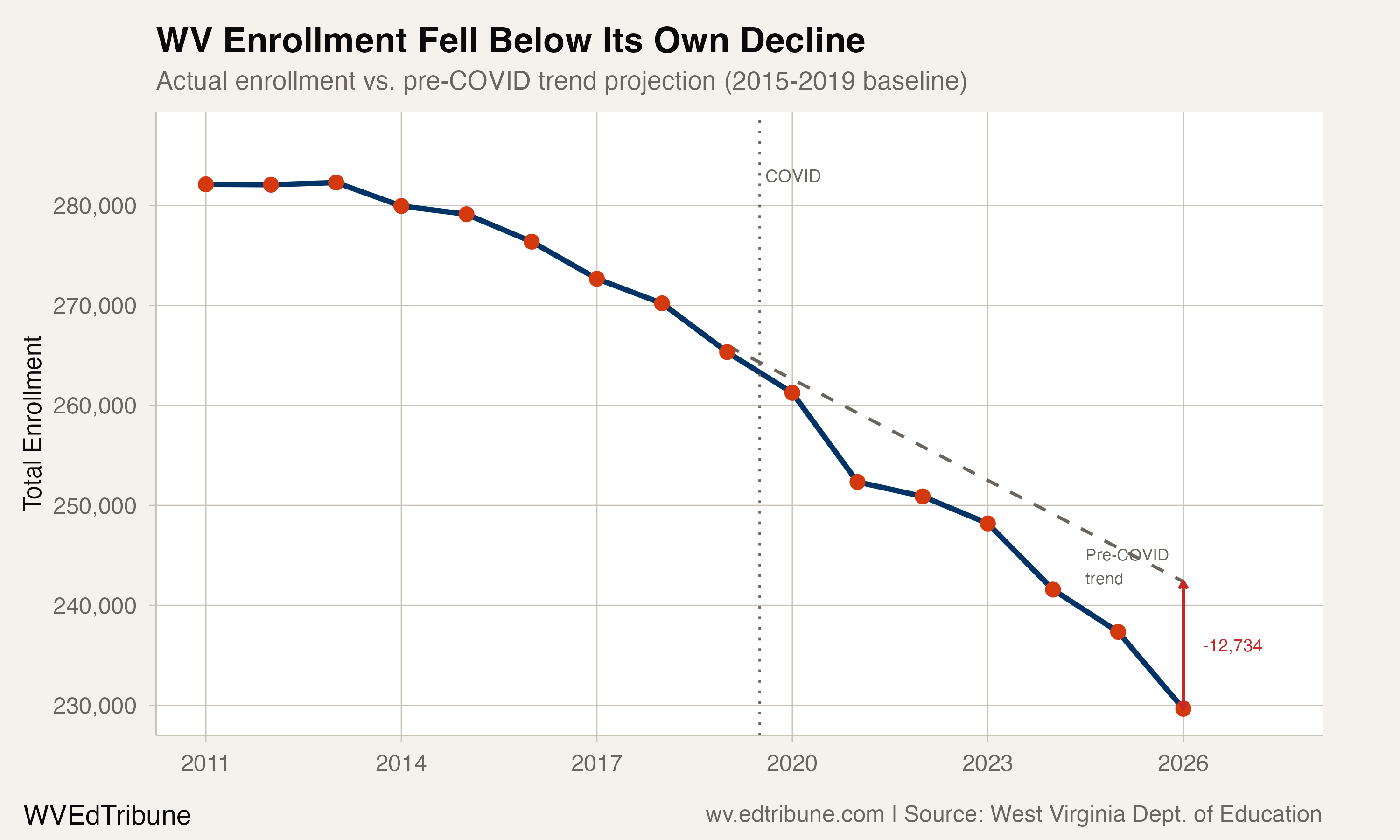
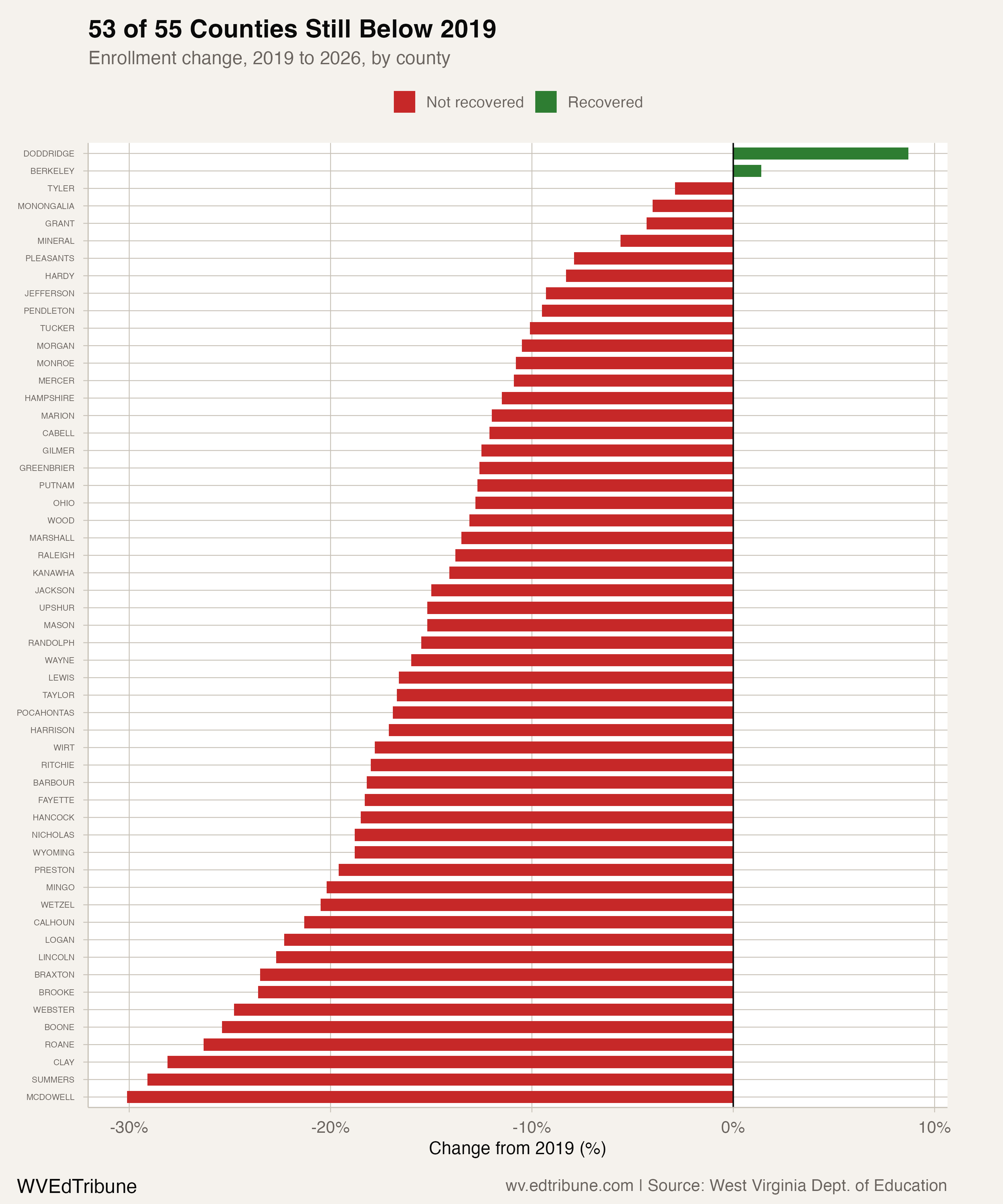
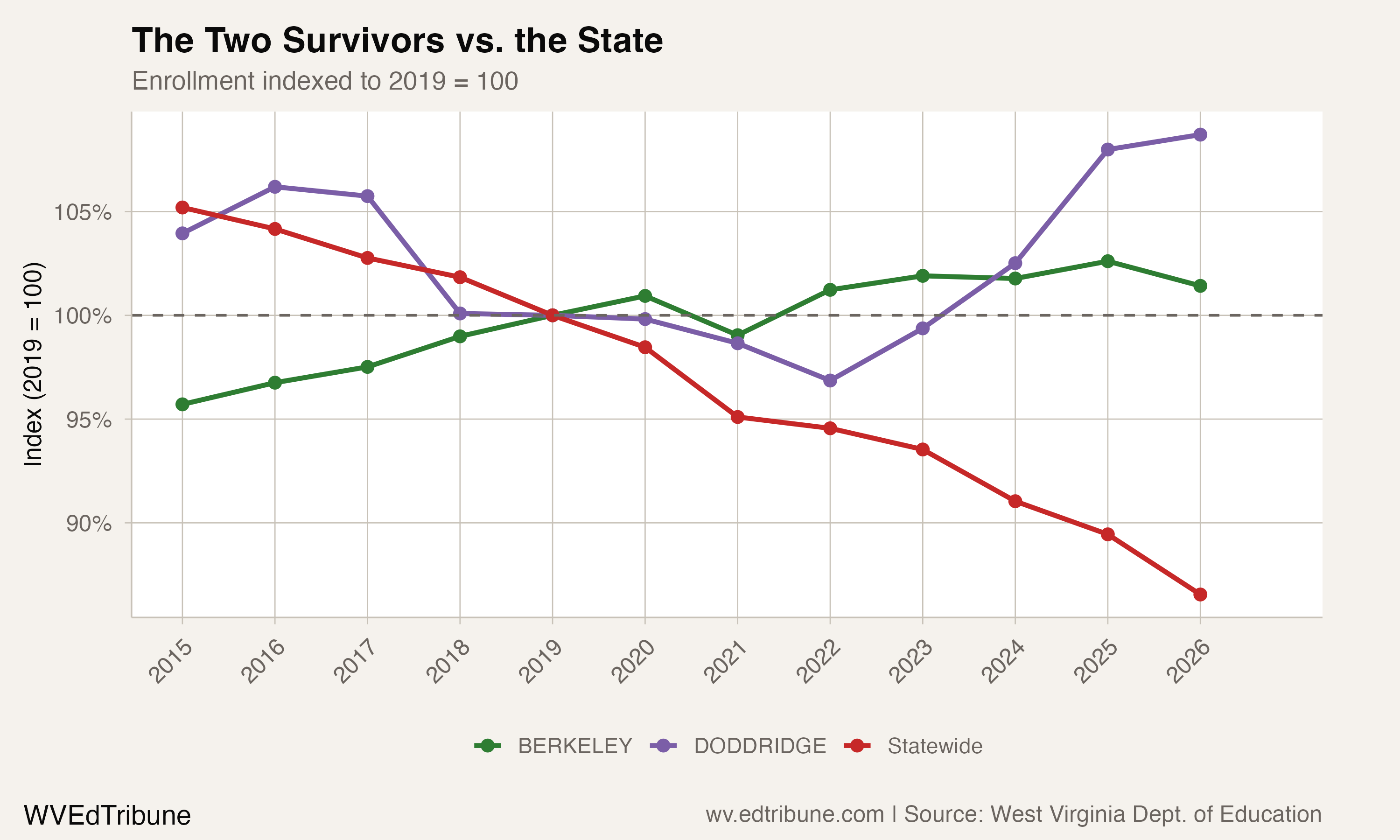
In the fall of 2019, West Virginia enrolled 265,344 public school students across 55 county systems. Seven years later, the state enrolls 229,646, a loss of 35,698 students, or 13.5%. Of the 55 counties that entered the pandemic, exactly two have returned to their 2019 enrollment level: Berkeley↗ET, with 276 more students, and Doddridge↗ET, with 97.
The other 53 are not recovering. They are not stabilizing. For 52 of them, the distance from their 2019 enrollment has grown wider since 2022. The pandemic did not cause a temporary dip in West Virginia. It permanently accelerated a decline that was already underway.
The gap that keeps widening
West Virginia was already losing students before COVID-19. Between 2015 and 2019, the state shed an average of 3,447 students per year. The pandemic deepened that trajectory: 4,080 lost in 2020, then 8,918 in 2021, the single worst year on record. What followed was not a recovery. After a brief deceleration in 2022 (a loss of 1,447), the decline resumed and intensified. The state lost 6,617 students in 2024 and 7,693 in 2026, the second-largest single-year drop in the dataset.
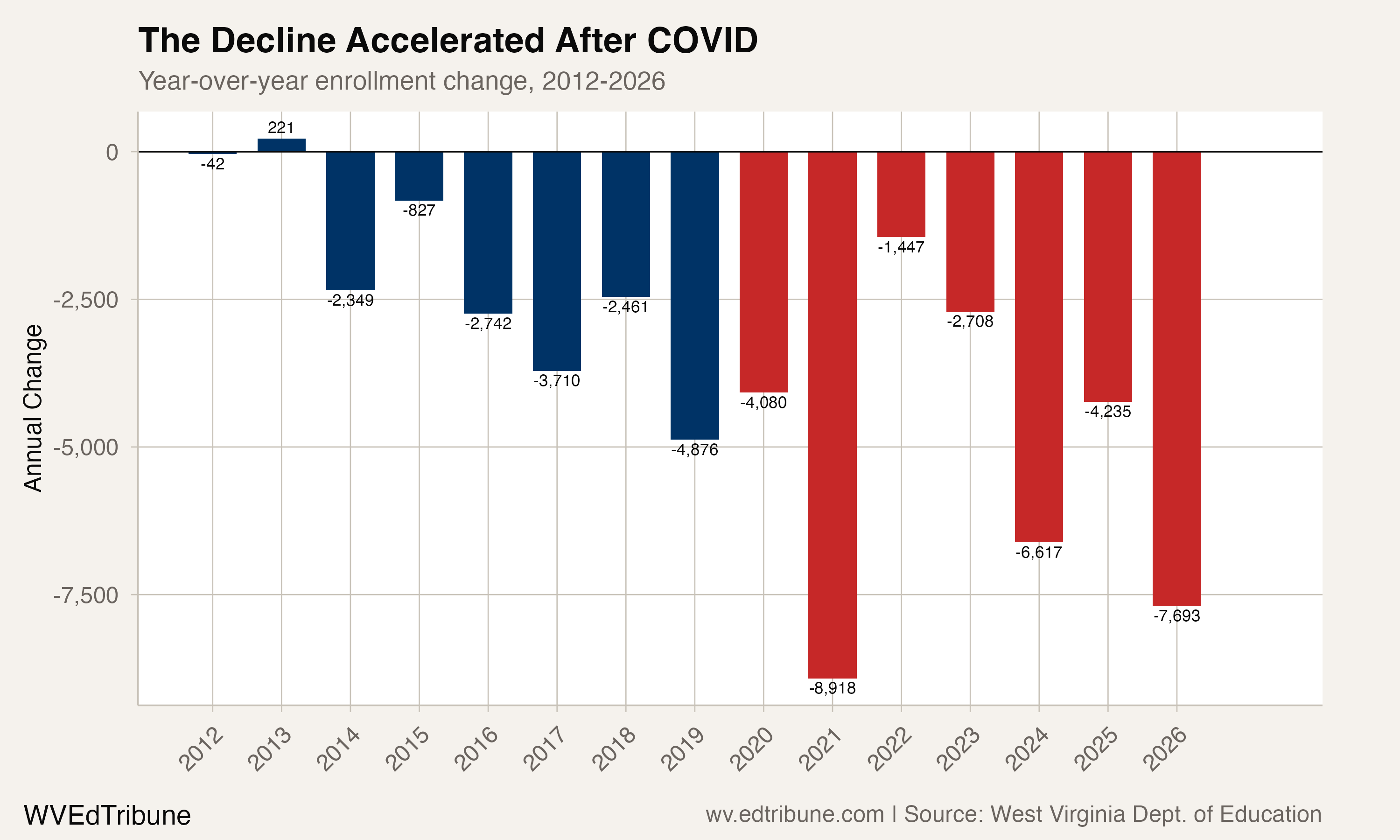
If pre-COVID trends (2015-2019) had continued on their existing trajectory, West Virginia would have enrolled roughly 242,380 students in 2026. The actual figure is 12,734 below that projection. COVID did not merely interrupt a decline. It bent the curve downward and the curve never bent back.
Post-COVID, the state has averaged a loss of 4,540 students per year, compared to 3,447 before. That is a 1.3x acceleration factor, sustained now across five consecutive years.
The 3.6% recovery rate
The starkest measure of West Virginia's post-pandemic trajectory is the recovery rate: 2 of 55 districts, or 3.6%. The median county has lost 15.2% of its 2019 enrollment. Thirteen counties have lost more than 20%.
The losses are not concentrated in a few large systems. The 10 worst-hit districts account for 44.2% of the statewide loss. The remaining 56% is distributed across 43 other declining counties. Every size bracket is affected: small districts (under 2,000 students) averaged a 14.3% loss, medium districts (2,000-5,000) averaged 17.5%, and large districts (5,000-10,000) averaged 14.3%.
Forty-nine of 55 counties have declined in at least five of the seven post-2019 years. Twenty-four have declined in every single year since 2019, without exception.
Coal country and the compounding crisis
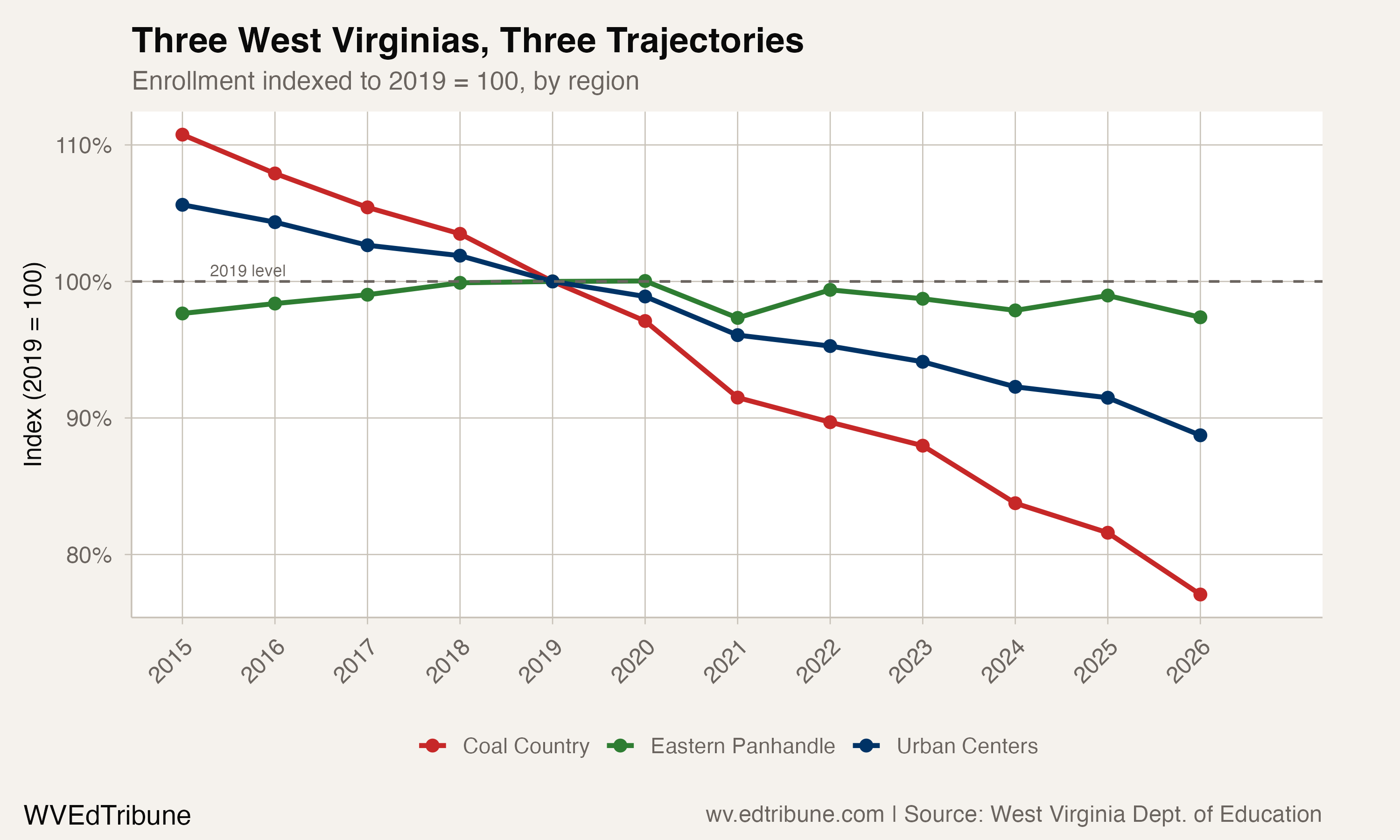
The southern coalfields are losing students at nearly double the state rate. Five coal-producing counties, McDowell↗ET, Mingo, Logan, Boone, and Wyoming, have averaged a 23.4% enrollment loss since 2019. McDowell County, which enrolled 2,967 students in 2019, is down to 2,075, a 30.1% decline. Boone County has lost a quarter of its students. Logan has lost 22.3%.
These counties entered the pandemic with already-fragile enrollment bases, depressed by decades of population loss tied to the coal industry's contraction. COVID compounded that fragility. The West Virginia Center on Budget and Policy estimated that the Hope Scholarship voucher program accounted for 51.9% of statewide enrollment decline, with the impact varying from under 1% in some counties to over 97% in Cabell County.
Urban centers are declining more slowly but still losing ground. Kanawha↗ET County, the state's largest system, has lost 3,615 students (14.1%) since 2019. Cabell County, home to Huntington, lost 1,506 (12.1%). Even Monongalia↗ET County, home to West Virginia University in Morgantown and one of the state's most economically stable communities, is down 465 students (4.0%).
What the two survivors share, and don't
Berkeley and Doddridge have almost nothing in common except that both have more students now than before the pandemic. Berkeley, with 19,716 students, is the state's second-largest district. Doddridge, with 1,211, is among the smallest.
Berkeley's advantage is geographic. Located in the Eastern Panhandle within commuting distance of the Washington, D.C. metro area, the county has added nearly 13,000 residents over the past decade, making it one of only eight West Virginia counties to grow in population. That population growth translates directly into school enrollment: Berkeley grew steadily from 17,720 students in 2011 to a peak of 19,947 in 2025 before dipping slightly to 19,716 in 2026, still 276 above its 2019 level.
Doddridge's path is different. This small north-central county, population around 8,500, dipped below its 2019 level through 2022 and then reversed course. From 1,079 students in 2022, it climbed to 1,211 in 2026, an increase of 132 students in four years, or 12.2%. At that scale, a single housing development or gas industry workforce shift can move the number.
Three forces pulling in one direction
The most likely explanation for the severity of West Virginia's non-recovery is that three separate downward pressures arrived simultaneously and reinforced one another.
The first is demographic. West Virginia's population declined by 4.3% between 2015 and 2025, one of only a handful of states to lose residents over that period. Deaths have exceeded births by thousands annually, according to U.S. Census Bureau estimates. Fewer people means fewer children.
The second is the Hope Scholarship, West Virginia's universal education savings account program, which launched in 2022. The program has grown rapidly, with county-level participation increasing more than tenfold on average between 2022 and 2026. At roughly $4,900 per scholarship, the program diverts students and funding simultaneously. The program's costs have grown from $9.2 million in 2023 to an expected $100 million in 2026, and the program has been expanded to include year-round open enrollment.
The third is the expiration of federal ESSER pandemic relief funds, which sustained staffing levels in many districts even as enrollment fell. With those funds exhausted, districts must now align budgets to actual headcount.
"We're looking at a kind of tipping point... various things hitting at public education." -- State Superintendent Michele Blatt, WV MetroNews, November 2024
Blatt described the current wave of school closures as "the largest number I'm familiar with, and I've been here around 17 years." Sixteen schools closed in 2024, up from nine in 2023 and five in 2022. Another dozen were approved for closure in December 2024, with consolidation efforts underway in Kanawha, Wetzel, and Nicholas counties.
What the enrollment data cannot see
This analysis measures public school enrollment. It does not track where departed students went. Some left for the Hope Scholarship. Some left the state entirely. Some aged out. Some were never born. The enrollment data captures the net result but not the decomposition.
What is visible is that 52 of 53 non-recovered districts are falling further behind their 2019 levels, not converging back toward them. The National Center for Education Statistics projects that West Virginia will lose another 13% of its public school enrollment by 2031. If that projection holds, the state would fall below 200,000 students within the decade, a figure it last saw before consolidated county school systems existed in their current form.
Every county superintendent except two is managing the same reality: a student population that is not coming back. The systems they run were built for larger cohorts, funded by larger enrollment, and staffed at levels that no longer make sense. Recovery is not on the horizon. Adaptation is the only option, and for many, it is not happening fast enough.
Detailed code that reproduces the analysis and figures in this article is available exclusively to EdTribune subscribers.
Discussion
Sign in to join the discussion.
Loading comments...