Of West Virginia's 55 county school districts, 52 had fewer students in 2025-26 than they did in 2011. The state as a whole has lost 52,484 students over that span, an 18.6% decline that ranks among the steepest in the nation.
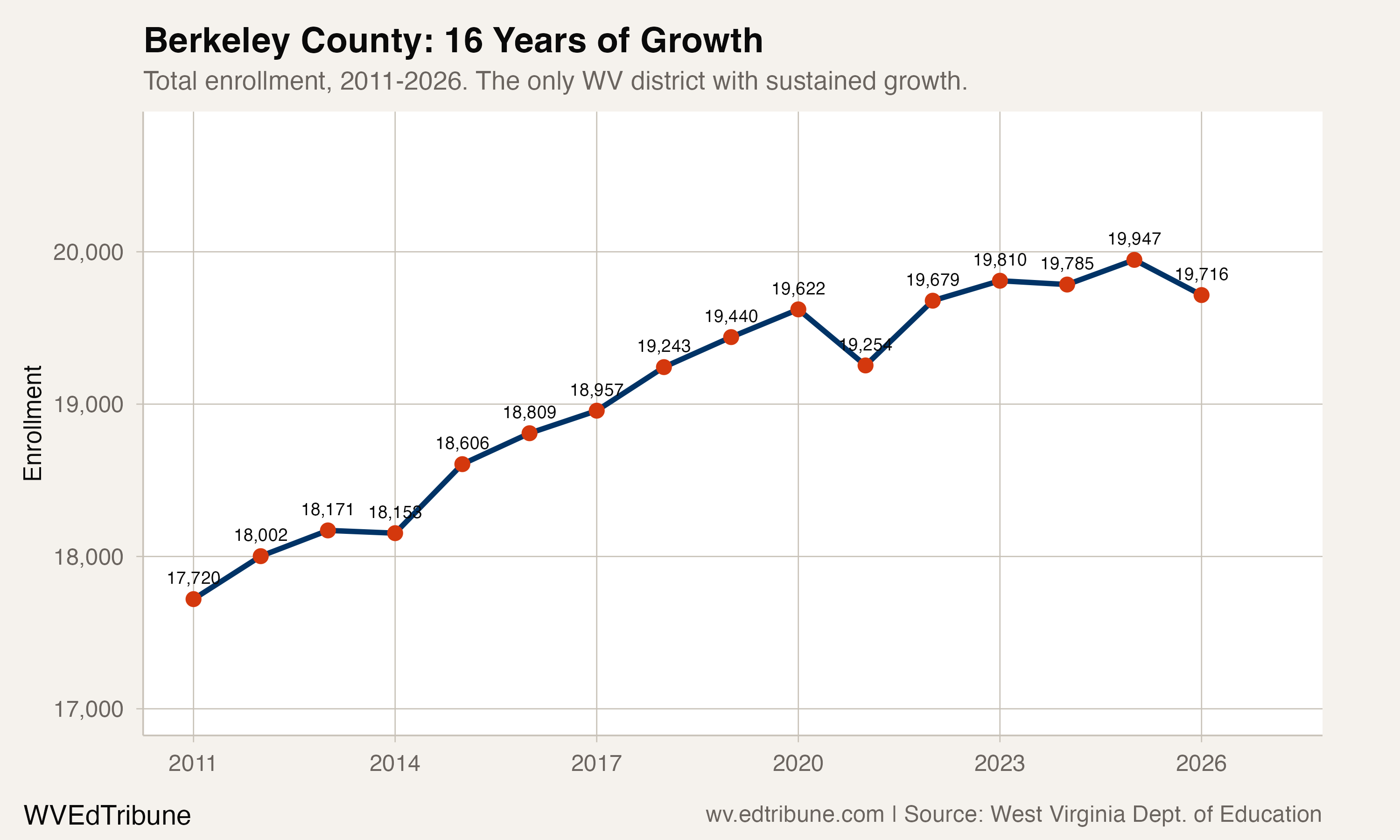
Berkeley County↗ET added 1,996.
That figure, an 11.3% increase since 2011, makes Berkeley the only district in West Virginia with sustained, meaningful enrollment growth over the past 16 years. Two others grew on paper: Monongalia County↗ET added 307 students, a 2.9% gain anchored by West Virginia University, and Doddridge County↗ET, a rural district of 1,211 students, added 42. Everyone else shrank.
Ninety minutes from the Capitol dome
The mechanism behind Berkeley's growth is geographic. Martinsburg, the county seat, sits 90 minutes from downtown Washington, D.C., connected by Interstate 81 and the MARC commuter rail. As housing costs in the D.C. metro area climbed past what many families could afford, Berkeley County offered an alternative: new-construction townhomes in the $260,000s and detached houses under $400,000, in a county where the population grew 21% between 2010 and 2020.
That population growth translated directly into school enrollment. Berkeley added students in 11 of 15 year-over-year periods since 2012, including six consecutive years of growth from 2015 through 2020. The largest single-year gain came in 2015, when the district added 453 students, a 2.5% jump.
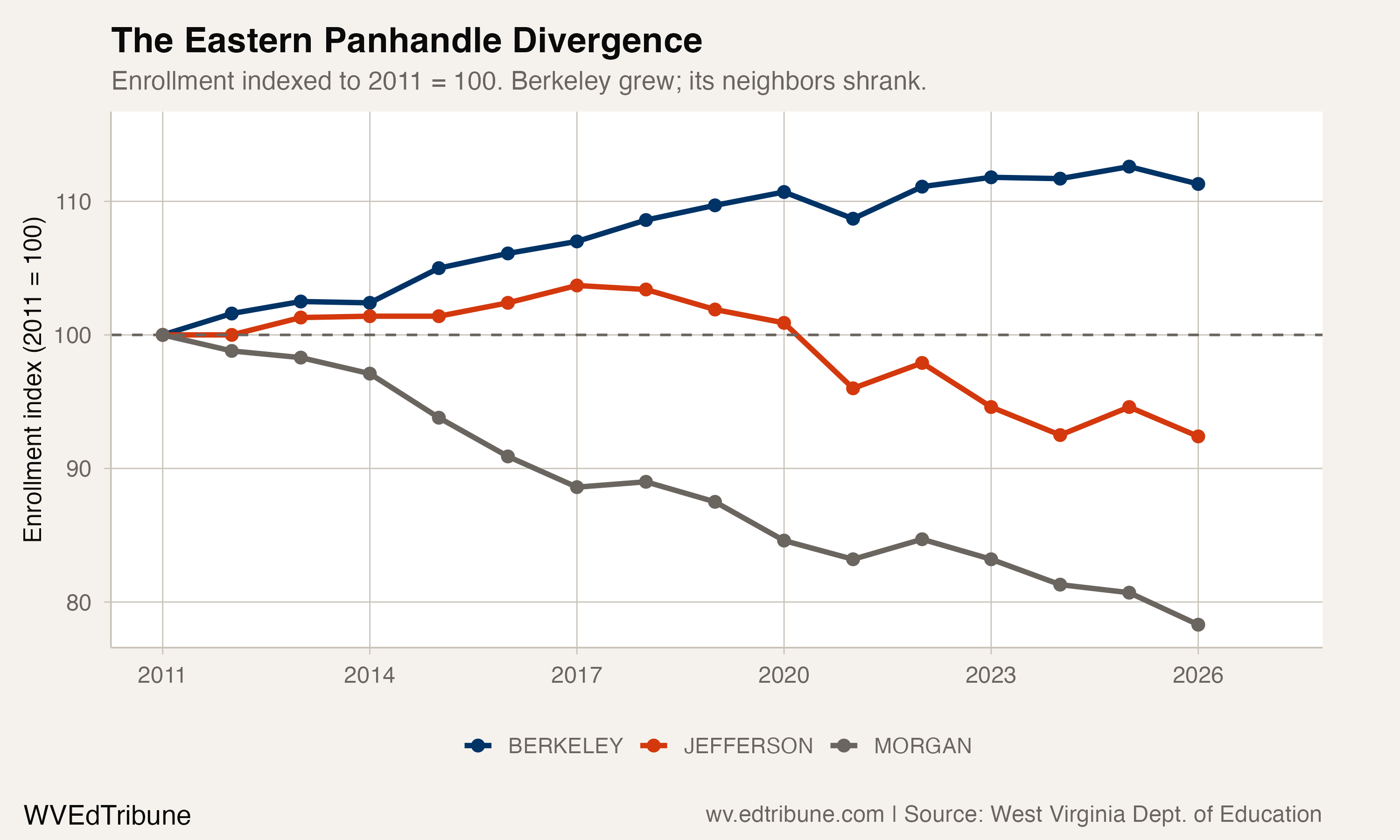
But the growth has not spread evenly across the Eastern Panhandle. Jefferson County↗ET, home to Charles Town and Shepherdstown, lost 671 students over the same period, a 7.6% decline. Morgan County↗ET, the smallest of the three Panhandle districts, lost 568 students, a 21.7% decline. Berkeley absorbed the region's growth while its neighbors followed the statewide pattern.
Closing in on Kanawha
The convergence between Berkeley and Kanawha County↗ET, the state's largest district, has been steady and accelerating. In 2011, Kanawha enrolled 10,738 more students than Berkeley. By 2026, that gap had narrowed to 2,335. Kanawha lost 6,407 students over the period, a 22.5% decline, while Berkeley gained nearly 2,000.
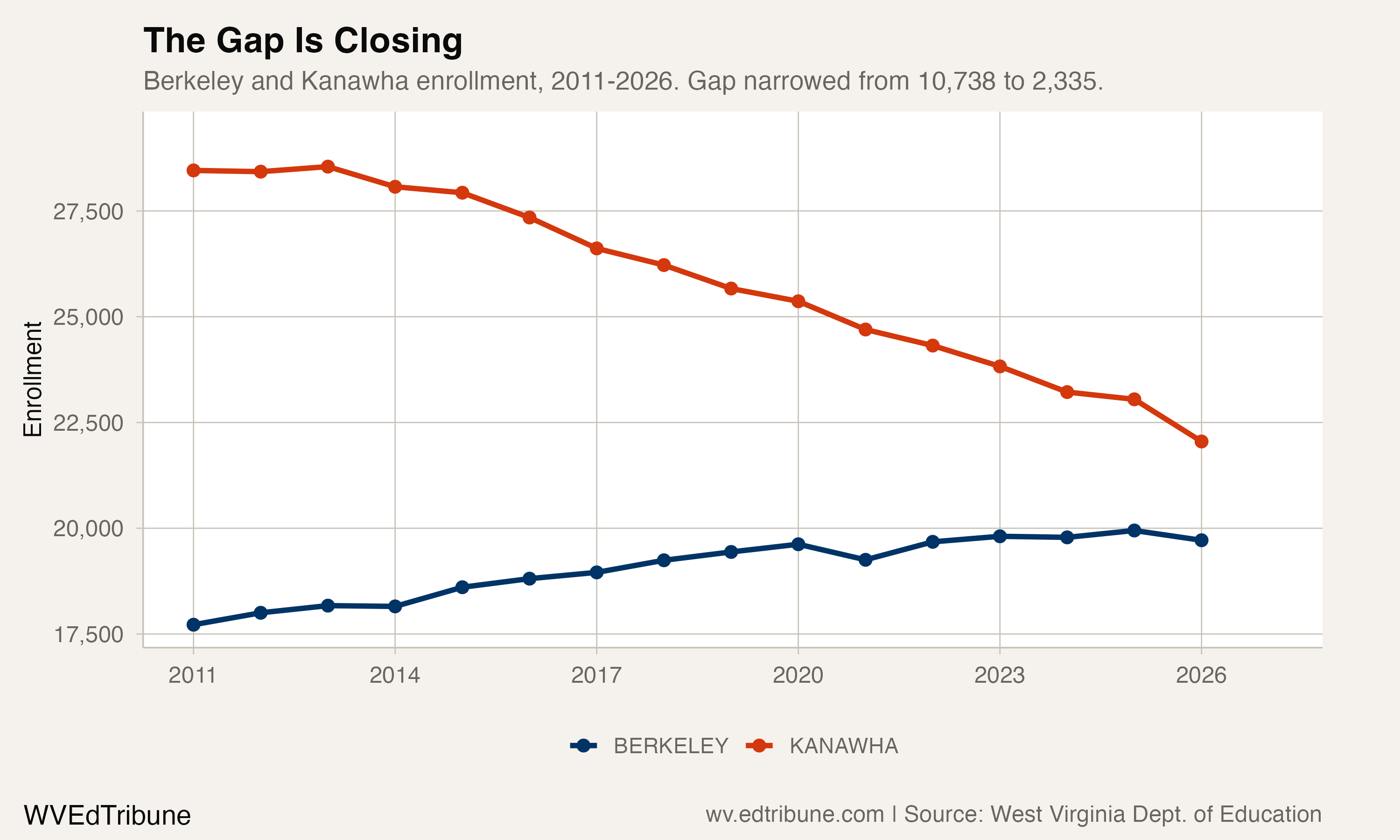
If both districts maintain their recent trajectories, Berkeley could overtake Kanawha as the state's largest district within a decade, though the 2026 dip complicates that projection. The two districts represent opposite poles of West Virginia's enrollment story: one is a legacy urban center hollowing out; the other, a commuter-driven exurb filling up.
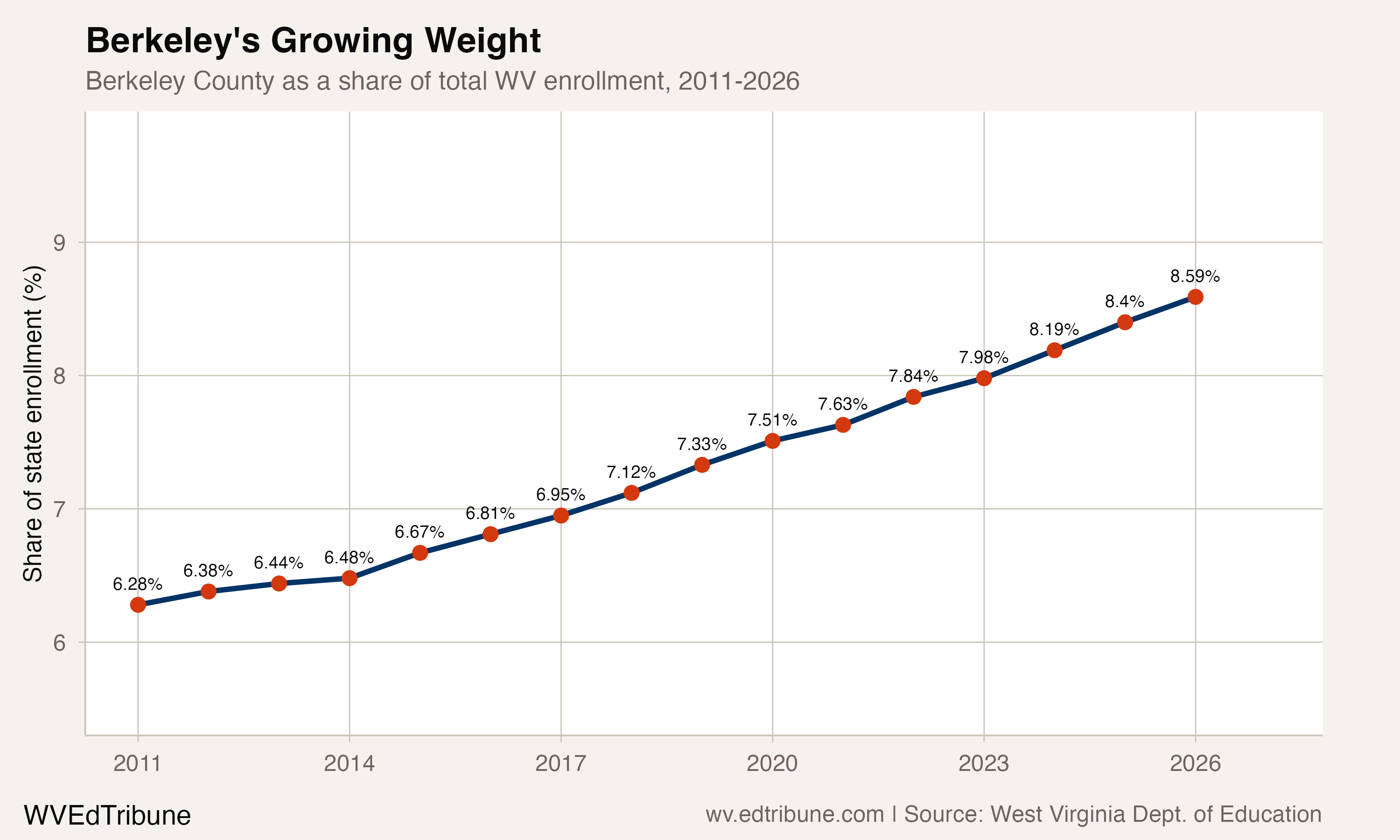
Berkeley's rising weight is visible in its share of total state enrollment, which climbed from 6.28% in 2011 to 8.59% in 2026. Nearly one in 12 West Virginia public school students now attends a Berkeley County school.
The most diverse district in a homogeneous state
Berkeley's demographic profile sets it apart from the rest of West Virginia in ways that go beyond enrollment numbers. Race data in West Virginia covers roughly 74% of Berkeley's total enrollment, so these figures represent shares of students with reported race, not the full student body. Among those students in 2026, white students accounted for 57.9%. Black students made up 13.8%, Hispanic students 13.0%, and multiracial students 14.4%.
Statewide, by contrast, white students account for 83.7% of reported enrollment. Berkeley's Black enrollment alone (2,006 students) represents more than one-fifth of the state total (9,003), and its Hispanic enrollment (1,889) accounts for more than a third of the state total (5,167).
This diversity reflects both the commuter corridor's proximity to the D.C. metro and the military presence at the Martinsburg Air National Guard base. It also means Berkeley faces instructional complexity that most West Virginia districts do not: a student body where no single group exceeds 60%, in a state where the typical district is 80% to 90% white.
"We have people sleeping in their vehicles, the motels around town are full of families. It's almost at crisis level." — Mountain State Spotlight, Nov. 2023, on housing pressure in the Eastern Panhandle
The affordable housing gap complicates the growth story. Berkeley County needs approximately 1,330 new rental units to close the affordable housing gap, according to a Mountain State Spotlight analysis. Rents rose 24% between 2018 and 2023, and incoming residents from the D.C. area are willing to pay $1,200 to $1,400 for a one-bedroom apartment, pushing lower-income families to the margins.
Then came 2026
Berkeley lost 231 students in 2026, a 1.2% decline that dropped enrollment from its all-time peak of 19,947 (set in 2025) to 19,716. It was the district's largest single-year loss outside of the pandemic year of 2021, when it lost 368.
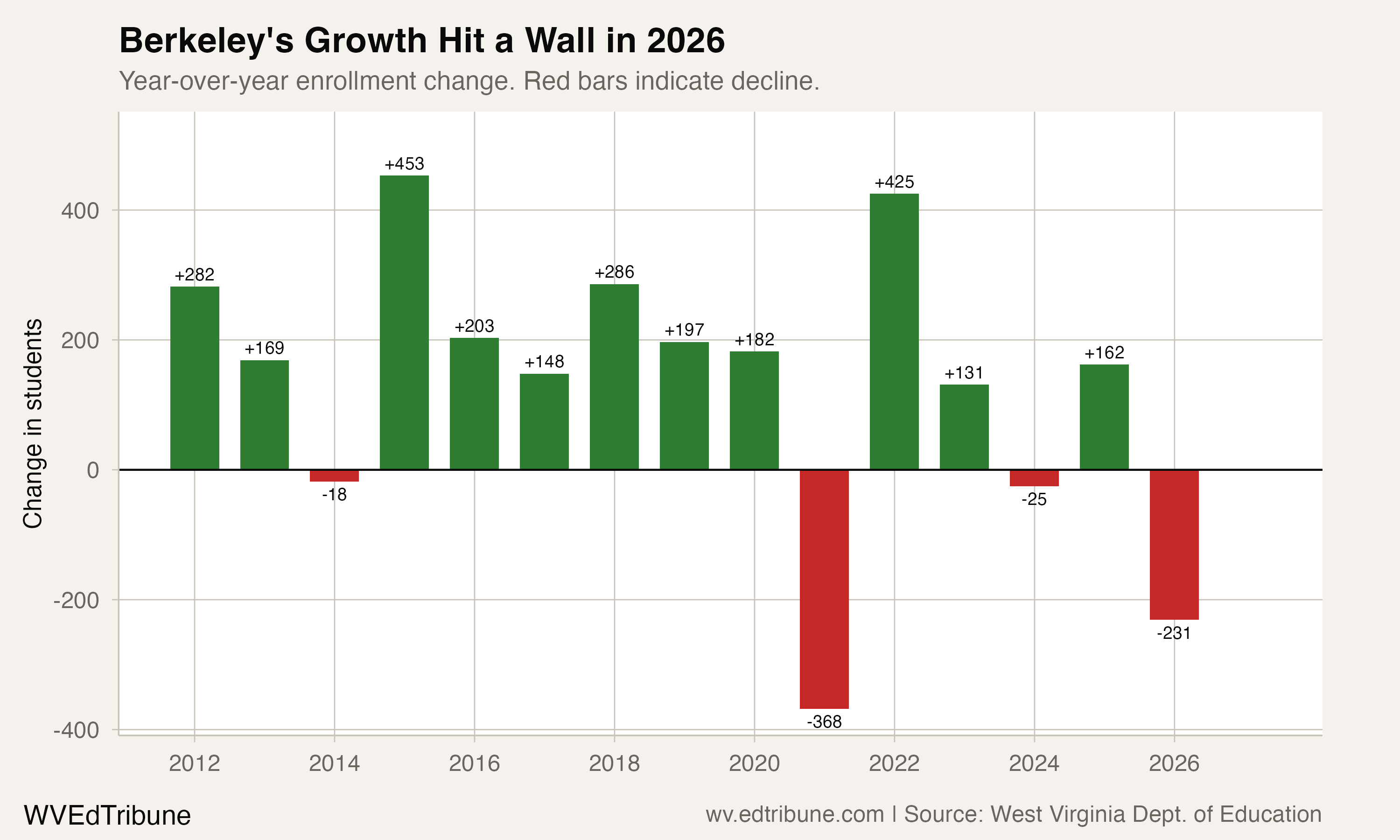
The 2026 dip has at least two plausible explanations. The first is the Hope Scholarship, West Virginia's school voucher program, which has expanded rapidly since its 2022 launch. Berkeley is one of the four counties that together account for one in three statewide Hope participants, alongside Kanawha, Monongalia, and Wood. The program is set to become universal in 2026-27, with a budget allocation exceeding $170 million, and the state anticipates as many as 42,000 students could enroll.
The second is the broader demographic headwind. Berkeley, for all its growth, exists inside a state that lost 7,693 students in 2026 alone. Only two of West Virginia's 55 districts, Berkeley and Doddridge, have enrollment above their pre-pandemic levels. The commuter-driven growth engine that powered Berkeley for a decade may not be strong enough to overcome falling birth rates, the voucher program's expansion, and the affordability crunch that is pricing some families out of the county even as it draws others in.
One district cannot carry a state
Superintendent Ryan Saxe has responded to the growth by completing more than 100 facility projects and putting four new schools under construction, a level of capital investment almost unheard of in a state where most districts are consolidating buildings. Berkeley is also reviewing its 10-year facility plan to align with projected enrollment.
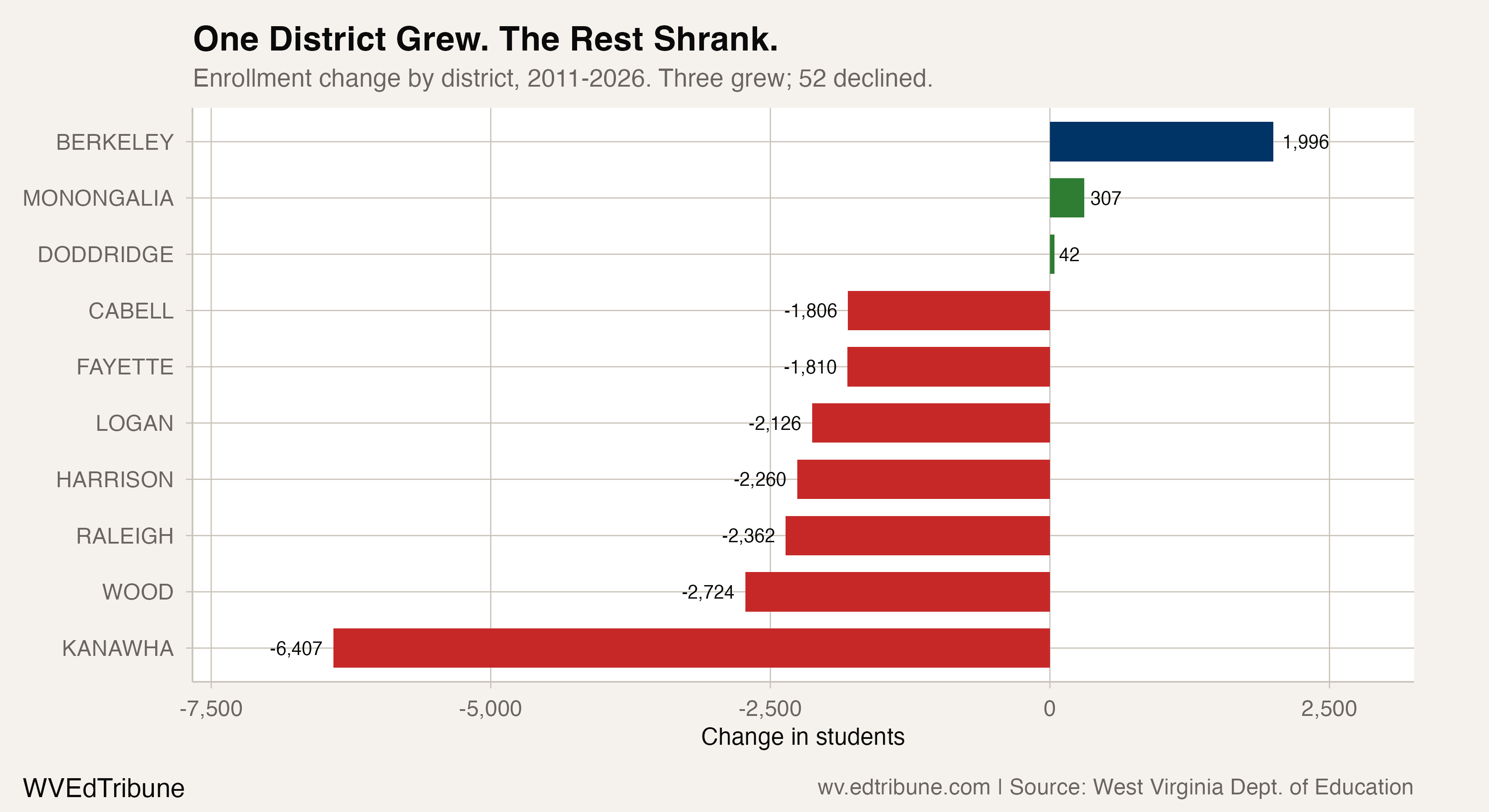
But one district's building boom does not change the statewide math. Berkeley added 1,996 students over 16 years. The rest of the state lost 54,480. The 2026 dip may be the kind of minor fluctuation that punctuated Berkeley's growth in 2014 and 2024, or it may be the first signal that the commuter pipeline is slowing while the voucher program accelerates. Four new schools are under construction. Whether they fill with students or join the long list of West Virginia buildings with empty wings depends on forces well beyond one county's control.
Detailed code that reproduces the analysis and figures in this article is available exclusively to EdTribune subscribers.
Discussion
Sign in to join the discussion.
Loading comments...