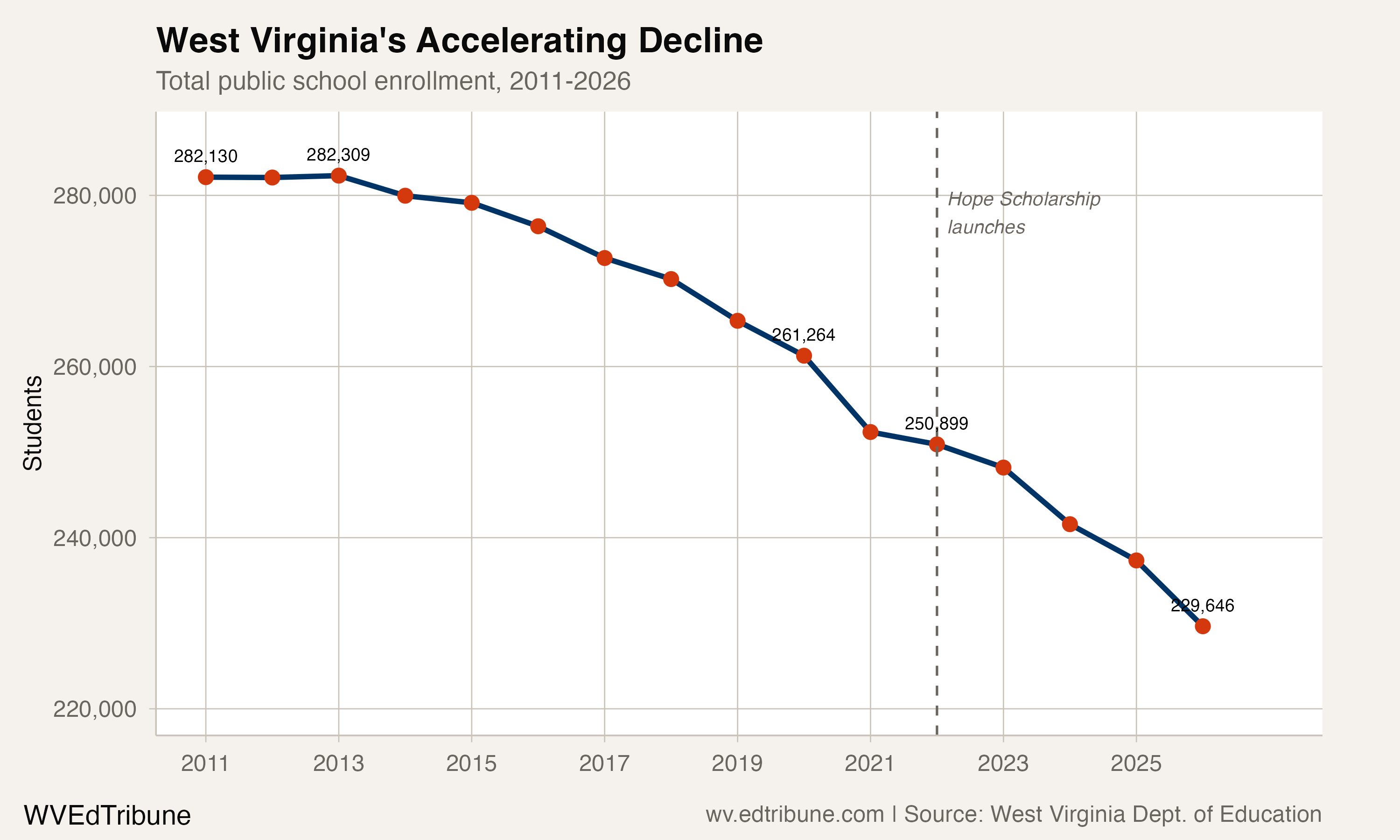
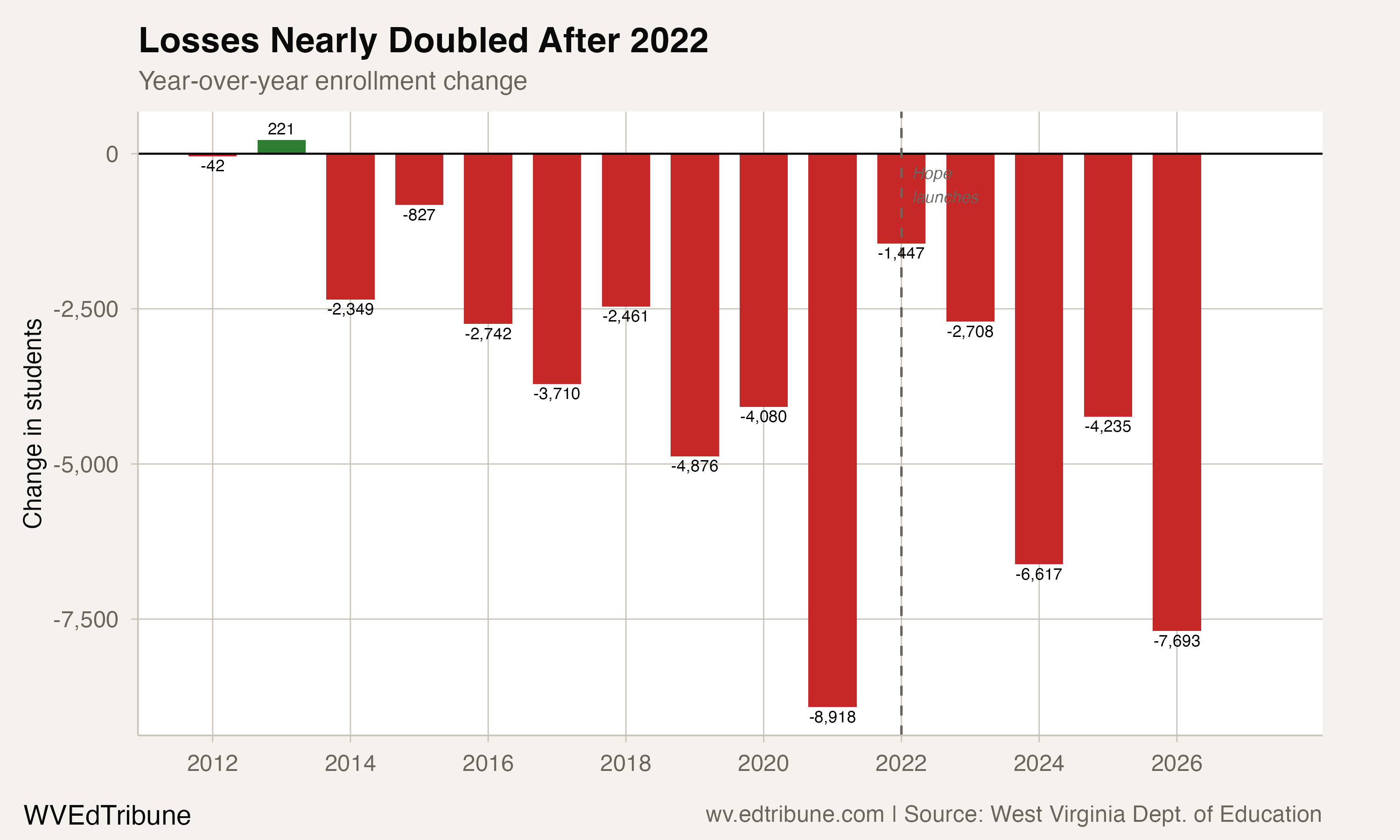
West Virginia's public schools lost 7,693 students in 2025-26, a 3.2% drop that ranks as the second-largest single-year loss in the state's recorded history. Only the pandemic year of 2020-21, when 8,918 students vanished from rolls, was worse. But the pandemic was a one-time shock. This is the fourth consecutive year of escalating losses since the Hope Scholarship voucher program launched in 2022, and the state now averages 5,313 fewer students per year, nearly double the pace of the decade before.
The numbers are stark: 229,646 students remain in West Virginia's 55 county school systems, down 21,253 from 250,899 when the Hope Scholarship began. Forty-nine of those 55 counties are at their lowest enrollment on record. Only three counties, Berkeley, Hardy, and Doddridge, have gained students since 2022. At least nine county school systems are under some form of state control or emergency oversight, a number that grew when the state seized control of Hancock County in January 2026.
A program that doubles every year
The Hope Scholarship is a universal Education Savings Account that allows families to redirect the state's per-pupil funding, currently $5,267 per student, toward private school tuition, homeschool expenses, or other approved educational costs. Since its 2022 launch, participation has grown from 2,333 students in 2022-23 to nearly 15,000 in 2025-26, with the state treasurer's office projecting roughly 19,000 for the current year. The program becomes universally eligible to all K-12 students in 2026-27, when the treasurer's office projects roughly 43,000 newly eligible students.
The cost trajectory has been just as steep. Annual program spending grew from $9.2 million in 2023 to $48.9 million in 2025, and the treasurer's office has projected a maximum of $244.6 million for 2026-27, a figure revised down from an initial $315 million estimate after the pool of newly eligible students shrank from 54,000 to roughly 43,000.
State Treasurer Larry Pack has framed the growth as a success:
"It is tremendous that we continue to see exponential growth year after year with more parents taking full advantage of the Hope Scholarship program." — West Virginia State Treasury, July 2025
The acceleration is measurable
West Virginia was already losing students before the Hope Scholarship. The state peaked at 282,309 students in 2012-13 and has declined every year since, driven by falling birth rates and persistent outmigration. But the pace has shifted decisively.
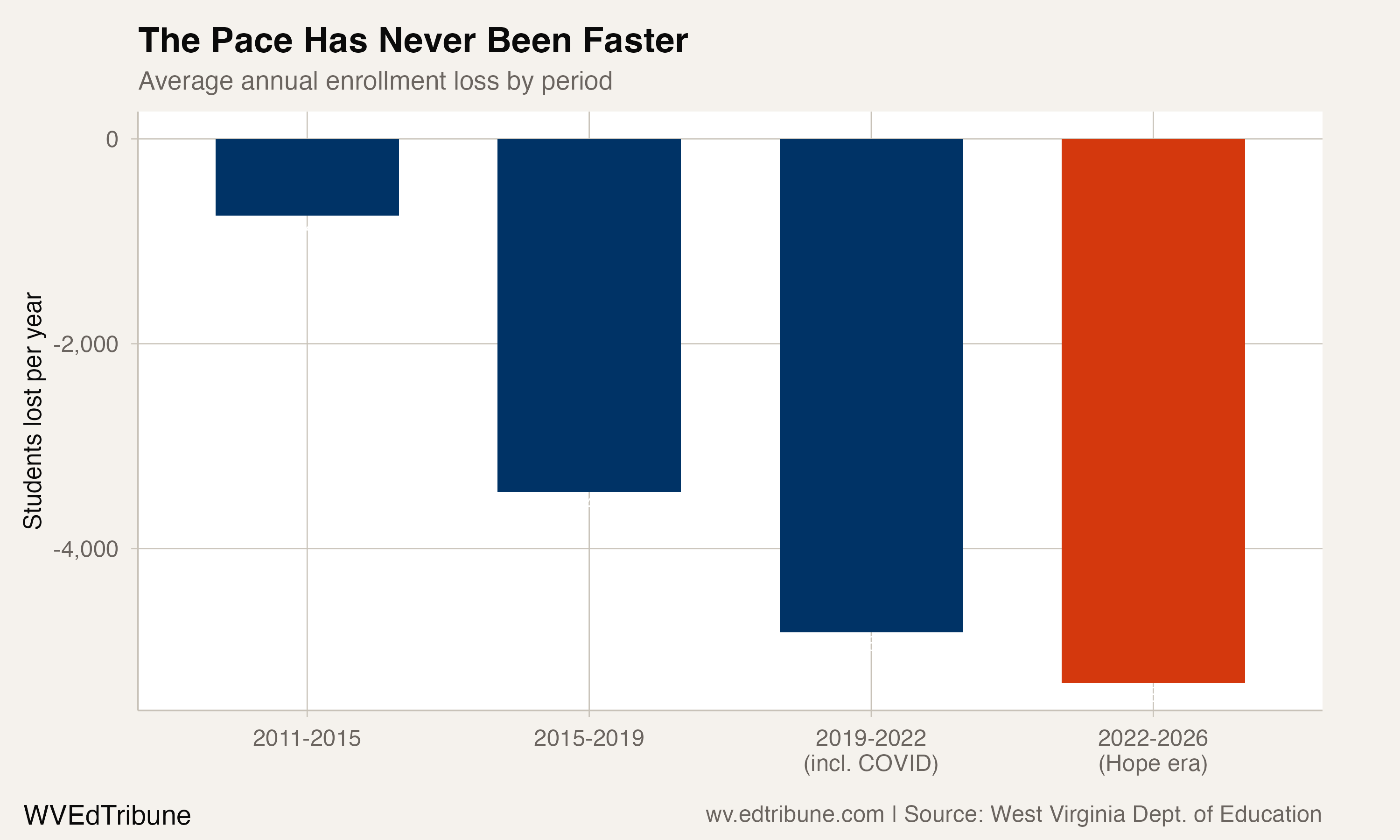
From 2011 to 2022, the state averaged 2,839 fewer students per year. Since 2022, the average is 5,313, an 87% acceleration. The 2025-26 loss of 7,693 students exceeds every pre-pandemic year on record.
The West Virginia Center on Budget and Policy estimated that 51.9% of the statewide enrollment decline between 2022-23 and 2023-24 was directly attributable to the Hope Scholarship. That figure varied widely by county. In Cabell County, the WVCBP attributed 97.1% of enrollment loss to the program. In eight counties, Hope Scholarship departures exceeded the total enrollment decline, meaning those counties would have gained students without the program.
The remaining half of the decline reflects longer-running forces. West Virginia's birth rate has fallen steadily for a decade. The state's working-age population has shrunk as coal, chemical, and manufacturing jobs have disappeared. These trends predated the Hope Scholarship by years. But the voucher program has added a second engine to a decline that was already the steepest in the country.
Where the losses concentrate
Kanawha↗ET County, the state's largest district and home to Charleston, has lost 2,267 students since 2022, a 9.3% decline that dwarfs every other county in absolute terms. Wood↗ET County lost 1,148 (9.7%), Harrison↗ET County lost 1,096 (11.0%), and Logan↗ET County lost 808 (15.7%).
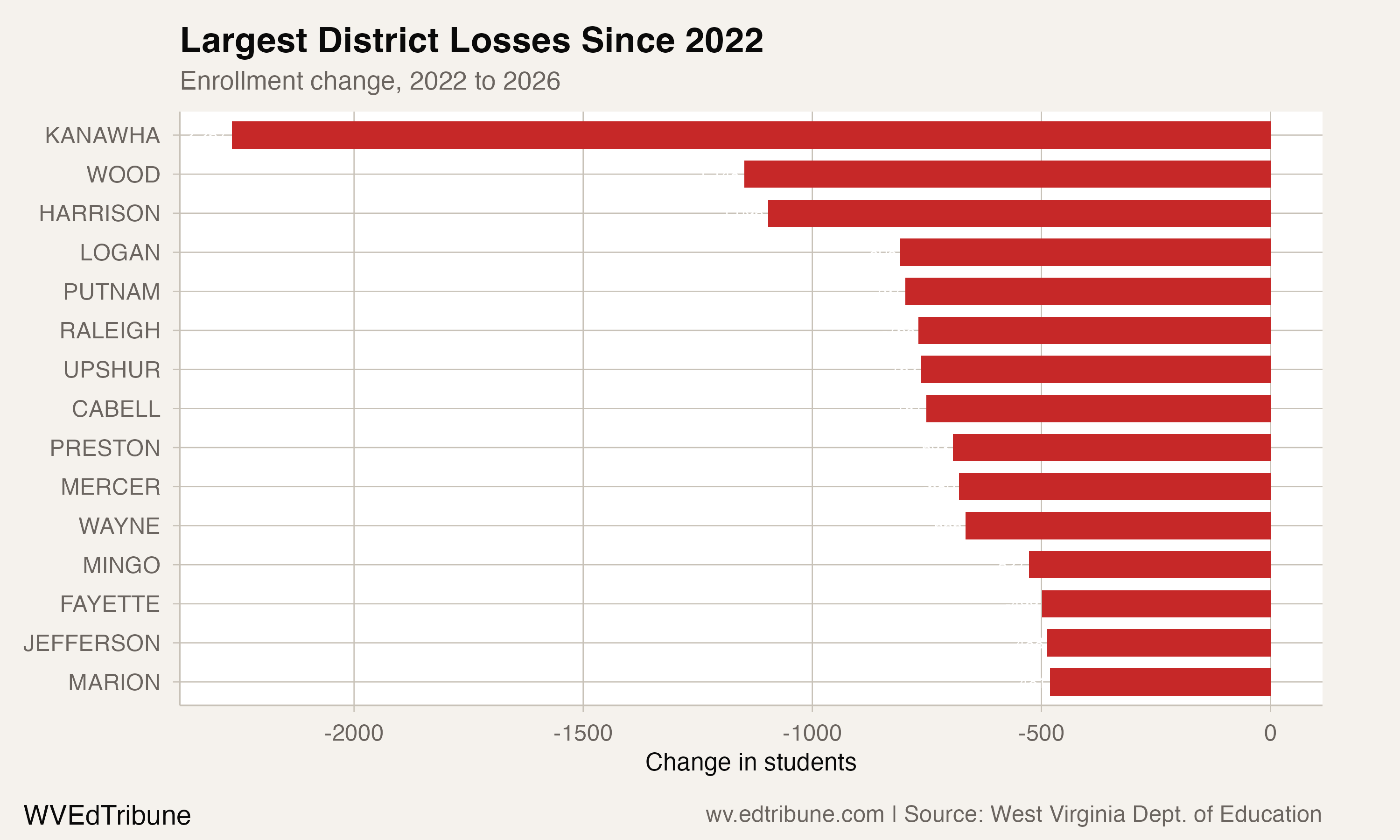
The percentage losses are most severe in the state's smallest and most rural counties. Summers↗ET County lost 21.5% of its students in four years. Upshur↗ET County lost 19.3%. Clay, McDowell, and Webster counties each lost more than 18%.
The four counties that the WVCBP identified as the largest sources of Hope Scholarship recipients, Berkeley↗ET, Kanawha, Monongalia↗ET, and Wood, tell divergent stories. Berkeley, the only county in the Eastern Panhandle growth corridor, held essentially flat (+37 students, 0.2%). Monongalia, anchored by West Virginia University, declined modestly (-222, 2.0%). But Kanawha and Wood fell sharply, losing a combined 3,415 students.
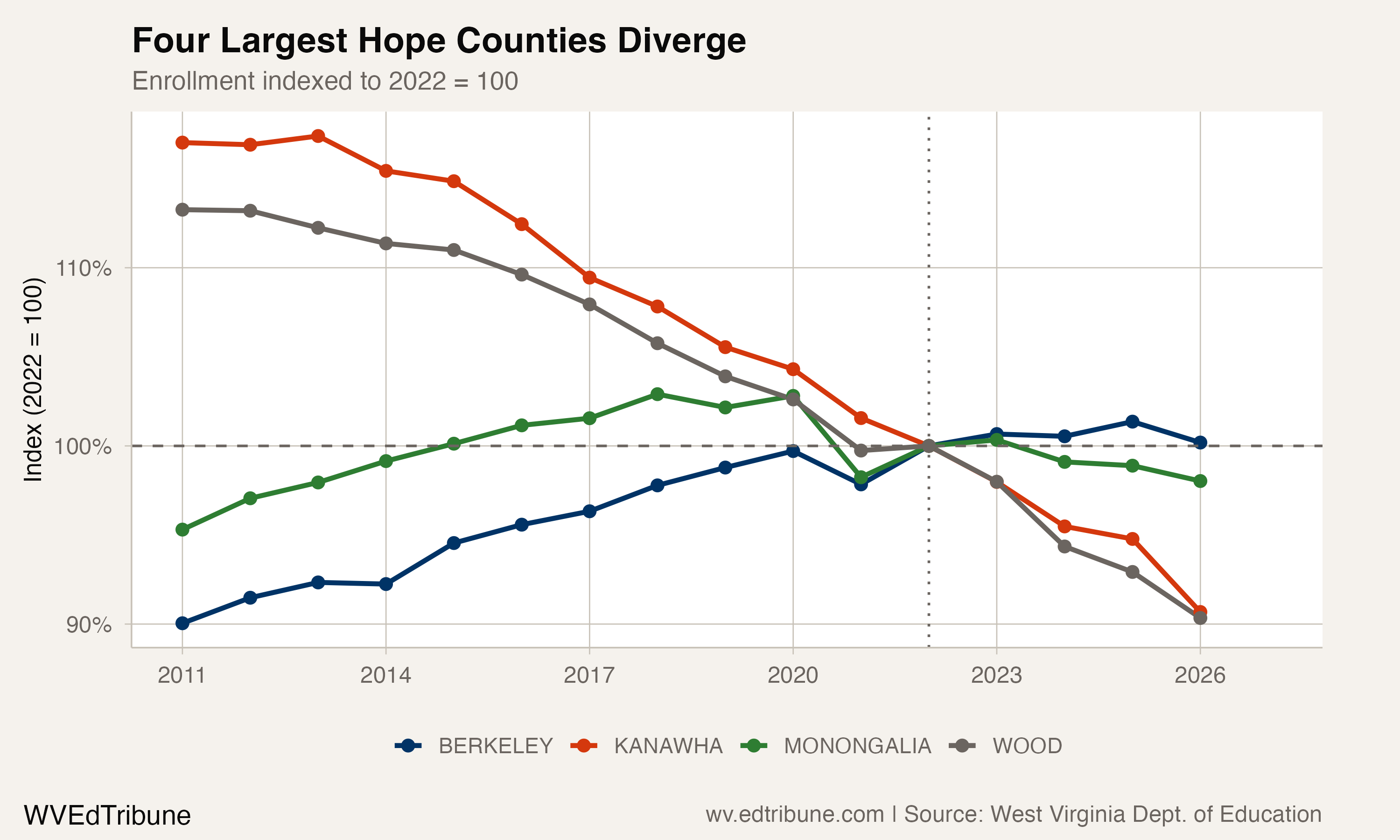
Berkeley's resilience is instructive. It is one of only two West Virginia counties (along with Jefferson) that consistently attracts families from out of state, fed by spillover from the Washington, D.C., metro area. That inflow has offset Hope Scholarship departures. Counties without a comparable migration pipeline have no buffer.
The fiscal spiral
Each student who leaves takes state funding with them, but the fixed costs of operating a school do not shrink proportionally. A building still needs heat. A bus still runs its route. When enrollment drops below the state's staffing formula thresholds, the math becomes punishing.
The WVCBP documented the operational consequences in granular detail. Kanawha County eliminated 82 positions, 58% of which the county attributed to Hope Scholarship losses. Harrison County closed three schools. Wood County ended the 2023-24 year overstaffed by 168 employees, with 57% of its 560-student loss traced to the voucher program.
The crisis has been severe enough to trigger state intervention across the system. By September 2025, eight county school systems were under state oversight, collectively serving nearly 25,000 students. The most recent takeover was Hancock County in January 2026, where the state Board of Education fired the superintendent after finding the district employed 140 people beyond its funding formula, costing $10 million annually. Roane County was placed under emergency in July 2025 facing $2.5 million in deficits.
Meanwhile, state education funding has not kept pace. The WVCBP found that state aid allowances are 17% below 2009 levels after adjusting for inflation, even as student enrollment fell only 14.7% over the same period. West Virginia's per-pupil spending of $14,575 ranks 32nd nationally, nearly $2,000 below the national average of $16,526.
More than 70 public schools have closed across the state since 2019, according to the WVCBP's closure tracker, and additional consolidations are expected.
Accountability questions
The Hope Scholarship operates with limited public reporting requirements. The WVCBP found that approximately $6 million in 2023-24 payments went to unaccredited schools, institutions that, according to the West Virginia Department of Education, are not required to employ credentialed educators or meet established graduation requirements. Nearly half of all recipients in the program's first two years were kindergarteners and first graders with little or no public school history, raising questions about whether the program is primarily drawing students away from public schools or subsidizing families who would not have enrolled in the public system regardless.
That distinction matters for interpreting the enrollment data. If a substantial share of Hope Scholarship recipients were never public school students, then the program's direct role in the enrollment decline is smaller than the raw participation numbers suggest. But the WVCBP's 51.9% attribution estimate attempts to control for this by comparing expected enrollment (based on prior trends) with actual enrollment in Hope Scholarship-participating counties.
A RAND Corporation study commissioned by the legislature recommended increased funding for students in poverty and special education, but lawmakers advanced no bills addressing those recommendations during the 2026 session. Dale Lee, co-president of Education West Virginia, told Mountain State Spotlight: "They can find the money for it."
The kindergarten signal
The enrollment decline is not uniform across grade levels. Kindergarten enrollment has fallen 27.2% since 2011, from 21,245 to 15,469. Twelfth grade has declined only 8.8%, from 18,342 to 16,726. For the first time in the dataset, the kindergarten-to-twelfth-grade ratio has fallen below parity: the state now enrolls 92.5 kindergarteners for every 100 twelfth graders.
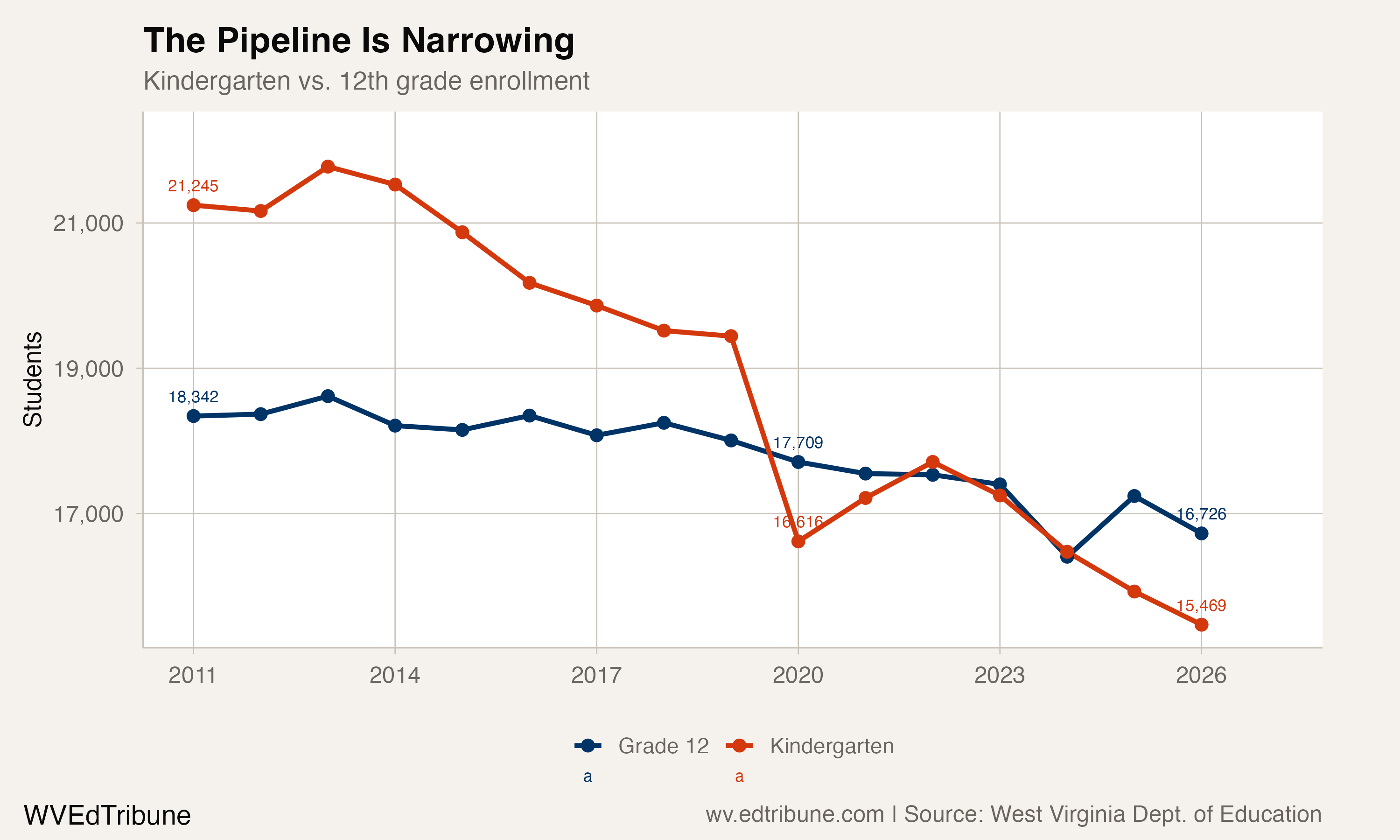
This inversion signals that the current losses will compound. The smaller 2025-26 kindergarten classes become smaller middle schools and, eventually, smaller high schools. The pipeline math is unforgiving: even if West Virginia's birth rate stabilized in 2026, the state would continue shrinking for at least a decade as those depleted elementary cohorts age through the system.
The Hope Scholarship's earliest participants were disproportionately young. Nearly half of recipients in the program's first two years were in kindergarten or first grade. If those families stay out of the public system permanently, the pipeline narrowing accelerates further.
What comes next
The Hope Scholarship becomes universally eligible in 2026-27. The treasurer's office projects roughly 43,000 newly eligible students. If even half that number participates, it would represent roughly 9% of current public school enrollment exiting in a single year.
Whether the state's public school enrollment decline is driven primarily by the voucher program or primarily by demographic forces is, at this point, a question with a documented answer: both. The WVCBP's analysis attributed roughly half to Hope Scholarship departures and half to pre-existing trends. The relevant question now is whether the fiscal architecture of West Virginia's school system can survive the combination.
Fifty-two of 55 counties lost students since 2022. Forty-nine are at all-time lows. At least nine are under state control. The legislature has not acted on the RAND Corporation's funding recommendations. And the program that is accelerating the decline is about to open its doors wider.
Detailed code that reproduces the analysis and figures in this article is available exclusively to EdTribune subscribers.
Discussion
Sign in to join the discussion.
Loading comments...