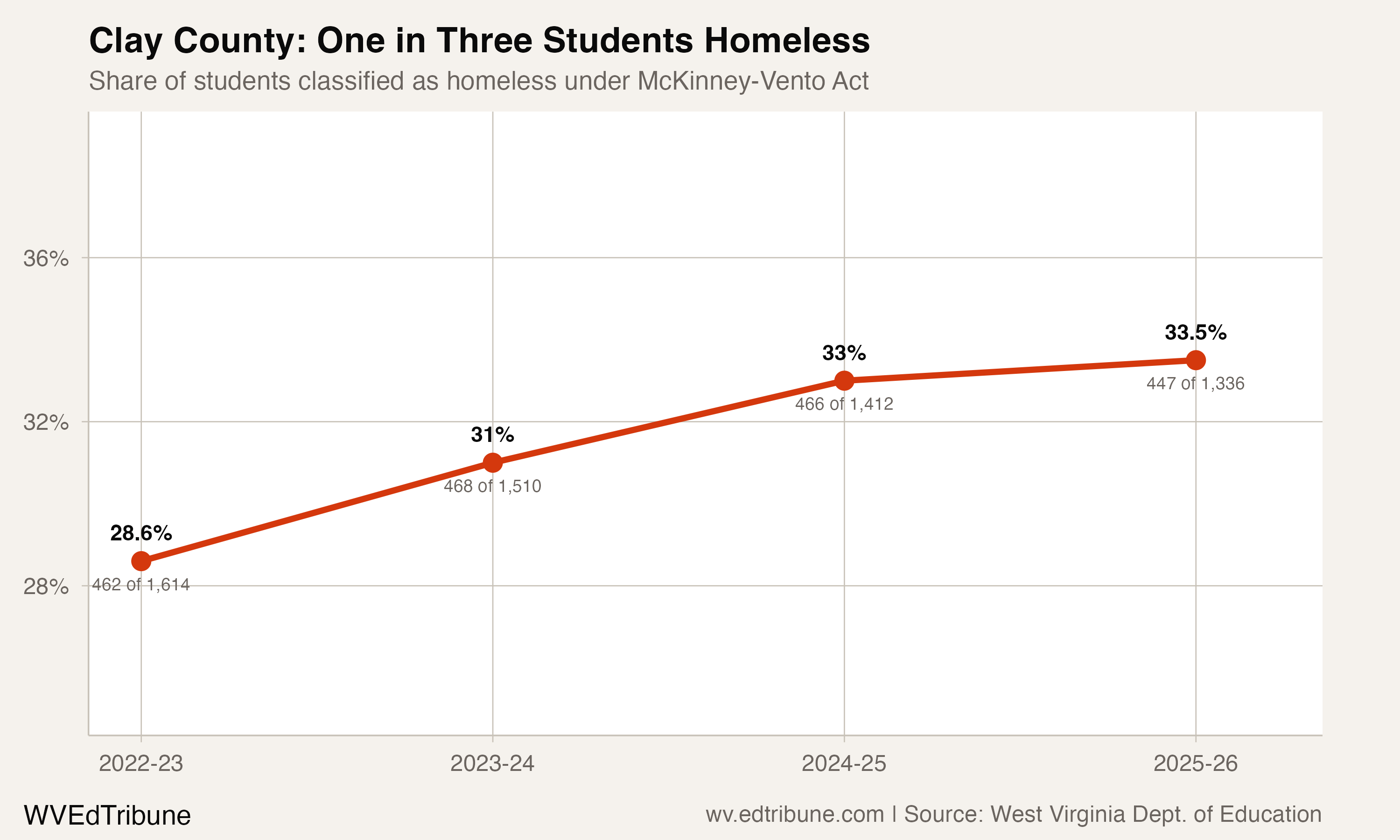
In Clay County↗ET, 447 of the school system's 1,336 students are classified as experiencing homelessness under federal law. That is 33.5% of enrollment, a rate more than eight times the statewide average, in a county with a population under 8,000 and a median household income below $43,000.
The number is not a data error. It has held above 28% for four consecutive years. And Clay County is not alone. Across West Virginia, 9,233 students, 4.0% of the state's shrinking enrollment, are classified as homeless under the McKinney-Vento Act, a rate that exceeds the national average and has climbed 15.7% since 2022-23.
What "Homeless" Means Here
The federal McKinney-Vento definition of homelessness is broader than the word implies. It covers students who lack a "fixed, regular, and adequate nighttime residence," including those doubled up with relatives, staying in motels, or living in substandard housing. In West Virginia, 86.1% of students classified as homeless are doubled up with other families. Only 5.4% are staying in shelters.
This distinction matters for interpreting Clay County's 33.5% rate. These are not 447 children sleeping under bridges. They are children whose families cannot secure stable housing of their own, who move from one relative's couch to another, who change addresses multiple times in a school year. The instability is real even if the word "homeless" overstates what most people picture.
A County Losing Both Students and Stability
Clay County enrolled 2,071 students in 2010-11. By 2025-26, that number fell to 1,336, a decline of 35.5%. The county has lost more than a third of its student body in 15 years, shrinking faster than most of the state's other 54 county school systems.
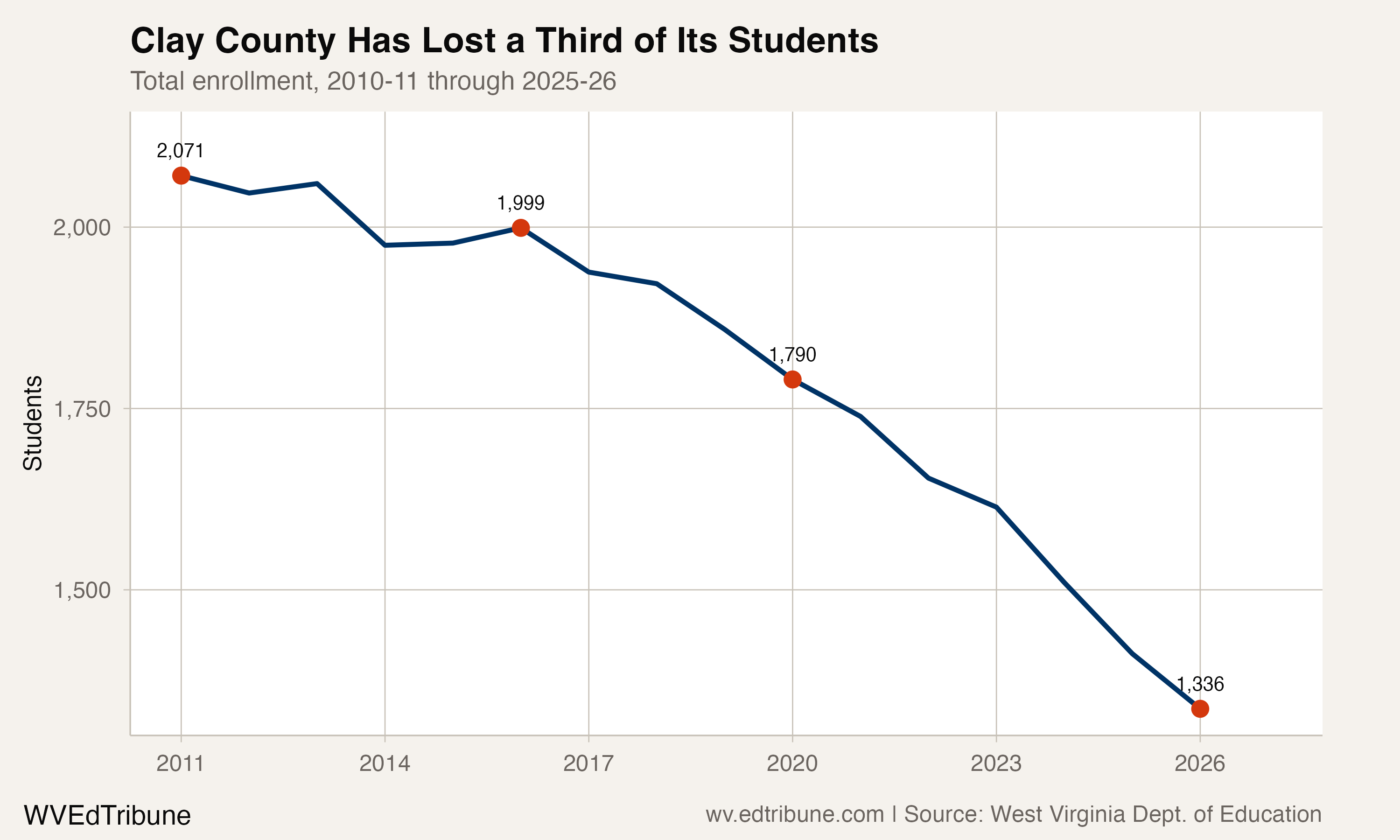
The enrollment decline compounds the homeless rate in two ways. First, families leaving the county tend to be those with the means to relocate, concentrating disadvantage among those who remain. Second, a shrinking student body means fixed costs are spread over fewer students. The West Virginia Board of Education approved the closure of Clay Middle School in late 2024, the county's only middle school, effective at the end of the 2026-27 school year. The consolidation is expected to save $500,000 annually in operational costs.
The overlap between homelessness and other indicators of need in Clay County is striking: 70.2% of students are economically disadvantaged, 25.7% receive special education services, and 2.4% are in foster care. Separately, these are high rates. Together, they describe a school system where the majority of students are navigating at least one form of instability.
Not Just a Clay County Problem
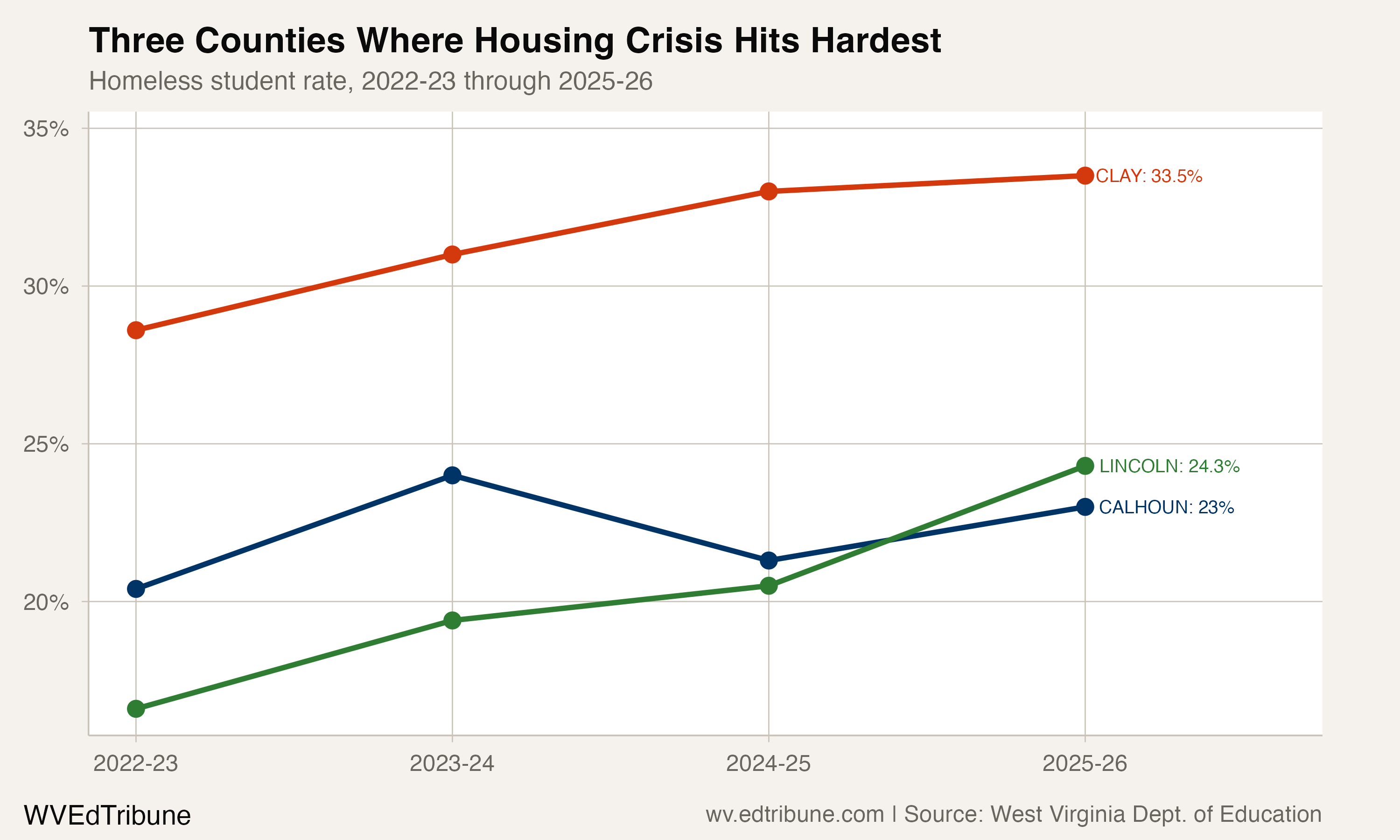
Three counties now have student who is currently homeless rates above 20%. Lincoln County↗ET has seen the steepest acceleration, rising from 16.6% in 2022-23 to 24.3% in 2025-26, a jump of 7.7 percentage points in three years. In absolute terms, Lincoln's 636 students who are currently homeless outnumber Clay's 447. Calhoun County↗ET, with just 756 students total, classifies 174 of them, 23.0%, as homeless.
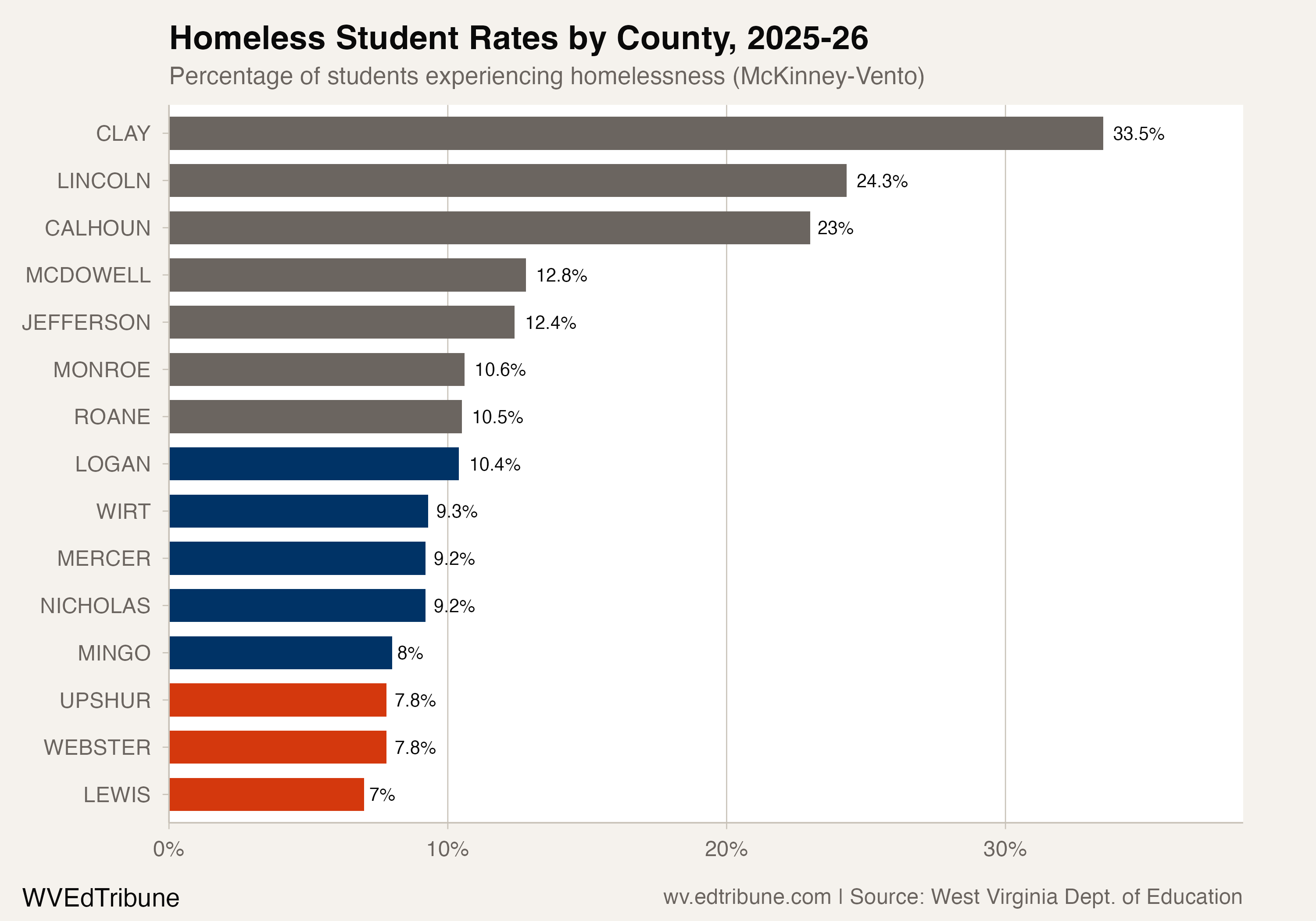
Eight counties exceed a 10% homeless rate. Twenty counties, more than a third of the state's 55 county systems, exceed 5%. At the other end, Putnam County reports a 0.3% rate, and Mason and Wetzel counties report zero students who are currently homeless.
That variation, from 0% to 33.5% within a single state, raises a question: is the gap driven by genuine differences in housing stability, or by differences in how aggressively each county identifies students eligible for McKinney-Vento services?
The Identification Question
The most likely explanation for the extreme county-level variation is a combination of real housing instability and uneven identification practices. West Virginia law assigns the McKinney-Vento liaison role to county attendance directors, effectively doubling their workload. In a small county where the attendance director knows every family, identification rates may be higher simply because the liaison has direct knowledge of students' living situations. In larger districts, students in doubled-up arrangements may never be flagged.
"One child experiencing homelessness is too many." — Margaret Williamson, Assistant Superintendent, West Virginia Department of Education
Jefferson County↗ET offers a counterpoint to the "small counties identify more" theory. With 8,174 students, it is one of the state's larger systems, yet it reports 1,013 students who are currently homeless, a 12.4% rate and the highest absolute count in the state. Jefferson County's proximity to the Washington, D.C., metro area has driven housing costs well above the state average, pricing families out of stable rentals.
The correlation between county poverty rates and student who is currently homeless rates is moderate (r = 0.50), which means poverty explains roughly a quarter of the variation. McDowell County↗ET, long considered the state's poorest with a 72.5% economically disadvantaged rate, reports a 12.8% homeless rate. That is high, but far below Clay County's 33.5%, even though Clay's economically disadvantaged rate (70.2%) is nearly identical.
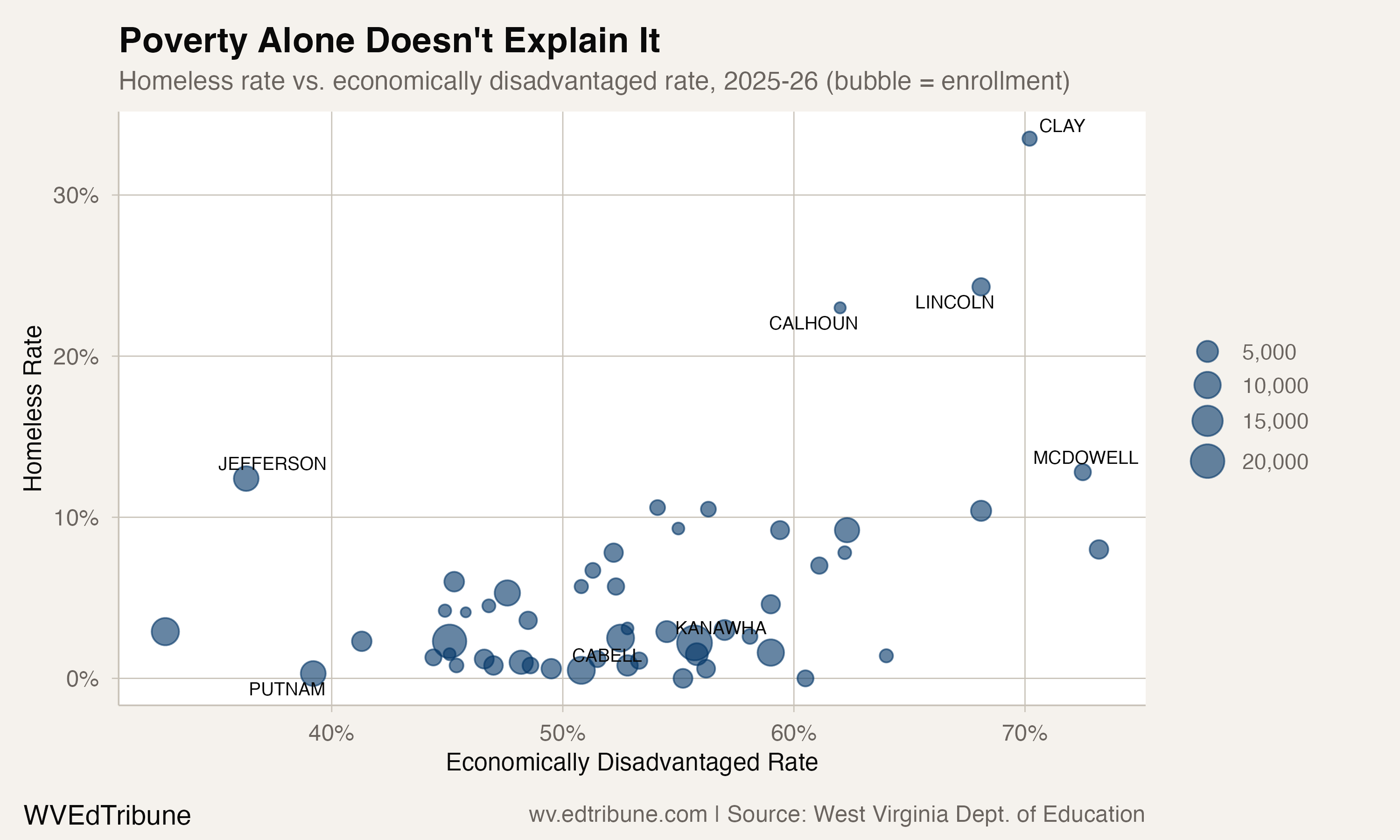
Something beyond income is driving Clay, Lincoln, and Calhoun into a different tier. The most plausible contributing factor is the collapse of affordable housing stock in rural central West Virginia, where aging properties deteriorate faster than they can be replaced. Nearly 150,000 West Virginia households are now considered "housing overburdened," spending more than a third of their income on housing, a figure that has grown substantially since 2015.
The Statewide Picture
West Virginia's 9,233 students who are currently homeless in 2025-26 represent a 15.7% increase from the 7,979 counted in 2022-23. The statewide rate has risen from 3.2% to 4.0% over that span. Because total enrollment dropped by 18,545 students over the same period, the rising rate reflects both more identified students who are currently homeless and fewer students overall.
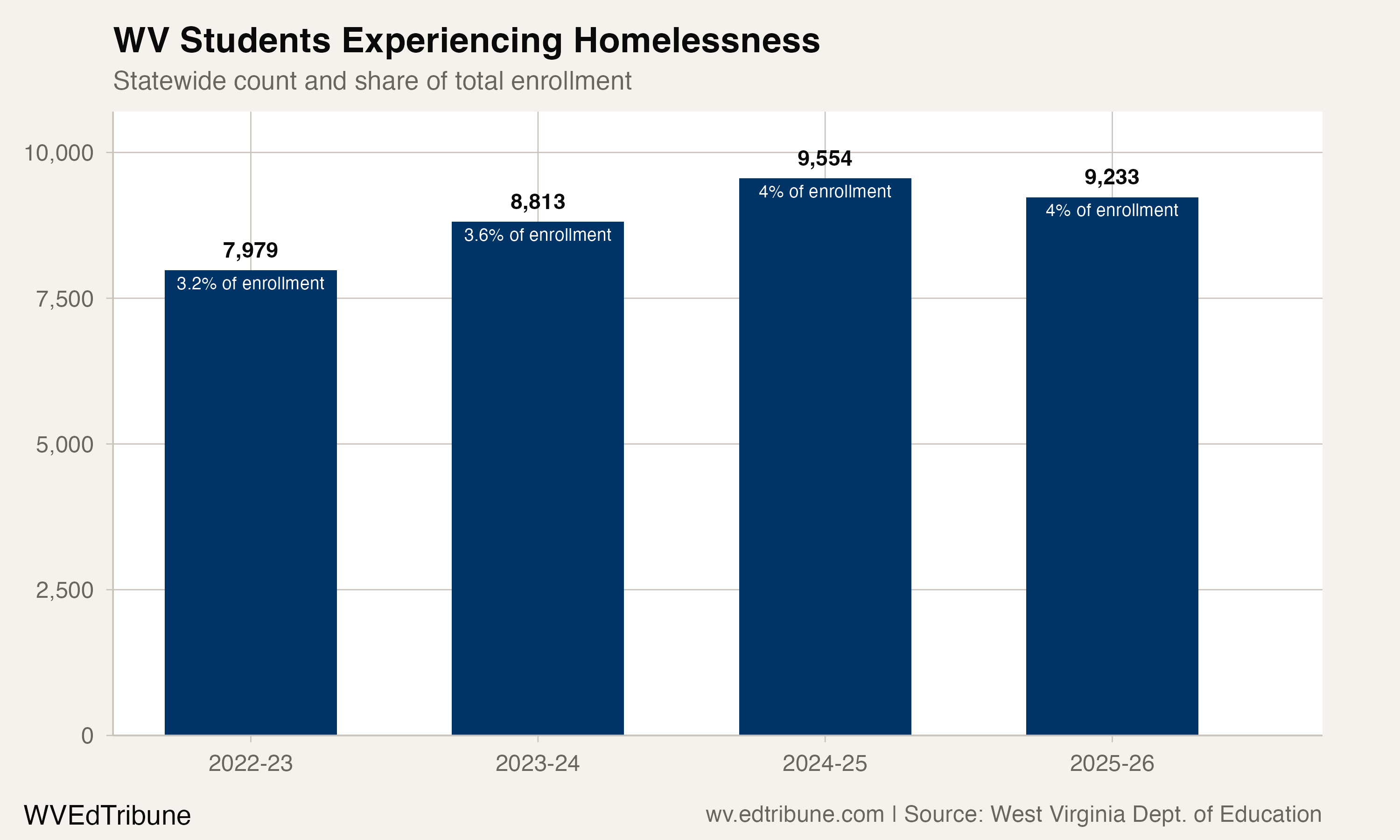
The 2025-26 count of 9,233 actually dipped from the 2024-25 peak of 9,554. Whether that reflects a genuine improvement in housing stability or a decline in identification is impossible to determine from enrollment data alone. The state's McKinney-Vento funding fell to $689,517 in 2025-26, down from $817,803 the prior year, which could reduce identification capacity even as the underlying need persists.
A Housing Crisis the Schools Cannot Fix
West Virginia's broader housing shortage is well documented. The National Low Income Housing Coalition estimates the state needs nearly 25,000 more affordable rental homes to meet demand from extremely low-income households. Sixty-five percent of the state's extremely low-income renters spend more than half their income on housing.
"It feels like there's just a lot of people doing this kind of work, and we're just kind of spinning our wheels." — Delegate Kayla Young (D-Kanawha), on legislative housing efforts, Mountain State Spotlight
State Senator Vince Deeds has introduced Senate Bill 432, which would allow youth experiencing homelessness to obtain identification documents at no cost, removing one barrier to employment and housing access. But the legislature has not advanced broader affordable housing measures. The only housing-related bills to move forward have focused on banning public camping and criminalizing squatting, not on supply or affordability.
For Clay County's 447 students who are currently homeless, school may be the most stable institution in their lives. It stays open at the same address, with the same adults, on a predictable schedule. But the county is closing its only middle school at the end of the 2026-27 school year. A third of its students lack stable housing. And the enrollment losses that force these consolidations are not slowing down. Stability, for these children, keeps getting harder to find.
Detailed code that reproduces the analysis and figures in this article is available exclusively to EdTribune subscribers.
Discussion
Sign in to join the discussion.
Loading comments...