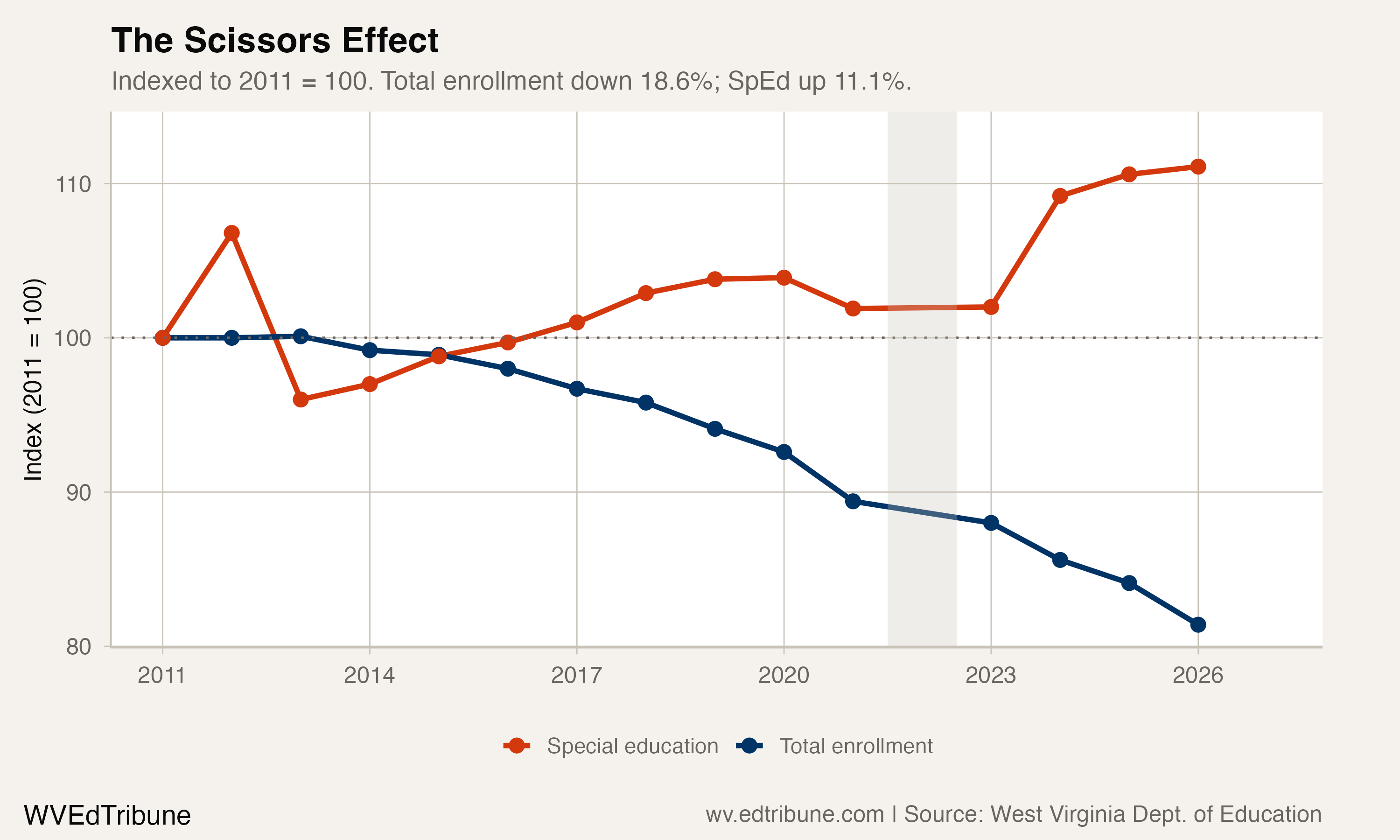
West Virginia has lost 52,484 students since the 2010-11 school year, an 18.6% decline that has shuttered schools and strained budgets across all 55 counties. Special education enrollment moved in the opposite direction. The state now serves 48,673 students with disabilities, up 4,880 from 2011, pushing the special education rate to 21.2%. That is more than one in every five students enrolled in a West Virginia public school.
The mismatch between a shrinking student body and a growing share of students entitled to specialized instruction has created a structural budget problem that no amount of austerity can solve. The state's school funding formula covers only "high acuity" special education cases, leaving counties to absorb the rest. In fiscal year 2025, that gap totaled $224 million statewide: $584 million in special education expenditures against $360 million in available revenue.
A rate that only moves in one direction
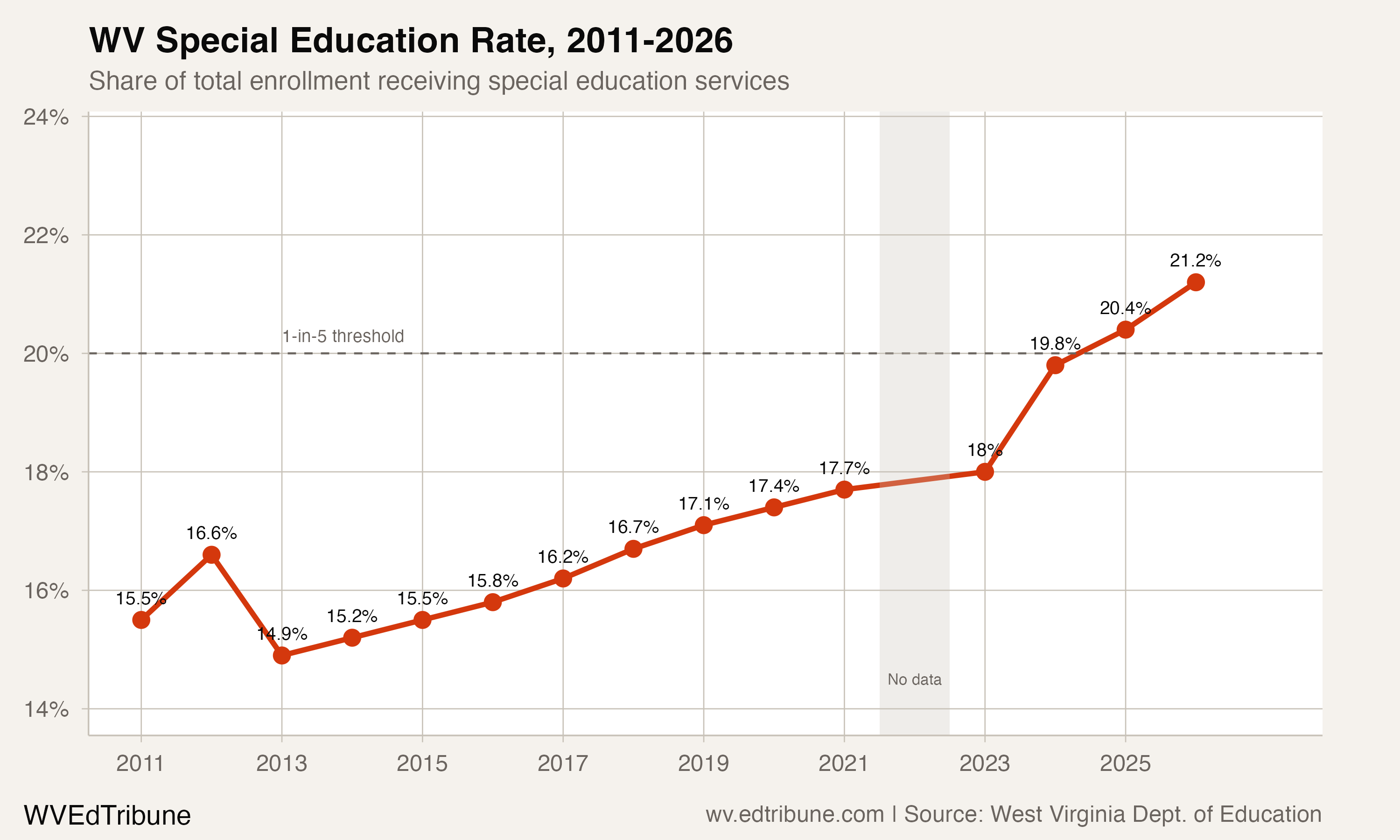
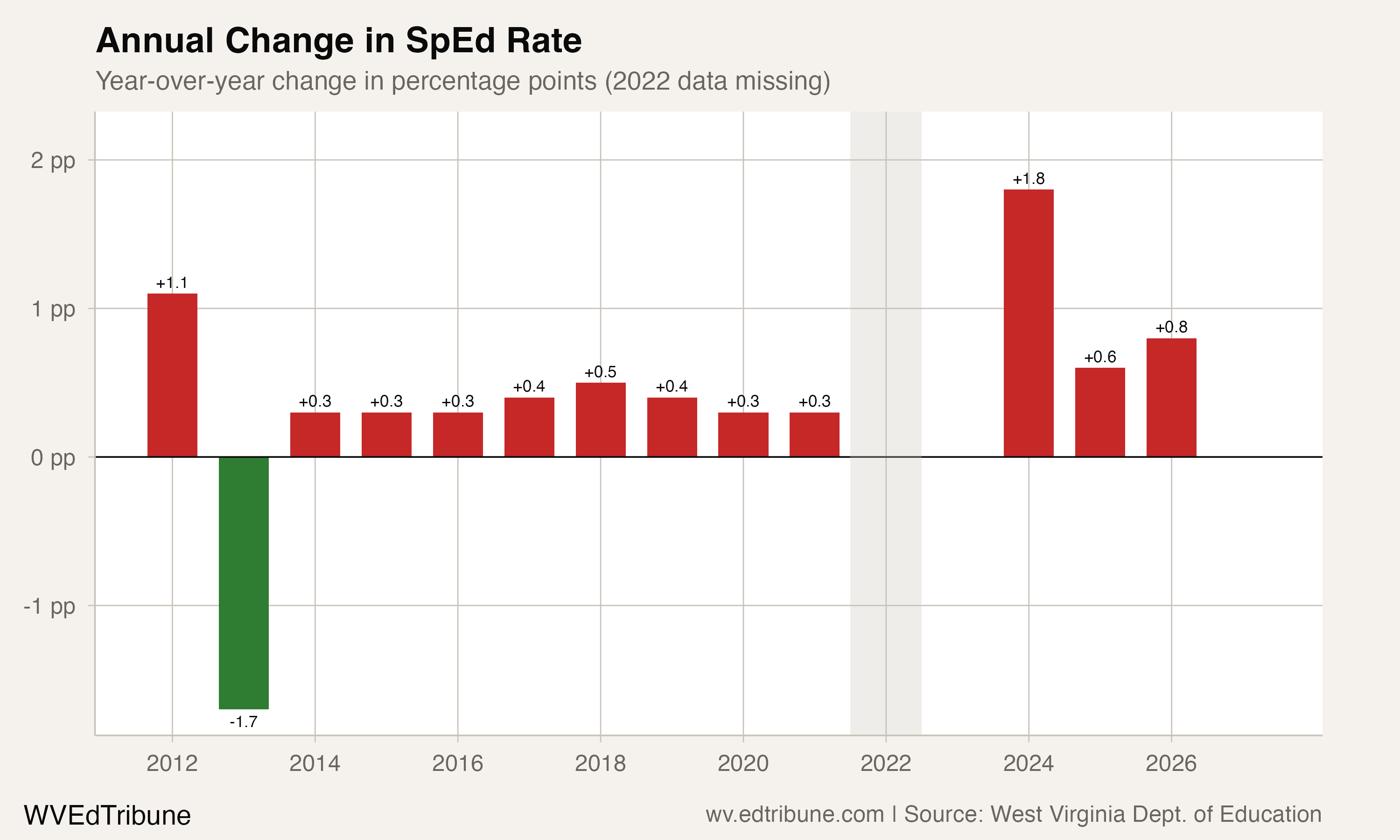
Since 2014, West Virginia's special education rate has increased every year for which data exists. (The state did not report special education counts for the 2021-22 school year.) The trajectory has been steady: 15.5% in 2011, 16.7% by 2018, 18.0% in 2023. Then it accelerated. The rate jumped 1.8 percentage points in a single year between 2023 and 2024, the largest annual increase in the dataset. It has continued climbing since, reaching 19.8% in 2024, 20.4% in 2025, and 21.2% in 2026.
The acceleration is partly mechanical. When total enrollment falls and special education counts hold steady or grow, the rate rises from both sides. Between 2011 and 2026, general education enrollment dropped by 57,364 students, a 24.1% decline. Special education gained 4,880, an 11.1% increase. The gap between these two trajectories is widening every year.
Seven counties above one in four
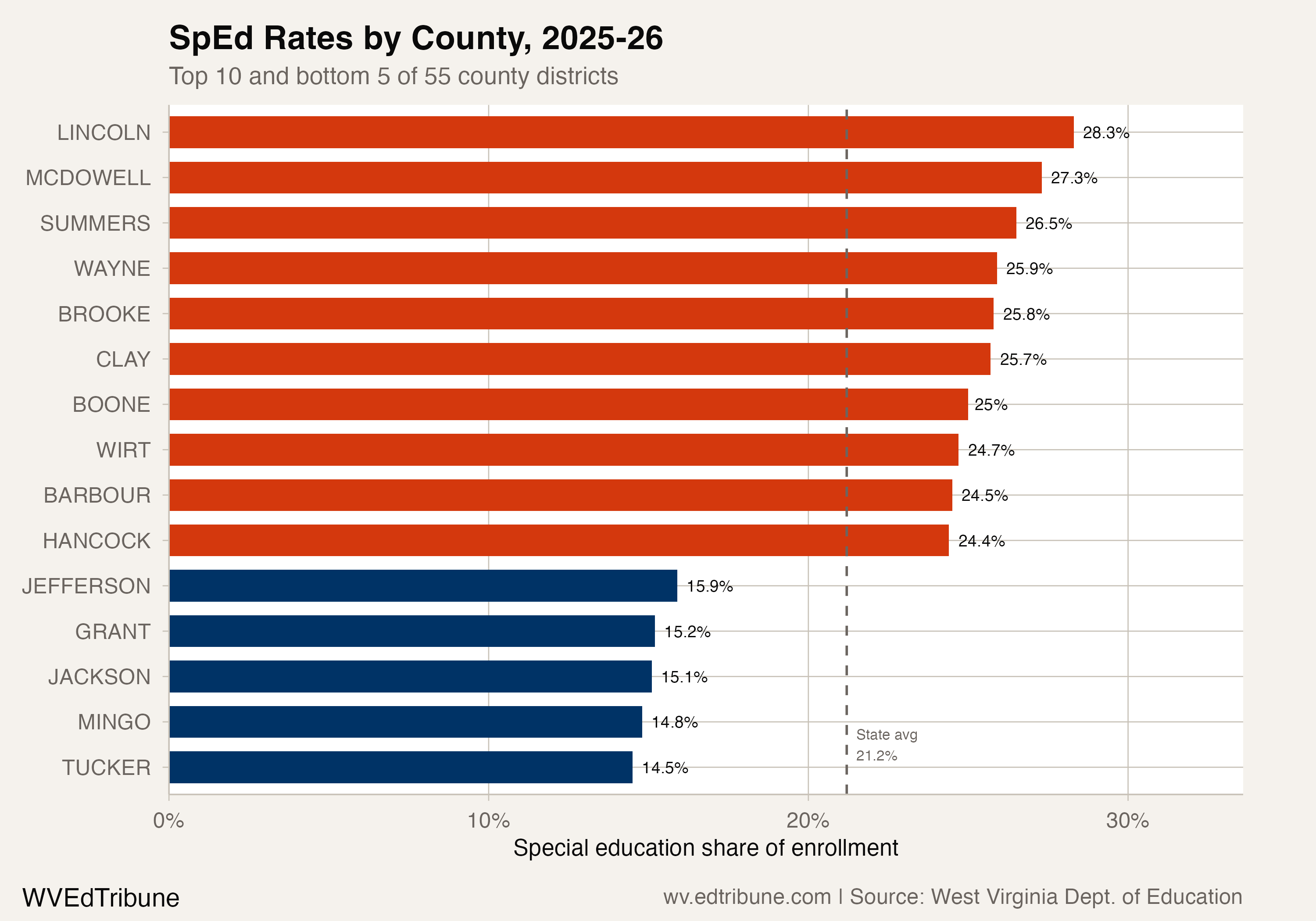
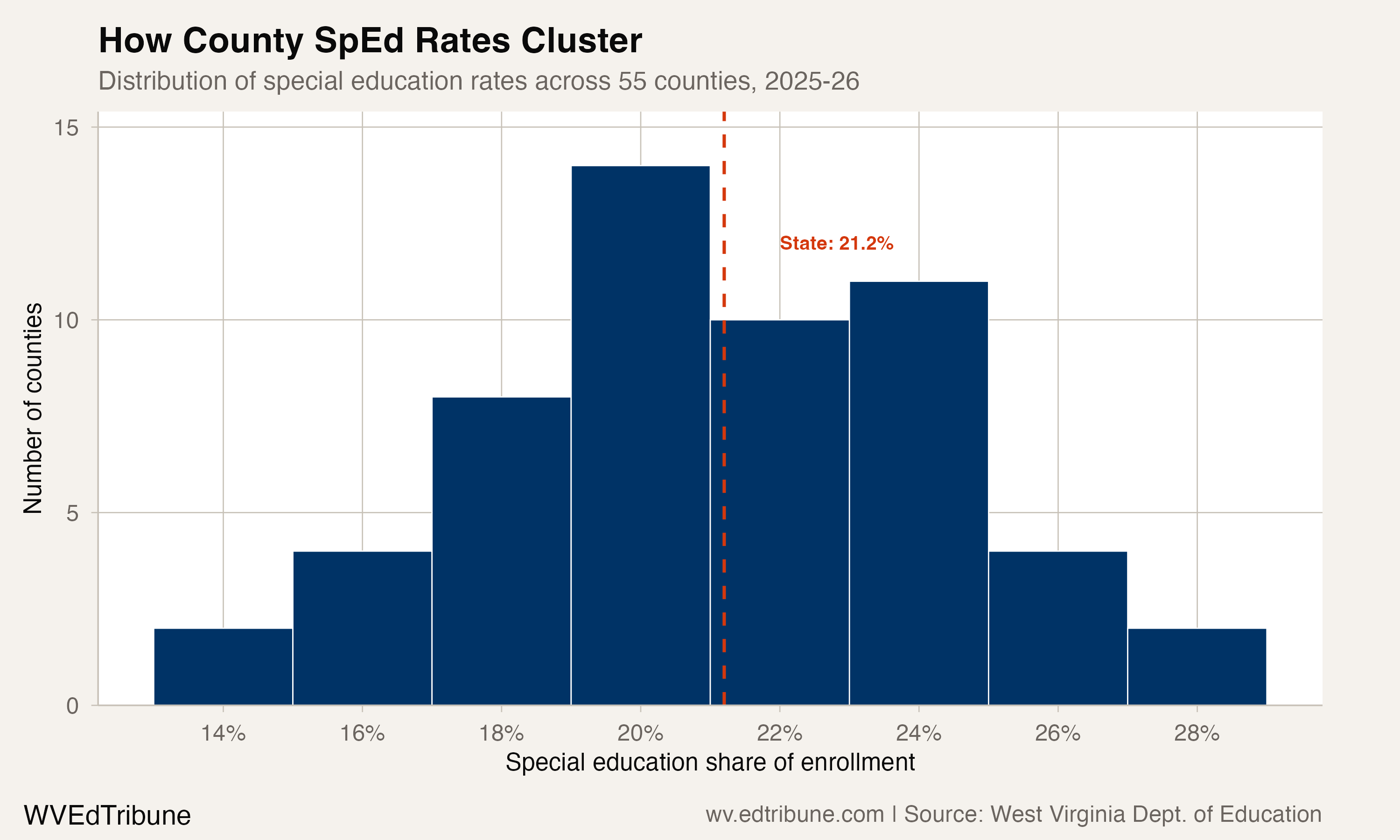
The statewide rate of 21.2% masks enormous variation. Lincoln County↗ET leads the state at 28.3%, meaning more than one in four students is entitled to an Individualized Education Program. McDowell County↗ET follows at 27.3%, then Summers County↗ET at 26.5%. In all, seven counties have special education rates above 25%, and 36 of 55 counties exceed 20%.
At the other end, only two counties remain below 15%: Tucker (14.5%) and Mingo (14.8%). The median county rate is 21.0%, nearly identical to the state average, which means this is not a story driven by a handful of outliers. The distribution is remarkably tight. Most of West Virginia's counties cluster between 18% and 25%.
The counties with the highest rates tend to be small and rural, but the pattern extends to mid-size systems too. Cabell County↗ET, home to Huntington and enrolling 10,894 students, carries a 23.5% special education rate. Its superintendent told state senators that the district runs an $8 million annual deficit on special education alone.
Why the rate keeps climbing
Two forces are at work, and they are difficult to disentangle.
The first is identification. Federal law requires schools to find and evaluate every child who may have a disability, and identification practices have expanded nationwide over the past decade. Specific learning disabilities remain the largest category of IEPs in West Virginia. Improved screening, broader awareness of conditions like autism and ADHD, and post-pandemic referrals for developmental delays have all contributed to higher identification rates. Whether West Virginia is identifying students who were always there but previously missed, or whether the underlying prevalence of disability is rising, the enrollment data alone cannot say.
The second is compositional. The Hope Scholarship, West Virginia's universal school voucher program, has grown from a $9.2 million program in 2023 to a projected $250 million program by 2027. As families who can navigate private school alternatives leave the public system, the students who remain are, on average, more likely to receive special education services. Private schools are not required to provide IEP-level accommodations, so families of children with significant disabilities have fewer options outside the public system. The voucher program does not report special education participation at a level that allows direct measurement of this effect.
The funding formula's blind spot
West Virginia's seven-step school aid formula determines how much state money flows to each county based on enrollment, but it does not account for the number of students receiving special education services. The formula provides supplemental funding only for "high acuity" cases, leaving the majority of special education costs to counties.
When Sen. Amy Grady, chair of the Senate Education Committee, asked county superintendents what they most needed, the answer was consistent:
"Nearly every single one said the special education costs." — Sen. Amy Grady, R-Mason, WSAZ, March 2026
The scale of the mismatch is large. Berkeley County↗ET posted a $38 million special education deficit in fiscal year 2025, the largest in the state. Monongalia County reported a $15.9 million gap; Kanawha, $13.1 million; Harrison, $12.4 million. Only six of 55 counties reported special education revenues that covered their costs.
The legislature's response has been modest. Senate Bill 437, the "Fair State Aid Formula Act of 2026," would have overhauled the funding formula, but senators stripped most provisions and kept only the special education component. The surviving measure would provide an additional $8 million for high-needs students, but not until the 2027-28 school year. For context, the statewide deficit is $224 million.
Hancock County↗ET announced earlier this session that its ability to make payroll was at risk. Seven county school systems were under state Department of Education oversight as of March 2026. Board of Education President Paul Hardesty warned lawmakers that more districts will face insolvency in the years to come.
The structural bind

The instructional programs that special education students receive carry per-pupil costs ranging from 50% to 420% above general education, depending on service intensity. As the share of students entitled to these services rises and the total enrollment generating base funding falls, the per-student cost of operating a West Virginia school district increases even when nothing else changes.
This is not a problem that can be managed through efficiency alone. Jackson County↗ET Superintendent Will Hosaflook told legislators that counties have been "supplementing with other funds they have available," but those reserves are finite. Districts facing special education deficits of $10 million or more cannot absorb the cost by cutting electives or deferring maintenance indefinitely.
Whether the special education rate stabilizes near 21% or continues climbing toward 25% will depend on factors that enrollment data cannot predict: identification practices, voucher uptake, migration patterns, and whether the legislature rewrites a funding formula that was designed for a different era. For now, the data shows a state where one in five public school students is entitled to specialized instruction, and the system built to fund that instruction covers roughly 60 cents of every dollar it costs.
Detailed code that reproduces the analysis and figures in this article is available exclusively to EdTribune subscribers.
Discussion
Sign in to join the discussion.
Loading comments...