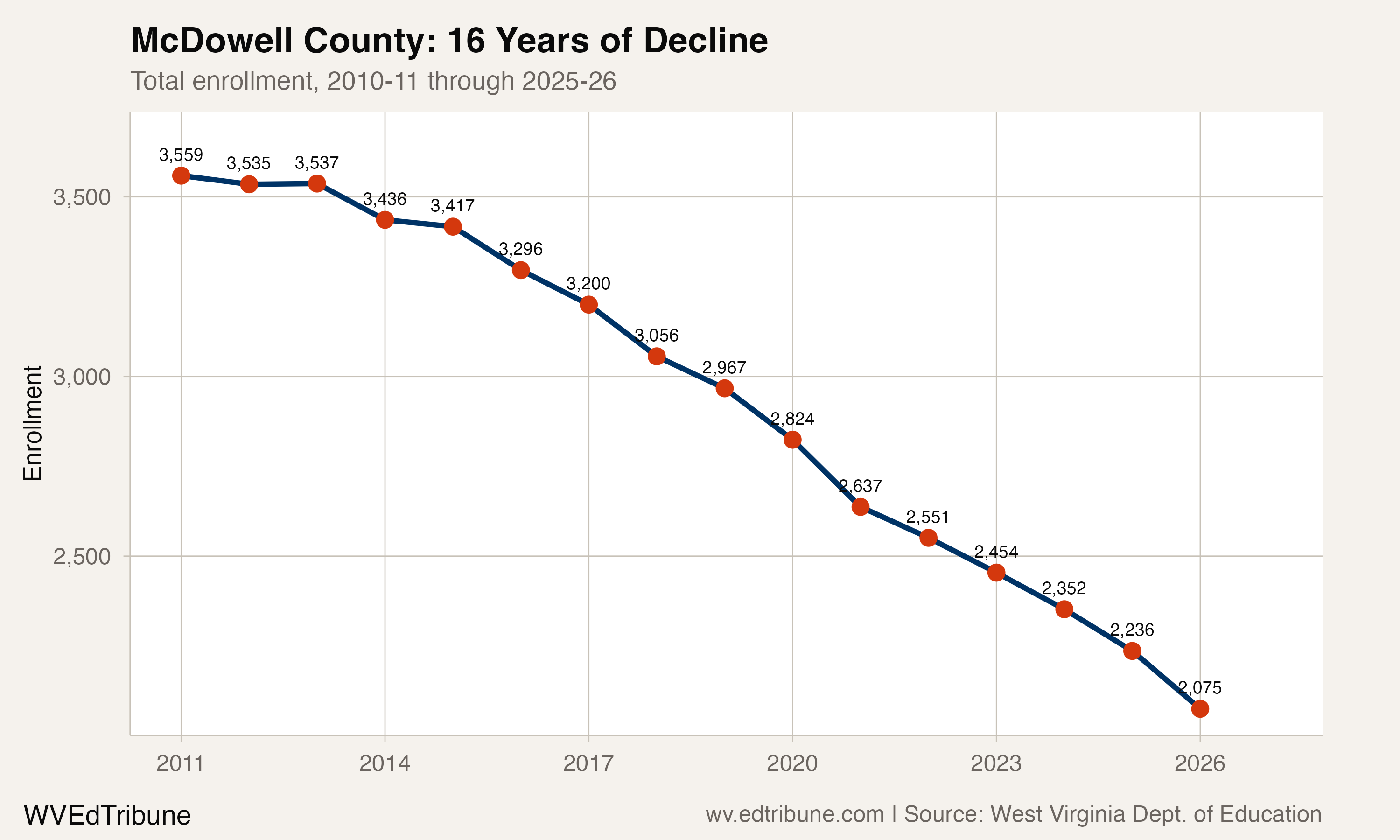
In 2010-11, McDowell County↗ET enrolled 3,559 students. Fifteen years later, the number is 2,075. That is a loss of 1,484 students, a 41.7% decline, the steepest of any county in West Virginia. It is also a new all-time low.
McDowell's enrollment trajectory does not surprise anyone who has watched the county's broader collapse. The population peaked at 98,887 in 1950, when the coal seams beneath its mountains employed tens of thousands. By 2020, the Census counted 19,111 residents, an 80% decline over seven decades. The school enrollment curve follows the population curve with a generational lag: families who left in the 1980s and 1990s took with them the children who would have enrolled in the 2010s and 2020s.
The acceleration no one expected
What stands out in the most recent data is not just that McDowell keeps declining, but that it is declining faster. The county lost 263 students between 2010-11 and 2015-16, a painful but manageable 7.4% drop across five years. The next five years brought a loss of 659 students, a 20.0% decline. The most recent five-year period, 2020-21 to 2025-26, erased another 562 students, a 21.3% decline.
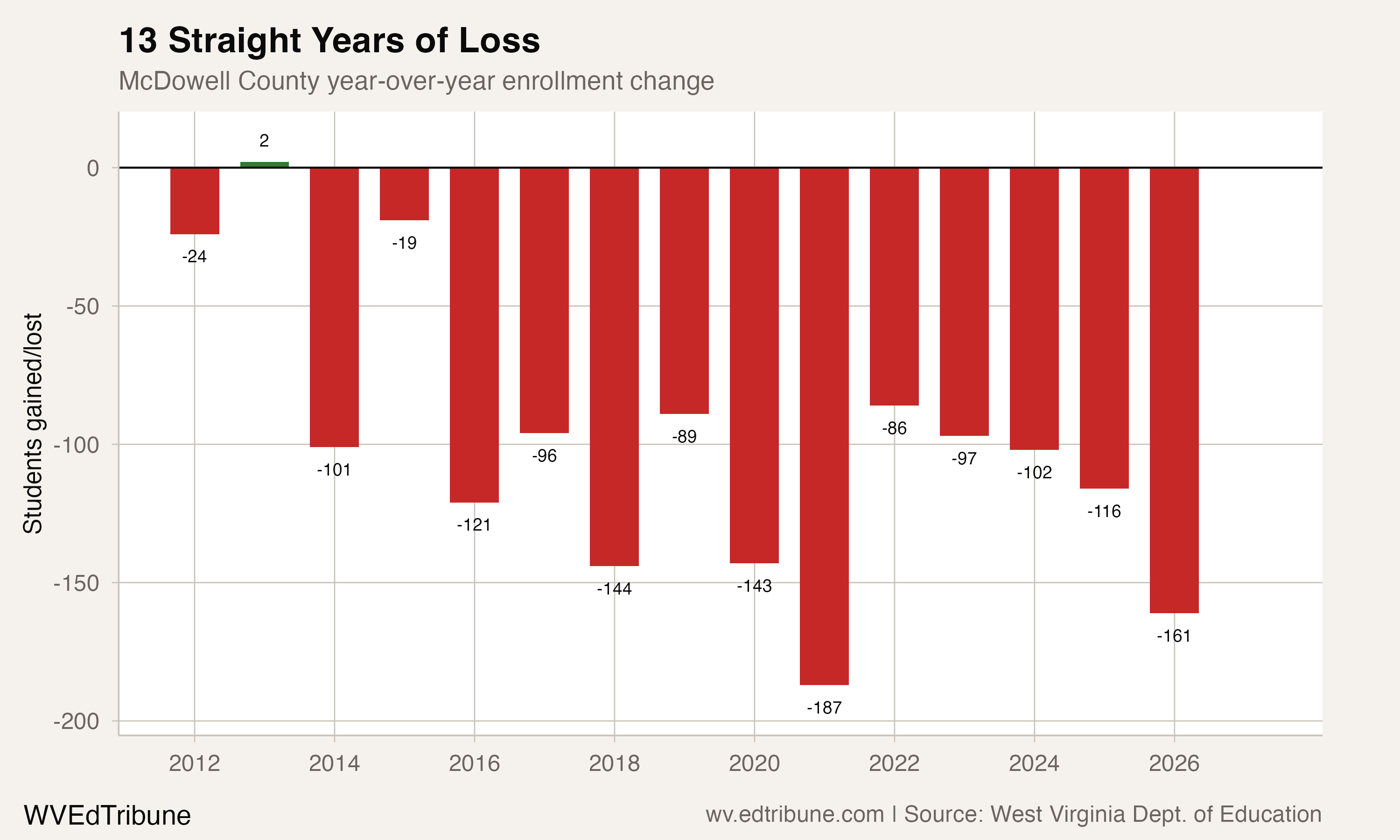
The 2025-26 school year was the second-worst single year on record: a loss of 161 students, a 7.2% drop. Only the pandemic year of 2020-21, when 187 students disappeared from the rolls, was worse. The county has now posted 13 consecutive years of enrollment decline, with every year since 2013-14 recording fewer students than the one before.
Not just McDowell: the entire coal belt is emptying
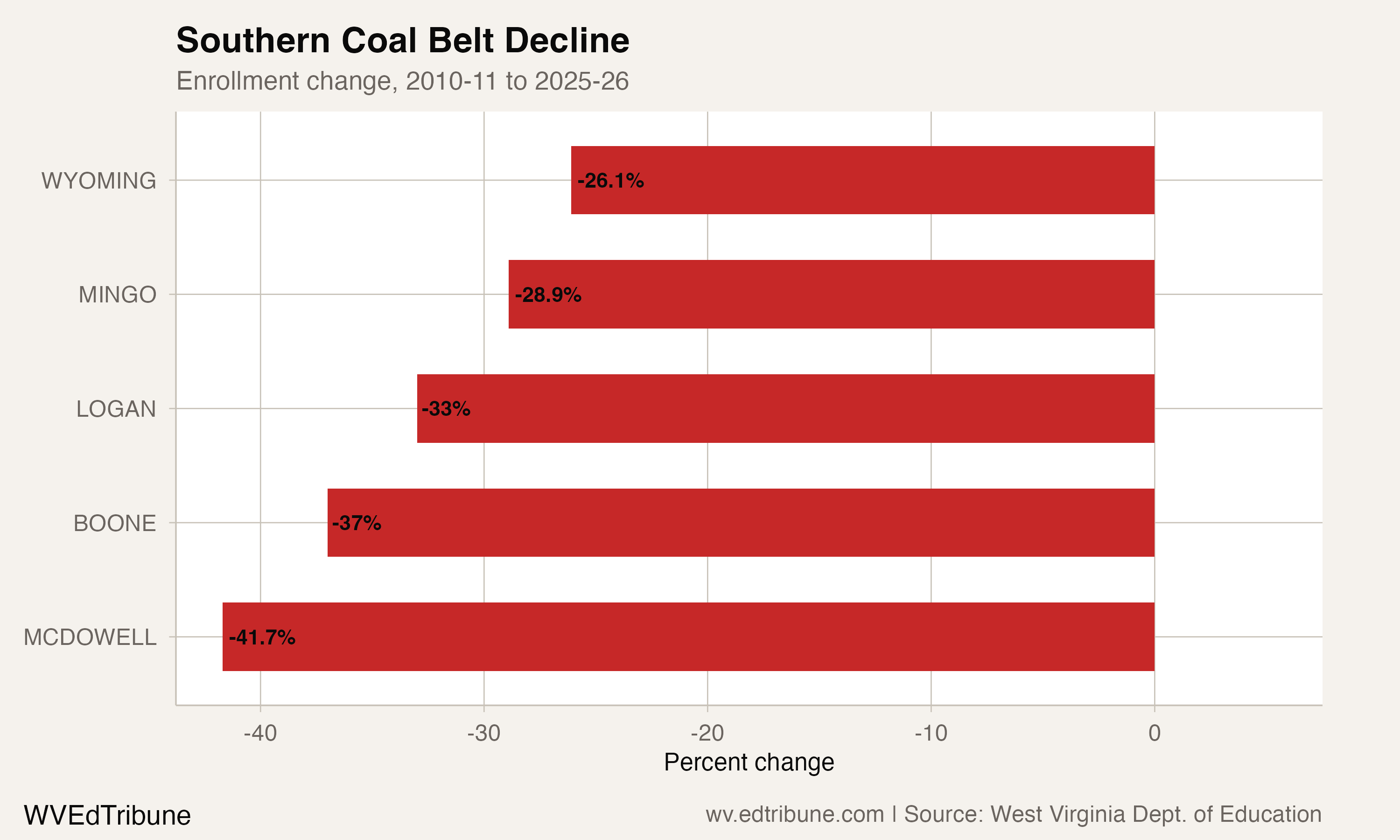
McDowell's decline is the worst in percentage terms, but it is not isolated. The five southern coal counties, McDowell, Boone↗ET, Logan↗ET, Mingo↗ET, and Wyoming↗ET, enrolled 23,355 students combined in 2010-11. By 2025-26, that number had fallen to 15,638. That is a loss of 7,717 students, a 33.0% decline across the coal belt.
McDowell leads the pack at -41.7%, followed by Boone at -37.0%, Logan at -33.0%, Mingo at -28.9%, and Wyoming at -26.1%. Every one of these counties sits at its all-time enrollment low.
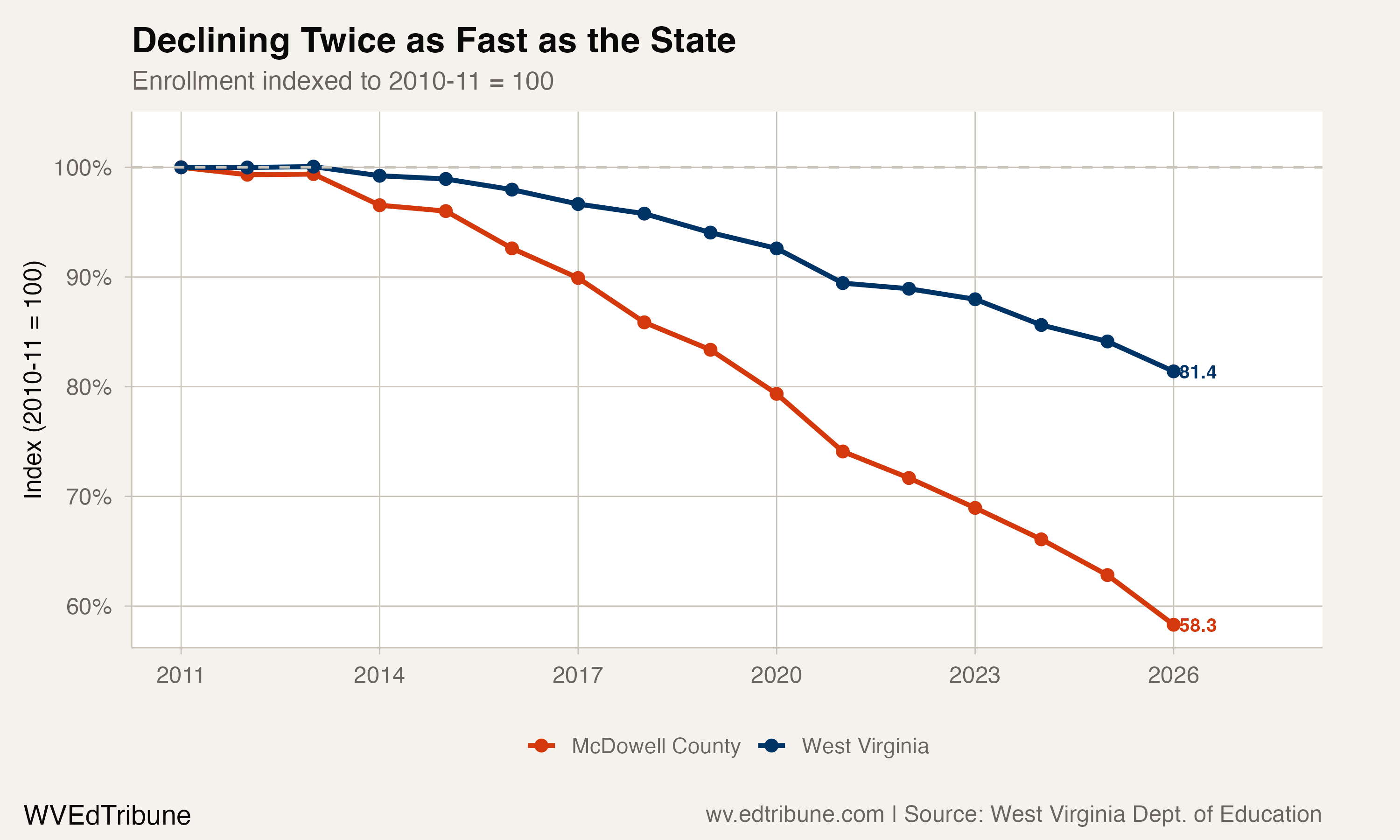
For context, West Virginia as a whole declined 18.6% over the same period, falling from 282,130 to 229,646 students. McDowell is declining at more than double the state rate. Indexed to 2010-11 as a baseline of 100, the state stands at 81.4 in 2025-26. McDowell stands at 58.3.
Where have the kindergartners gone?
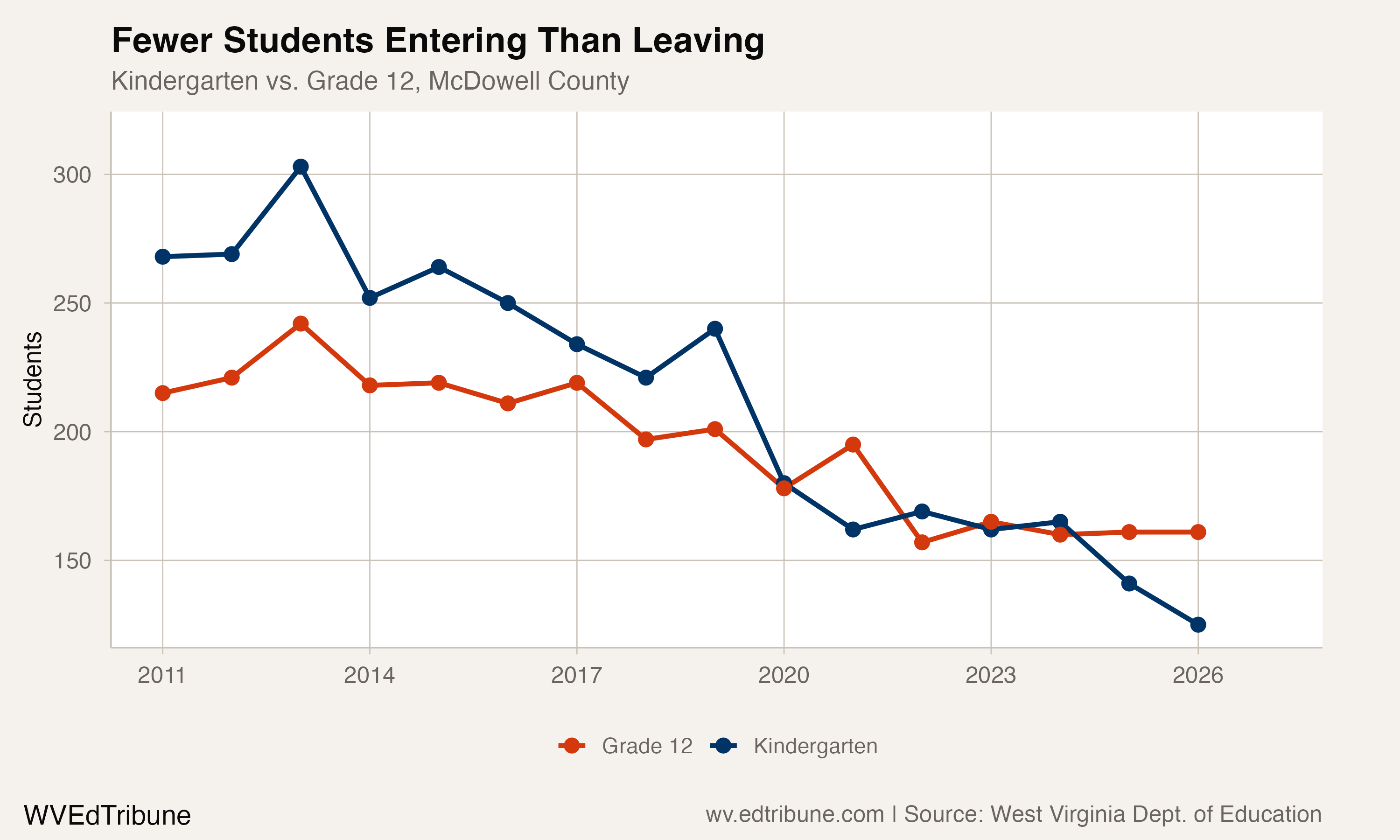
The pipeline data tells the most consequential story about McDowell's future. In 2010-11, 268 children entered kindergarten. In 2025-26, that number was 125. That is a 53.4% collapse in the entry-level cohort.
Meanwhile, Grade 12 enrollment has remained comparatively stable. In 2025-26, 161 seniors were enrolled in Grade 12, more than the 125 kindergartners who entered. When more students leave a system each year than enter it, the decline compounds. McDowell's kindergarten-to-twelfth-grade ratio crossed below 1.0 in 2020-21 and has stayed there since, widening to 0.78 in 2025-26.
The kindergarten collapse reflects something more fundamental than school policy. Demographers project that McDowell County will lose nearly a third of its remaining population by 2040, driven by a compounding cycle: young families leave, taking future births with them, which means even fewer working-age adults in the next generation.
"When young families leave the area, future births are exported somewhere else. This creates a compounding effect: fewer children being born today means fewer working-age adults tomorrow, which means even fewer births in the future." -- The Daily Yonder, Oct. 2025
One in four students receives special education
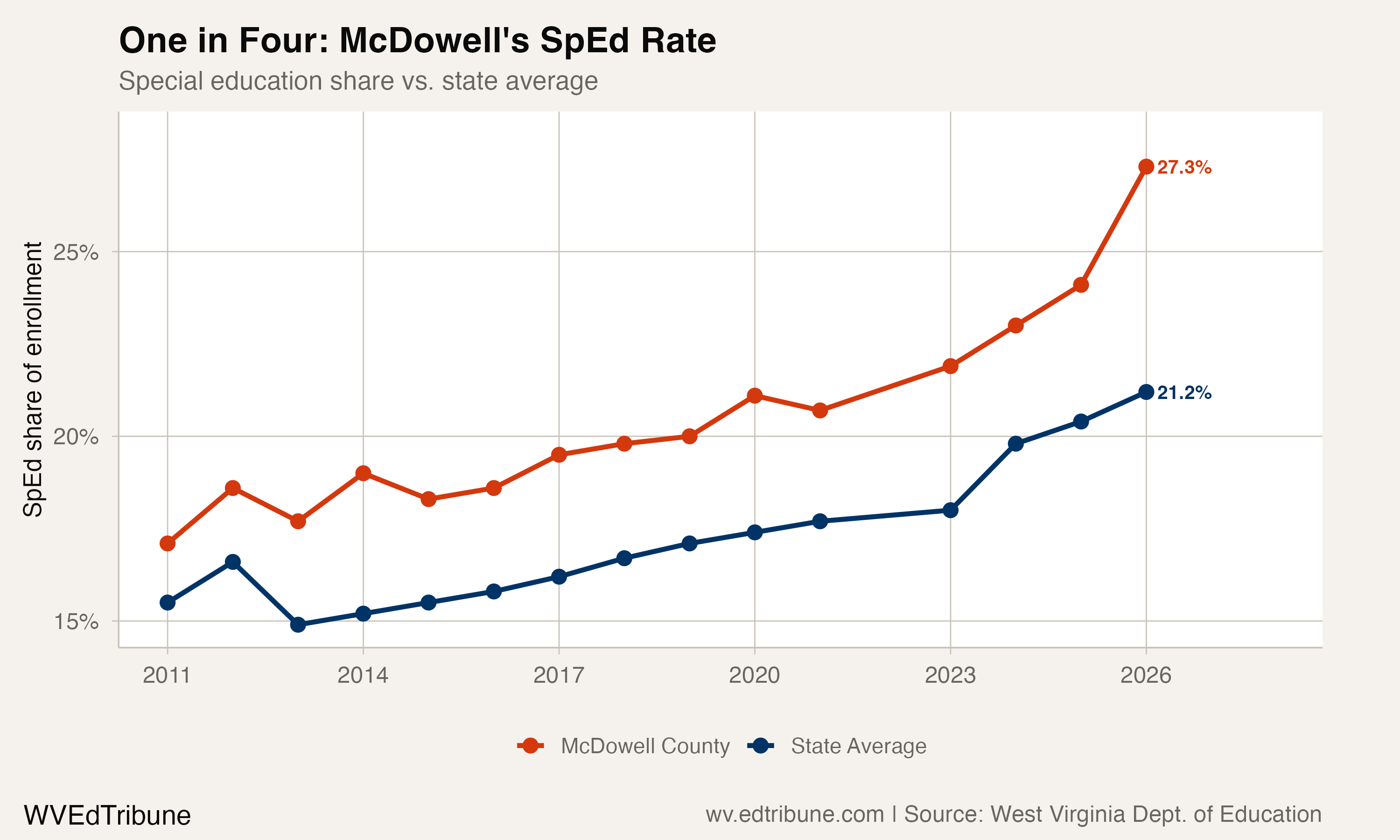
As McDowell's total enrollment contracts, the share of students who receive specialized instructional services has grown sharply. In 2010-11, 17.1% of the county's students were enrolled in special education programs. By 2025-26, the rate had climbed to 27.3%, the second-highest of any county in the state behind Lincoln County (28.3%). The statewide average is 21.2%.
The raw count of special education students has held relatively steady, declining from 608 to 566 over 15 years, a 6.9% drop compared to a 41.7% drop in total enrollment. The rising rate is largely a denominator effect: as the overall student body shrinks, the proportion of students who receive services grows even if the absolute number does not.
This creates a structural budget challenge. The instructional programs these students receive carry higher per-pupil costs. With total enrollment falling and the share of higher-cost services rising, per-pupil spending must increase just to maintain the same level of service, even as the state funding formula sends fewer dollars based on lower headcounts.
Consolidation as survival
McDowell County's response to the enrollment collapse has been consolidation. In December 2024, the state Board of Education approved closing three elementary schools, Fall River, Kimball, and Welch Elementary, and combining them into the new Coalfield Elementary School, which opened for the 2025-26 school year.
Superintendent Dr. Ingrida Barker framed the consolidation in practical terms.
"Those schools are staying halfway empty and we end up putting the students in split grades which is never the best option for them. We don't have as many resources as they could have like with this newly consolidated school." -- WVVA, Feb. 2025
The new facility serves roughly 500 students, replacing three aging buildings, two of which were built in 1954 and sit in the 100-year floodplain. The consolidation logic is straightforward: when enrollment drops below the level needed to staff individual classrooms by grade, combining schools preserves single-grade instruction and concentrates limited resources.
Poverty as backdrop, not as cause
McDowell County's median household income of $27,682 is more than 40% below the state median. The county is one of 11 in West Virginia classified by the Census Bureau as experiencing "persistent poverty," meaning poverty rates have exceeded 20% continuously for three decades. Approximately 72.5% of the county's students are classified as economically disadvantaged. One in three households relies on SNAP.
In 2025-26, 265 of McDowell's 2,075 students, 12.8%, met the federal definition of homeless, the fourth-highest rate among West Virginia's 55 counties.
But poverty alone does not explain the enrollment collapse. McDowell was poor in 2011 too, when it enrolled 3,559 students. The proximate cause is population loss: when there are no jobs, working-age adults leave and take their children with them. Coal employment in the region has fallen from roughly 100,000 miners at the end of World War II to a few thousand in recent years. Mechanization came first, then market shifts as utilities converted from Appalachian coal to natural gas and renewables.
"No one's going to come and save us. We save each other." -- Linda McKinney, food bank director, CBS News/60 Minutes
The Hope Scholarship is not driving this
West Virginia's Hope Scholarship program, which diverts approximately $4,900 per student in state funding toward private schooling or homeschooling, has drawn significant enrollment away from public schools statewide, accounting for 51.9% of the state's total enrollment decline. But in McDowell County, the program is a minor factor: just 6.1% of the county's enrollment loss is attributable to Hope Scholarships, among the lowest rates in the state. In a county with a median household income under $28,000, there are few private school alternatives to leave for. The losses in McDowell are overwhelmingly driven by families leaving the county entirely.
What to watch
McDowell's 125 kindergartners in 2025-26 are the smallest entering class in the dataset. If that cohort is representative of what the county can expect going forward, McDowell will fall below 1,500 students within five years and could approach 1,000 within a decade. At that scale, maintaining two high schools, two middle schools, and even a single consolidated elementary becomes difficult to justify financially.
McDowell County once held nearly 100,000 people and filled classrooms across dozens of schools. Now it is consolidating its last elementary buildings and watching kindergarten classes shrink below 130 a year. The enrollment data does not show a plateau. It does not show a floor. Coalfield Elementary opened in fall 2025 as a monument to adaptation, but the children it was built to serve are fewer each year, and the population projections offer no reason to expect that to change.
Detailed code that reproduces the analysis and figures in this article is available exclusively to EdTribune subscribers.
Discussion
Sign in to join the discussion.
Loading comments...