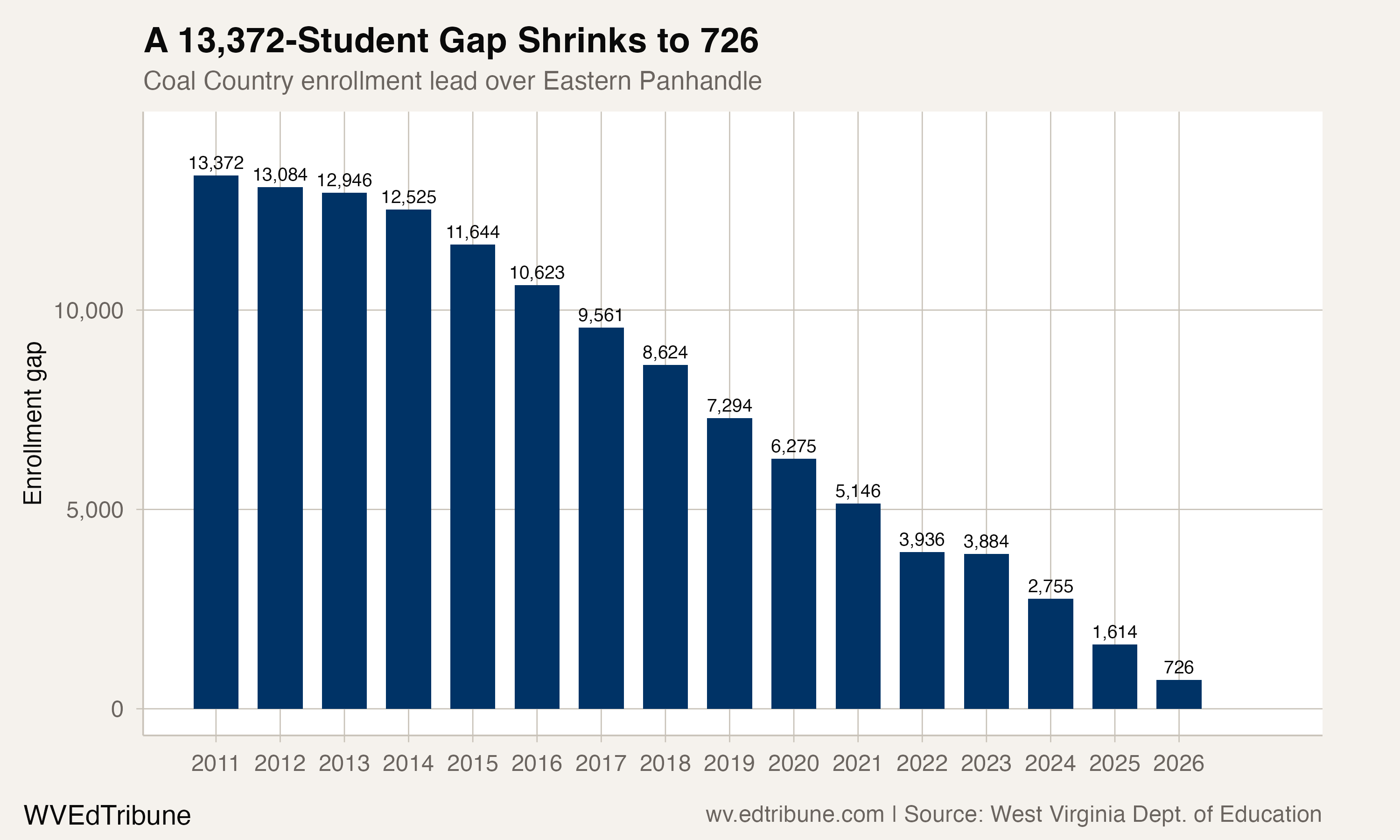
Correction (2026-10-20): This article now uses one West Virginia Department of Education count throughout: enrollment counted for school funding (FTE). An earlier version measured from 2010-11 using a different WVDE publication for the early years; WVDE publishes the FTE count only from 2013-14, so the comparison now starts there. The starting gap is 12,525 students, not 13,372, and the 2025-26 gap of 726 is unchanged. An earlier version also said Berkeley County's 2026 dip was its first decline in four years; it also declined in 2023-24.
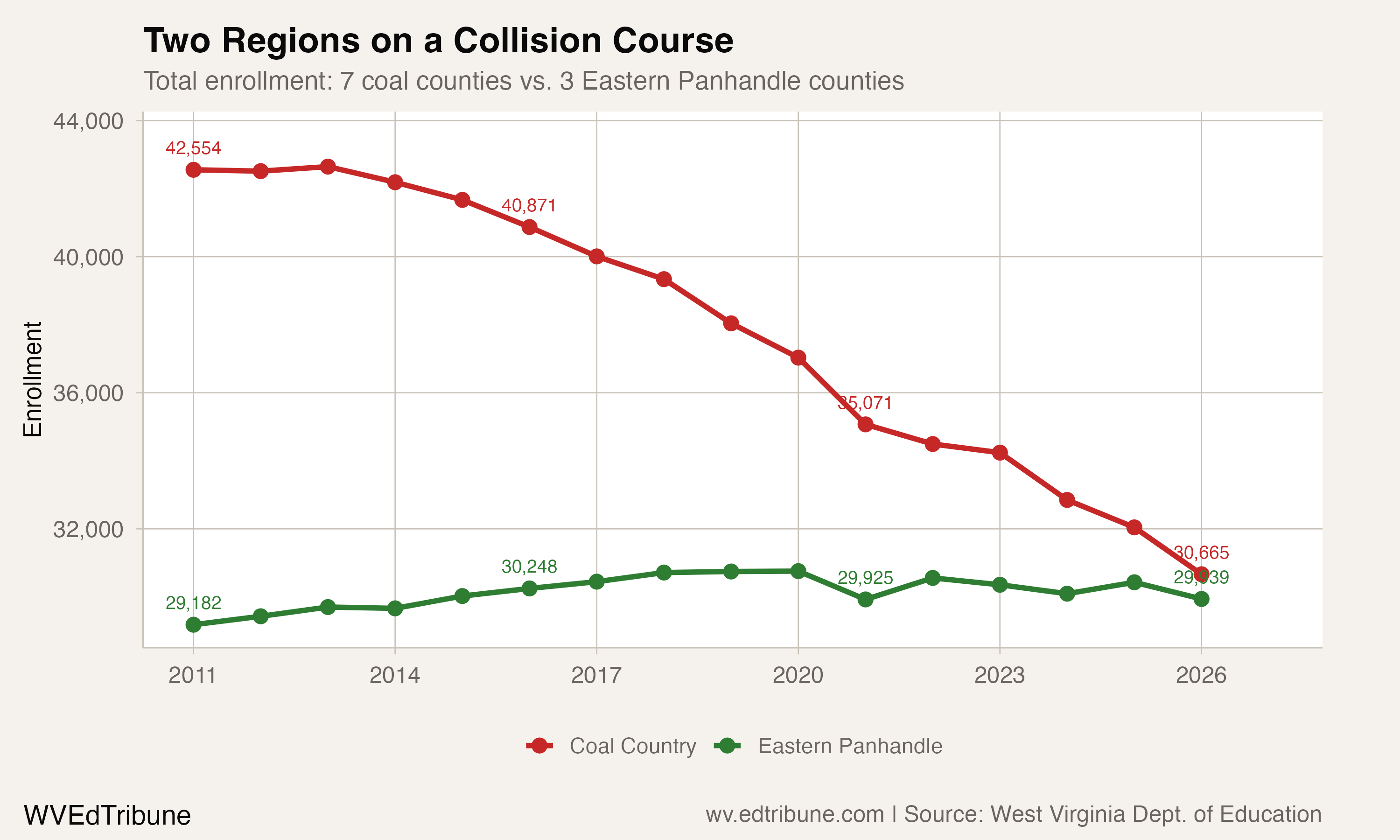
In 2013-14, the first year of the state's count of enrollment for school funding (FTE), seven coal counties in southern West Virginia enrolled 42,189 students. Three Eastern Panhandle counties, tucked against the Maryland border at the far end of the state, enrolled 29,664. The gap between them, 12,525 students, was roughly the size of a mid-sized county school system.
By 2026, coal country has fallen to 30,669 students. The Eastern Panhandle sits at 29,943. The gap is 726, less than the enrollment of a single elementary school. At current rates, the Panhandle will surpass the coalfields within a year.
This is not a story about one region's growth. It is a story about what happens when two regions sit inside the same state but inhabit different economies, and the enrollment data finally catches up to a demographic reality that has been building for decades.
Twelve years of divergence
The seven coal counties, Boone↗ET, Fayette↗ET, Logan↗ET, McDowell↗ET, Mingo↗ET, Raleigh↗ET, and Wyoming↗ET, have lost 11,519 students since 2014, a 27.3% decline. The three Eastern Panhandle counties, Berkeley↗ET, Jefferson↗ET, and Morgan↗ET, have gained 279 students over the same period, a 0.9% increase.
The gap has closed in two distinct phases. From 2014 to 2019, it narrowed by 5,231 students in five years, driven by coal country losses averaging 830 per year. From 2019 to 2026, the collapse intensified: 6,568 students of gap closure in seven years, as the coalfields lost an average of 1,053 students a year, 27% faster than in the earlier period.
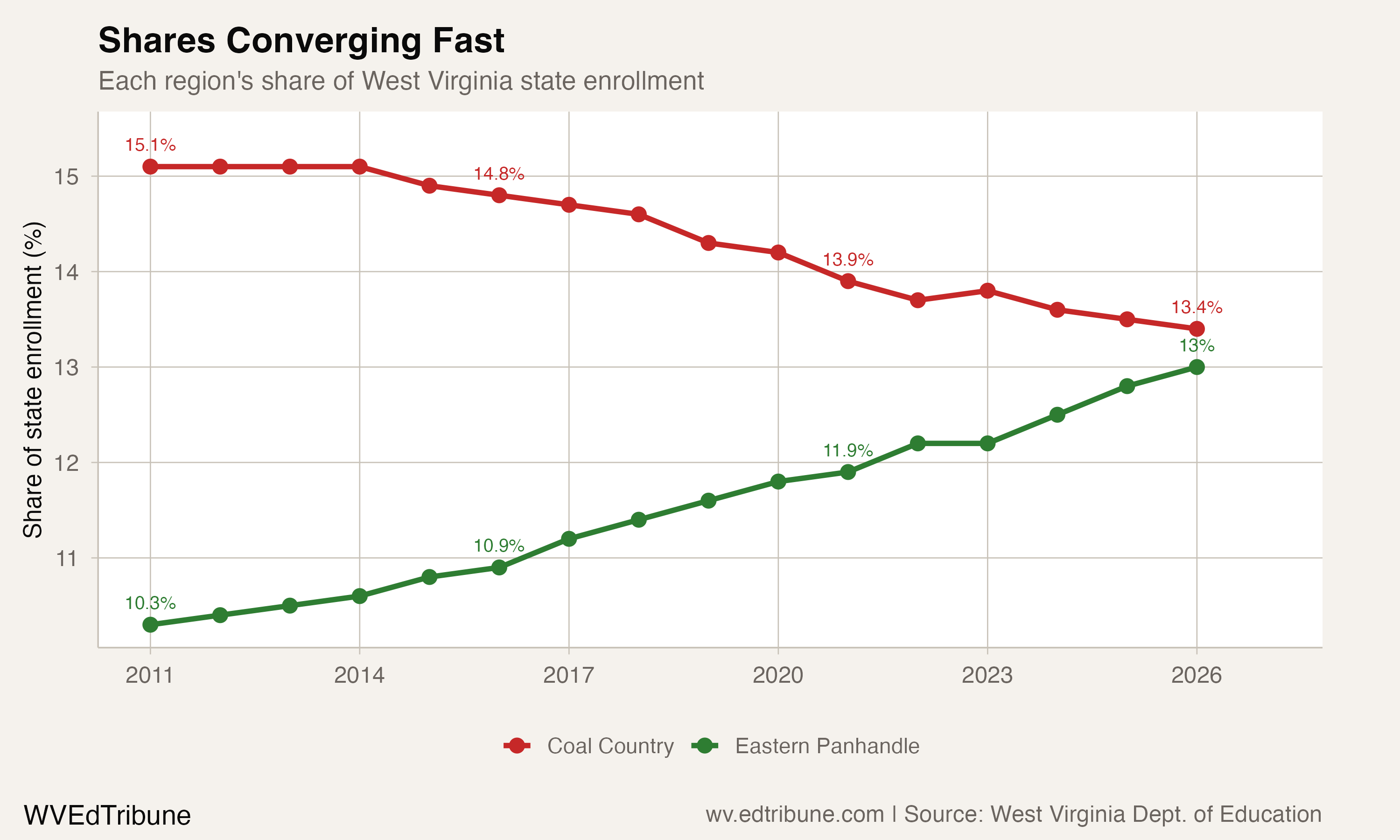
The convergence shows up in state enrollment shares. In 2014, coal country represented 15.1% of West Virginia's enrollment; the Panhandle represented 10.6%. By 2026, those shares are 13.1% and 12.8%. The lines are converging on the same share of a shrinking state.
The coalfields: decline at every scale
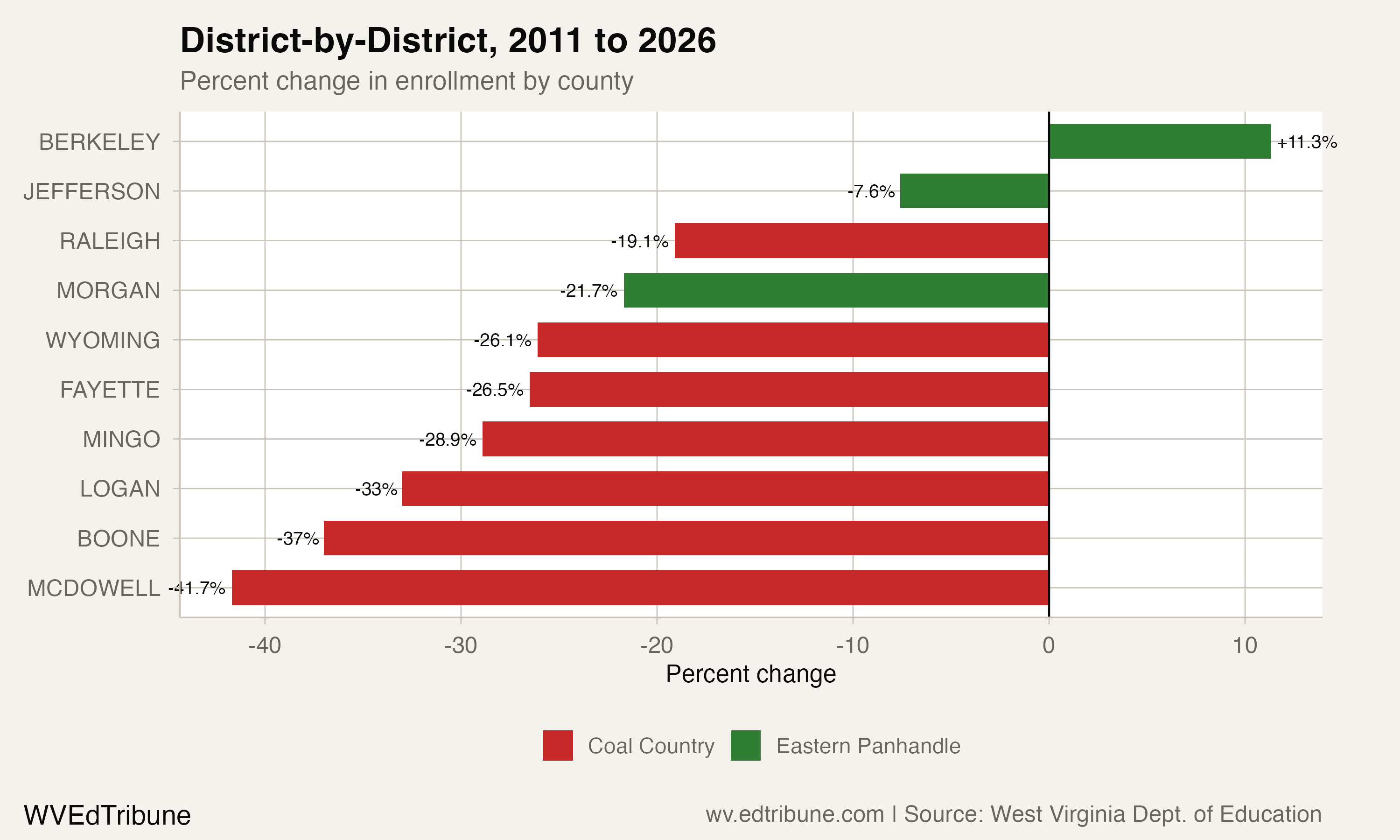
Every coal county in this group has lost students since 2014. McDowell County has lost the most in percentage terms, falling from 3,436 to 2,075 students, a 39.6% decline. Boone County is close behind at -36.4%, dropping from 4,500 to 2,862. Logan County has shed nearly a third of its enrollment, falling from 6,270 to 4,324.
Raleigh County, the region's largest district at 10,011 students, has lost 2,507 students since 2014, a 20.0% decline. It accounts for roughly a third of the region's total enrollment and a fifth of its total losses.
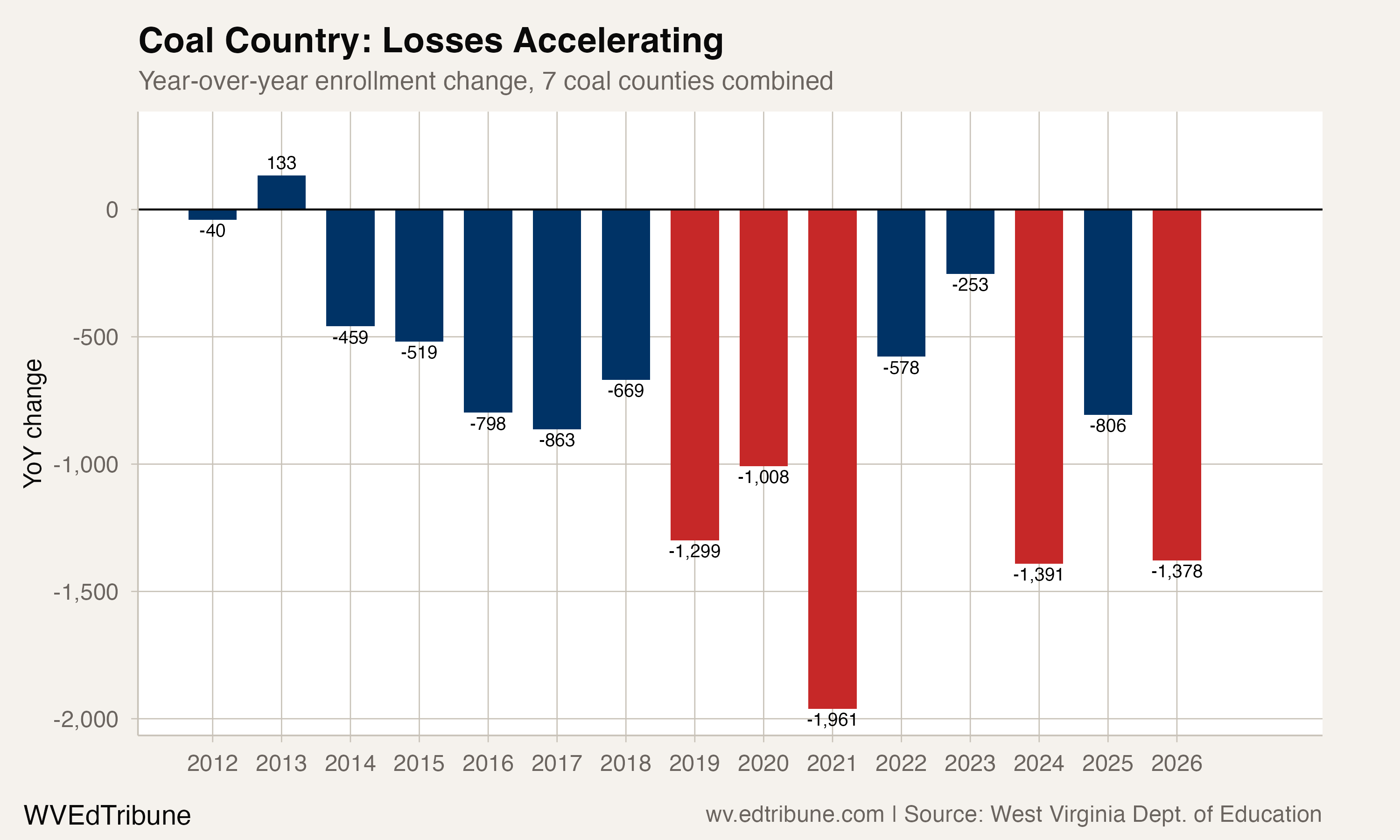
The year-over-year pattern in coal country has shifted from slow erosion to something closer to freefall. In 2015, the seven counties combined lost 519 students. By 2021, the single-year loss reached 1,998 students, the worst since at least 2013-14. Since 2019, losses have exceeded 1,000 in four of seven years, including a 1,274-student drop in 2026.
The Panhandle: growth that stalled
The Eastern Panhandle is not a growth story in the traditional sense. Its combined enrollment is virtually unchanged from 2014, up just 0.9% over 12 years. The aggregate masks a sharp internal divide.
Berkeley County, the region's anchor, has grown from 18,154 to 19,719 students, an 8.6% increase. It is one of only two counties in the entire state, alongside Doddridge, to have more students in 2025-26 than in 2013-14. Berkeley County alone is doing the work of keeping this region roughly flat.
Jefferson County, the second-largest Panhandle district, has declined 8.9%, falling from 8,969 to 8,175. Morgan County, the smallest, has lost 19.4% of its enrollment, dropping from 2,541 to 2,049. Morgan's percentage loss is comparable to Raleigh County's, even though the two sit on opposite ends of the state in very different economic circumstances.
The Panhandle's proximity to Washington, D.C., which drives Berkeley's growth, does not insulate it from the same pressures affecting the rest of the state. Berkeley County's population grew more than 21% between 2010 and 2020, fueled by federal workers and contractors commuting from Martinsburg. But even Berkeley peaked at 19,880 students in 2025 and dipped to 19,719 in 2026, its second decline in three years.
What the kindergarten numbers signal
The kindergarten pipeline offers a forward-looking view of where each region is headed. Coal country's kindergarten enrollment has fallen 34.8% since 2014, from 3,231 to 2,107 students. The Panhandle's kindergarten enrollment has dropped 12.6%, from 2,310 to 2,018. In absolute terms, the two regions now enroll nearly identical numbers of kindergartners, separated by just 89 students.
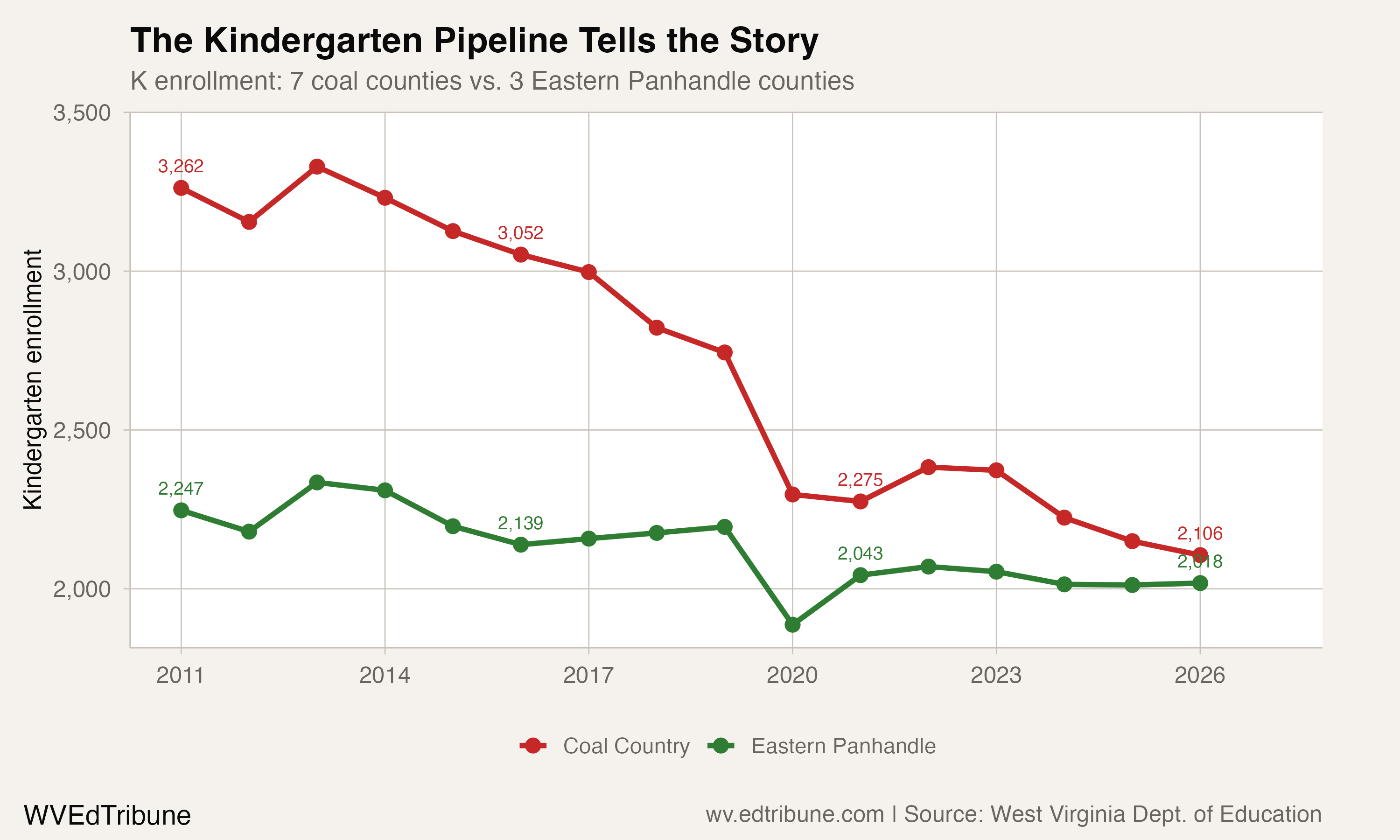
The kindergarten convergence foreshadows total enrollment convergence. The children entering kindergarten in coal country in 2025-26 will spend 13 years moving through the system, and there are far fewer of them than the high school seniors they will eventually replace. Coal country's total enrollment losses over the next decade are already locked in.
The mechanisms behind the divergence
The coalfield decline is not primarily a school-quality story. It is a labor market story.
McDowell County, the most extreme case, had a population of 98,887 in 1950 when it was one of the leading coal-producing counties in the United States. By 2020, the population had fallen to 19,111, an 80% decline over seven decades. The school enrollment trajectory, 3,436 to 2,075 since 2014, is the latest chapter of a collapse that began when mechanization eliminated thousands of mining jobs in the 1960s.
The current decline has a different character than past outmigration. A Daily Yonder analysis of Appalachian coalfield populations found that the region's losses are now driven by "natural decrease," deaths outnumbering births, rather than people moving away. That distinction matters for schools: outmigration removes families with school-age children, but natural decrease means fewer children are being born in the first place. The kindergarten data in coal country confirms this. There is no cohort arriving to replace the one graduating.
The Hope Scholarship voucher program, which expanded to all K-12 students in 2026 with projected costs of $170 million, adds a second layer of pressure. Students who leave public schools through the voucher program disappear from enrollment counts entirely. This effect is statewide, but it falls hardest on districts that are already small and shrinking.
School closures follow the enrollment line
The enrollment decline has begun forcing physical consolidation.
"We continue to hemorrhage enrollment. Somebody has to factor in rural counties with large square mileage but not many kids." -- Paul Hardesty, WV Board of Education President, WV MetroNews, Dec. 2025
In December 2025, the State Board of Education approved closures and consolidations affecting more than a dozen schools across six counties, including Logan County in the coalfield group. The state's school funding formula, unchanged since 1982, allocates aid based on enrollment head counts. Districts that lose students lose funding, even as their fixed costs, transportation routes, building maintenance, and administrative overhead remain.
West Virginia lost 36,112 students, 12.9%, between 2014 and 2024. A legislative effort, Senate Bill 504, has been introduced to create new hurdles for rural school closures, including voter approval requirements. The bill reflects a tension between fiscal arithmetic, which says small schools cost more per student, and community survival, since a school is often the last public institution in a small coal town.
What a crossover would mean
At the three-year average rate of change, coal country is losing roughly 1,191 students per year while the Panhandle loses about 137. If those rates hold, the Eastern Panhandle will surpass coal country in total enrollment by 2027.
The crossover itself is symbolic. It will not trigger any policy change or funding reallocation. But it will mark a milestone in the geographic rebalancing of West Virginia's student population: the state's center of educational gravity shifting from the coalfields that defined its economy for a century toward a commuter corridor that barely existed as a population center a generation ago.
Berkeley County's 2026 dip, its second decline in three years, hints that even the D.C. commuter economy may not permanently insulate a region from West Virginia's broader population decline. Deaths exceed births by roughly 7,900 per year statewide, and no commuter suburb can offset that math indefinitely. What the convergence makes plain is simpler: the economic geography that sustained coal country's schools for a century is gone, and the replacement that Berkeley represents cannot carry the state alone.
Detailed code that reproduces the analysis and figures in this article is available exclusively to EdTribune subscribers.
Discussion
Sign in to join the discussion.
Loading comments...