In this series: West Virginia Chronic Absenteeism.
In Jefferson County↗ET, 1,160 students are classified as homeless, more than any other county in the state, in a district you might not associate with the word. Jefferson County sits in the Eastern Panhandle, one of West Virginia's more affluent areas, home to commuters who work across the Potomac in Northern Virginia. Yet the McKinney-Vento definition of homelessness, which includes students doubled up with relatives, living in motels, or sleeping in cars, captures a population that suburban prosperity does not always make visible.
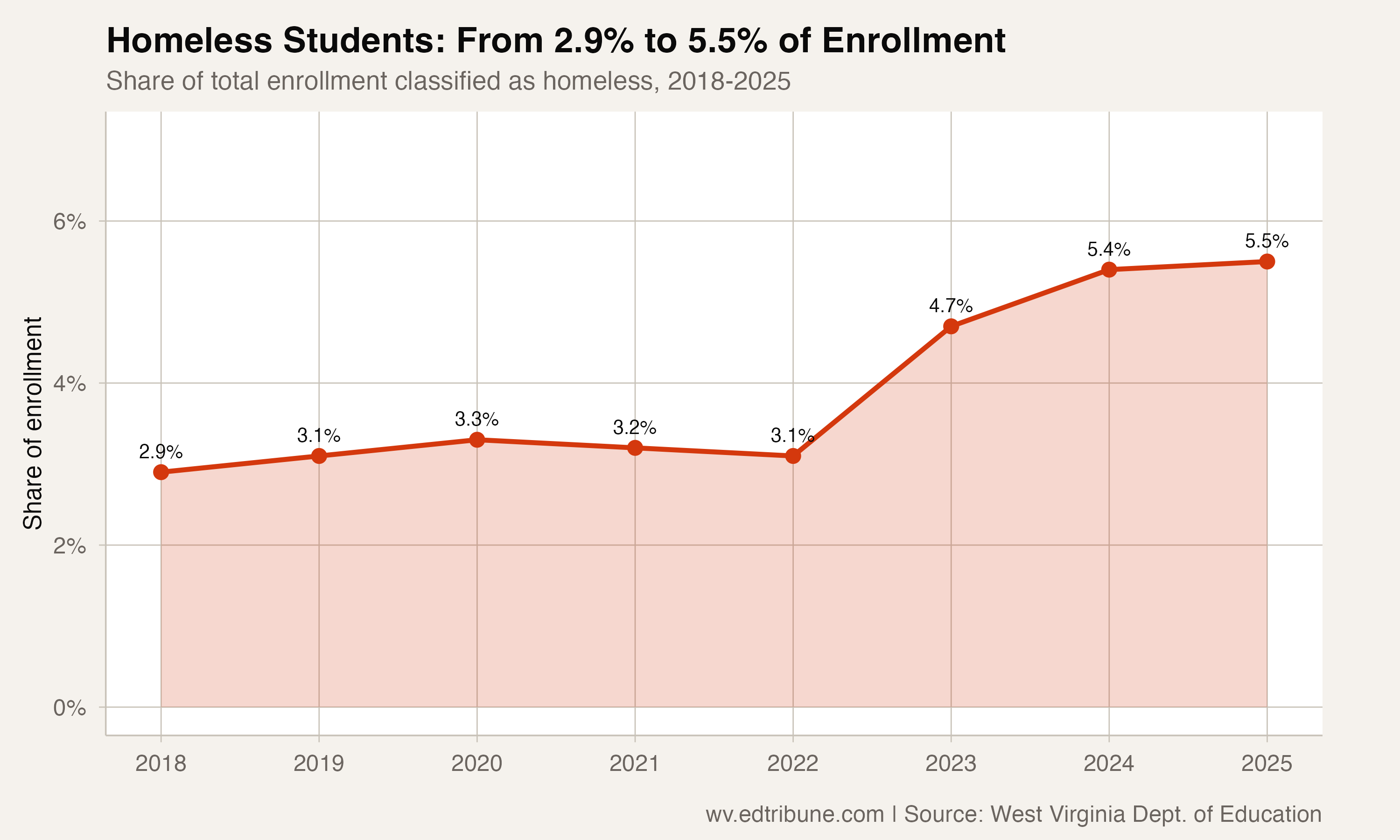
Across West Virginia, 11,707 students met that definition in 2024-25. That is 5.5% of total enrollment, roughly one in every 18 students, and a 69% increase from the 6,921 classified as homeless in 2017-18.
The count rose while enrollment fell. West Virginia lost 27,186 students over the same period, an 11.3% decline. The share of students classified as homeless nearly doubled, from 2.9% to 5.5%.
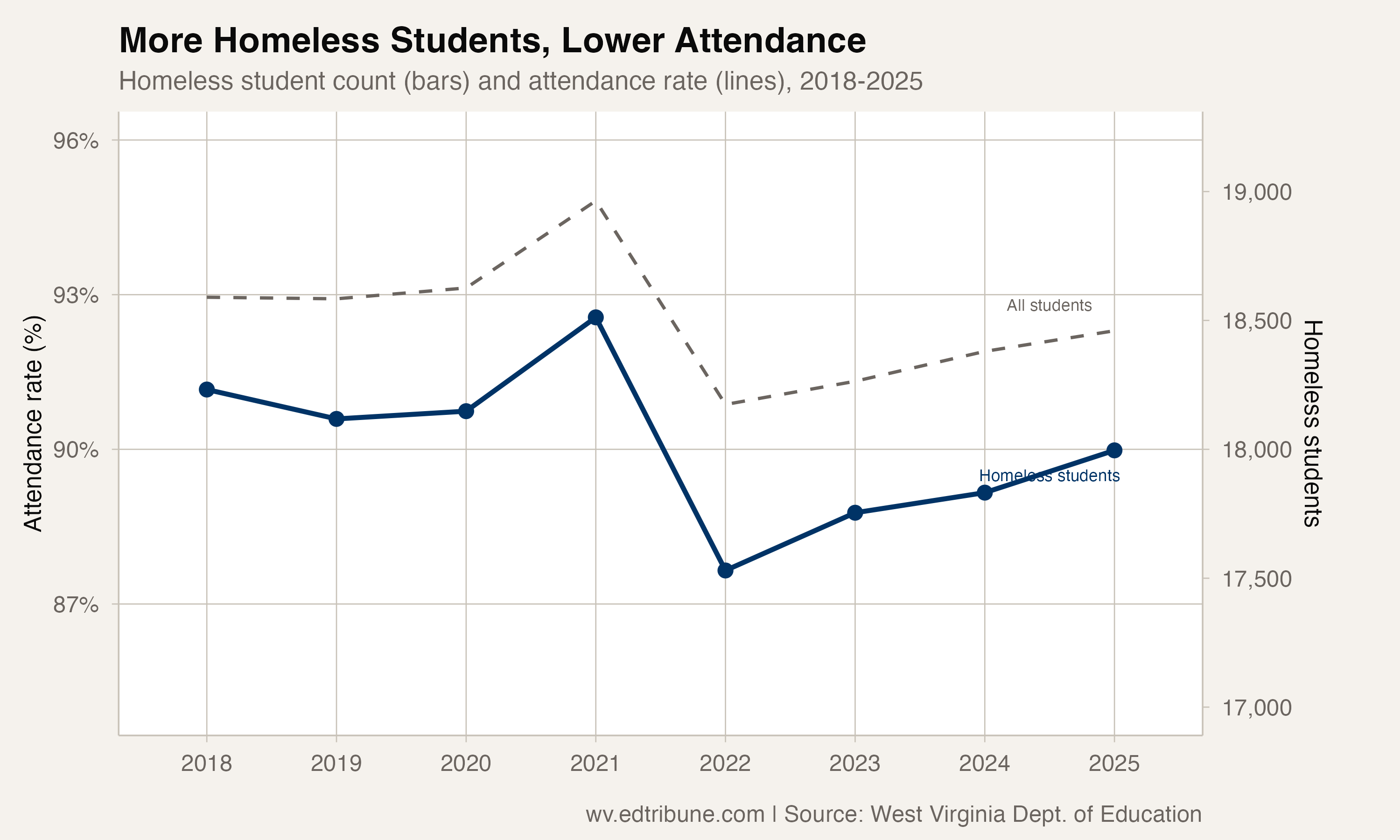
The attendance gap is persistent, not growing
Students who are currently homeless attended at 90.0% in 2024-25, compared to 92.3% for all students. That 2.3-point gap is exactly where it was before the pandemic, when students who are currently homeless attended at 90.6% against a 92.9% state average.
What changed during COVID was the depth of the trough. Attendance among students who are currently homeless fell to 87.6% in 2021-22, a 3.2-point gap and the widest on record. At that rate, the average student who is currently homeless was missing roughly 22 days per year. The recovery since then (+2.3 points) has been substantial, but it traced the same path as overall attendance rather than closing the gap.
The stability of the 2.3-point gap across eight years raises an uncomfortable question: the interventions that brought attendance back from the COVID crash may have restored the pre-existing inequity rather than fixing it.
Where attendance is lowest for students who are currently homeless
At the district level, the gap compounds. Cabell County↗ET, home to Huntington, has the lowest attendance for students who are currently homeless in the state at 85.3%, meaning these students miss about 26 days per year. Boone County↗ET follows at 85.8%, then Wyoming County at 86.6%.
Kanawha County↗ET, the state's largest district, has 828 students who are currently homeless attending at 88.5%. That rate sits 2.9 points below its overall average, which itself is already at an all-time low. Logan County↗ET has 460 students who are currently homeless attending at 87.4%, the worst rate among counties with large numbers of students experiencing homelessness.
One counter-example: Clay County↗ET, which had the highest share of students classified as homeless in the state during the enrollment series (33.4% of students), posts a 92.0% attendance rate for its 423 students who are currently homeless. That rate is among the best in the state for this group.
Foster care: the subgroup that recovered
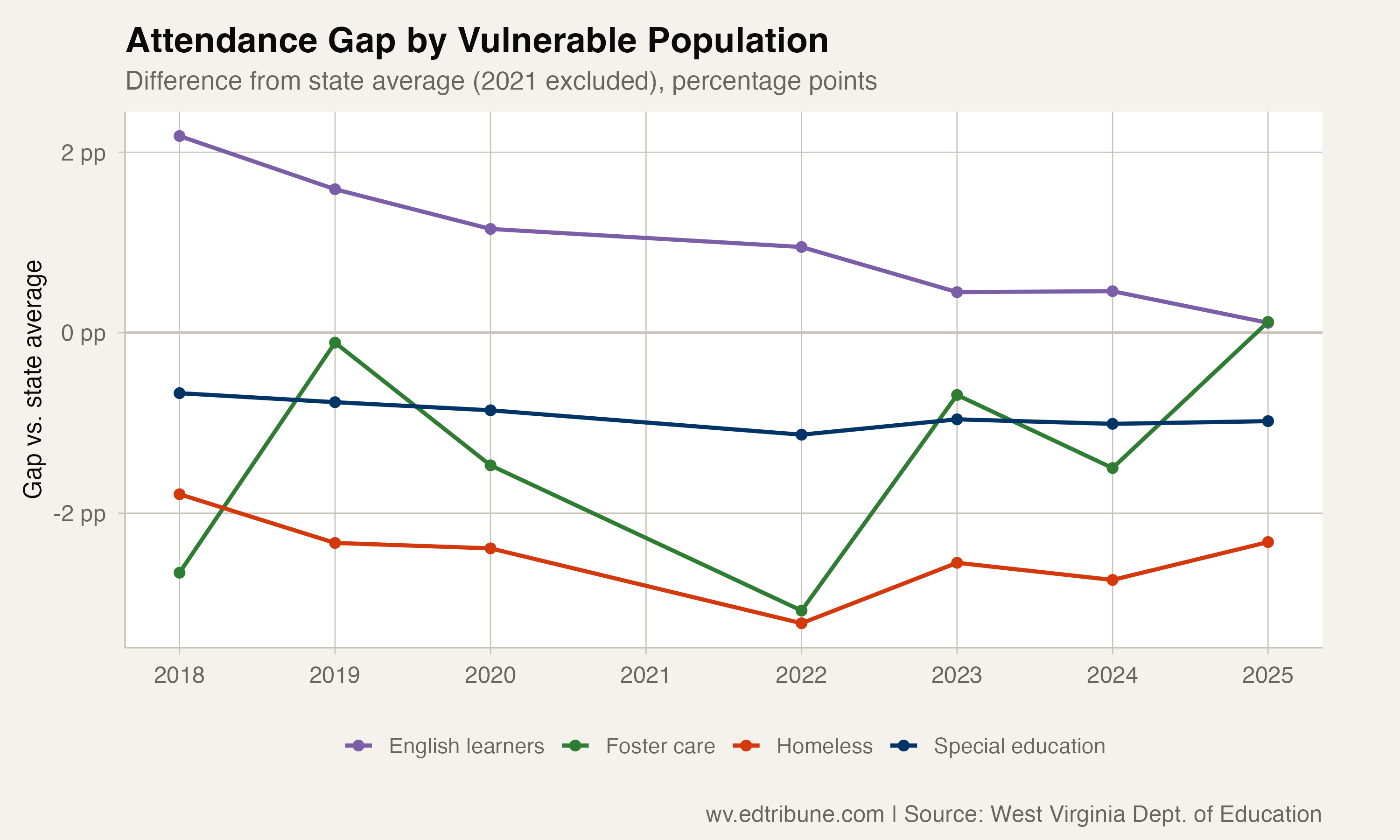
Against the persistent gaps for students who are currently homeless and students with disabilities, foster care attendance tells a different story. Students in foster care crashed harder than any subgroup during the pandemic, from 92.8% in 2018-19 to 87.8% in 2021-22, a 5.0-point drop. Then they recovered almost entirely, reaching 92.4% in 2024-25.
That recovery, 92.2% of the COVID loss recaptured, outpaces every other vulnerable group. Students who are currently homeless recovered 79.3% of their loss. Students with disabilities recovered 65.6%. The state overall recovered 69.8%.
The foster care recovery may reflect the structured support system around these students. Foster families have caseworkers, court-mandated check-ins, and a legal framework that makes disappearing from school harder. West Virginia's Bridge program, which provides transitional services for aging-out youth, adds another layer of institutional attention.
Families experiencing homelessness have no equivalent scaffolding.
Why the count keeps rising
The 69% surge in students who are currently homeless is partly a counting change. The McKinney-Vento Act was reauthorized in 2015, and districts have gotten better at identifying students who qualify. West Virginia's Communities In Schools program, now in all 55 counties with 298 coordinators in 285 schools, has likely improved identification rates.
But identification alone does not explain the magnitude. West Virginia's economy has shed coal jobs, rural housing stock has deteriorated, and the opioid crisis has displaced children into grandparent or relative households that qualify under the doubled-up provision. The counties with the largest counts of students who are currently homeless (Jefferson, Kanawha, Mercer, Lincoln, Berkeley) span the state geographically, suggesting this is not a regional phenomenon.
The 2024-25 count of 11,707 was nearly flat from the prior year (11,714), which may signal a plateau. Whether that reflects a real stabilization or simply the limits of a county-based identification system is not yet clear.
What is clear: West Virginia now has a larger share of its students classified as homeless than at any point in the dataset, and those students attend at rates that trail the state average by a margin that has not budged in eight years.
Detailed code that reproduces the analysis and figures in this article is available exclusively to EdTribune subscribers.
Discussion
Sign in to join the discussion.
Loading comments...