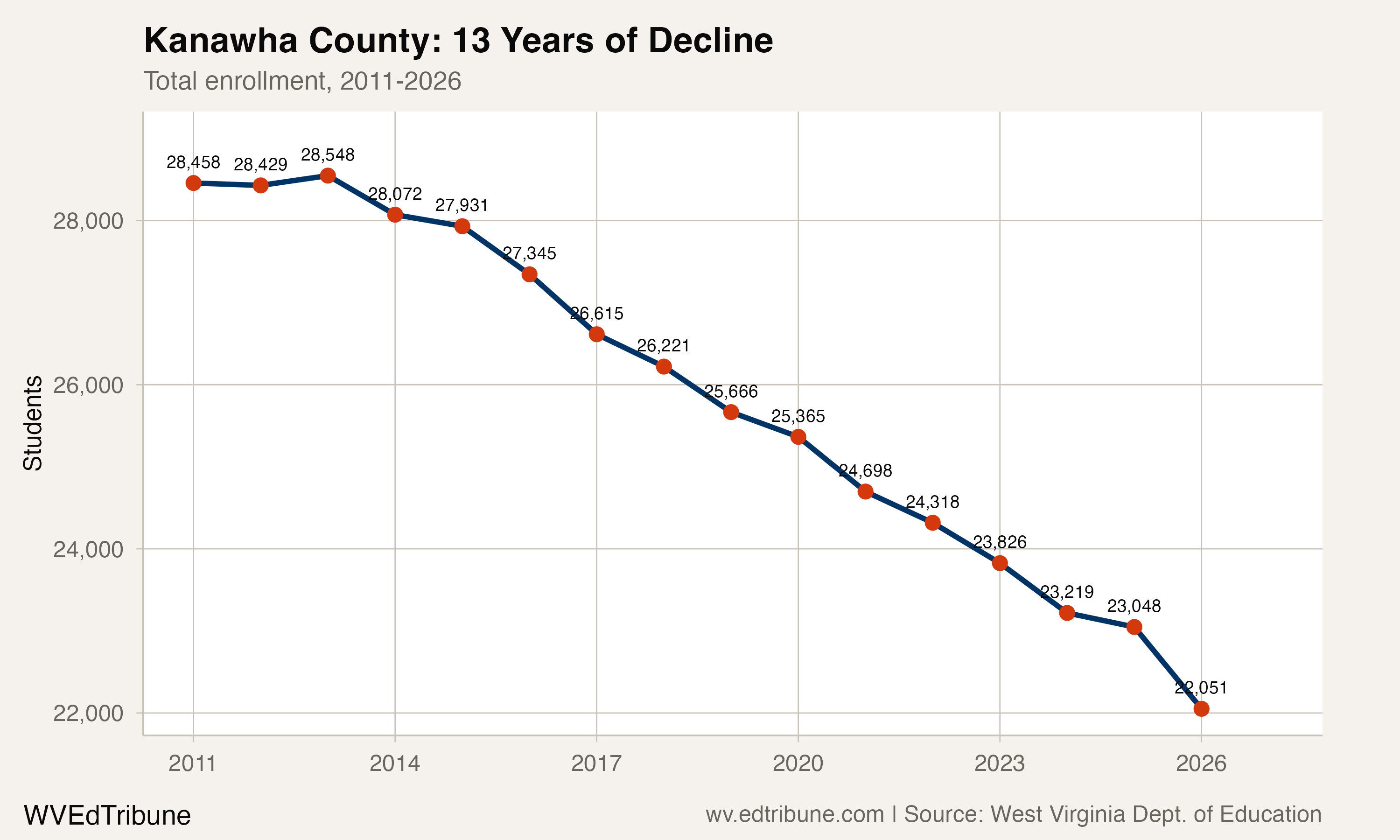
Every year since 2014, Kanawha County↗ET has started the school year with fewer students than the year before. Thirteen consecutive years of decline have carried West Virginia's largest district from 28,548 students at its 2013 peak to 22,132, a 22.5% drop. Since 2011, the net loss is 6,326. The 2025-26 school year delivered the sharpest single-year drop in the dataset: 969 students gone, a 4.2% decline that exceeded the previous worst year by more than a third.
Kanawha County is the seat of state government, home to Charleston. It accounts for 9.4% of West Virginia's public school enrollment but 13.4% of the state's total losses since 2011. The district is now at its lowest enrollment in at least 16 years of available data, and the response has been swift: four elementary schools planned for closure, two middle schools already merged, 140 positions targeted for elimination.
A decline with no floor in sight
The trajectory has been remarkably consistent. Between 2014 and 2026, Kanawha lost students every single year, with annual losses ranging from 170 to 969. The only year in the dataset that showed a gain was 2012-13, when enrollment ticked up by 119 students. That was the last increase.
What changed in 2025-26 was the magnitude. After losing 336 students the previous year, the district shed 969, nearly three times as many. Over the most recent three years (2023-2026), Kanawha lost 1,842 students, compared with 1,398 in the preceding three-year window (2020-2023). The decline is accelerating.
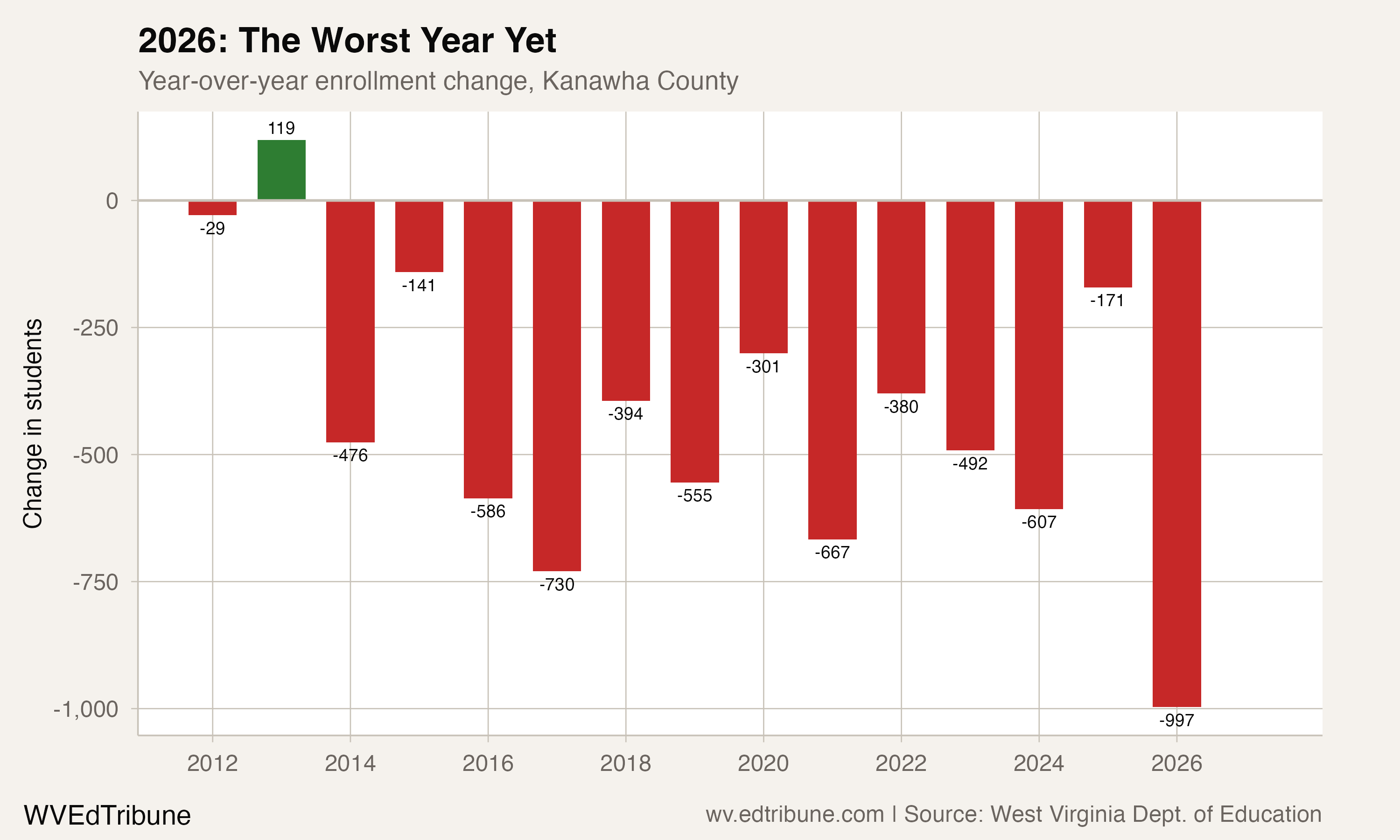
No single year looks like a pandemic shock or a policy cliff. The pattern is a steady bleed that has recently opened wider. The 2026 loss of 969 represents 4.2% of the prior year's enrollment, the highest single-year percentage drop in the 16-year series.
The pipeline is shrinking from the bottom
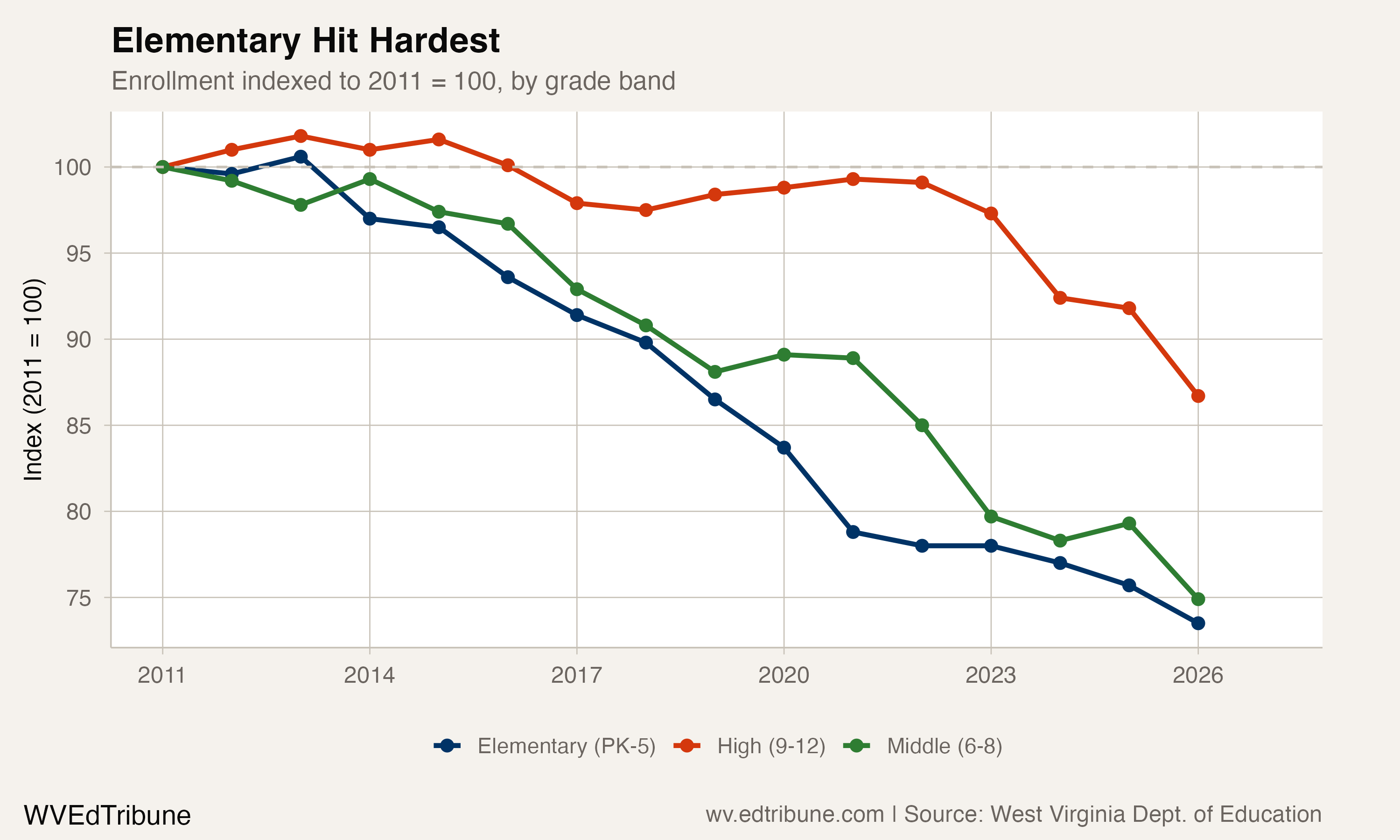
The decline has not hit all grade levels equally. Elementary enrollment (PK-5) has fallen 26.4% since 2011, from 14,102 to 10,385. Middle school (6-8) has tracked a similar path, down 25.0%. High school (9-12) held up longer, staying roughly flat before dropping 12.6% overall.
Kindergarten tells the starkest story. In 2011, Kanawha enrolled 2,086 kindergartners. In 2026, that number was 1,442, a 30.9% decline. The drop was not gradual: kindergarten held above its early-decade level through 2014, then stepped down to the 1,800s, cratered to 1,560 during COVID, partially recovered, and has now fallen to a new low.
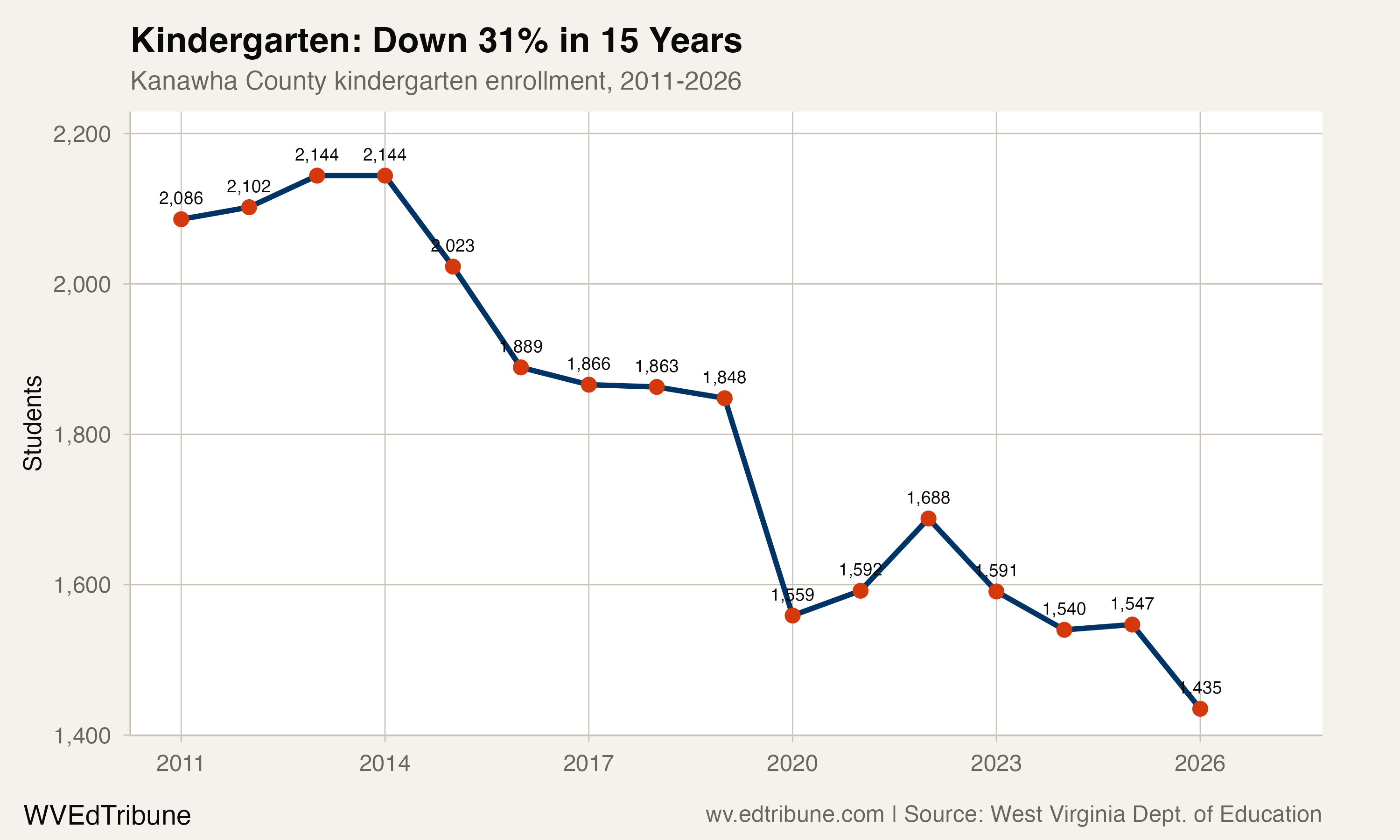
Each small kindergarten class becomes the following year's small first grade, and the year after that's small second grade. The pipeline math is unforgiving: the students who did not enter kindergarten in 2025-26 will not materialize as eighth graders in 2034.
Losing faster than its peers
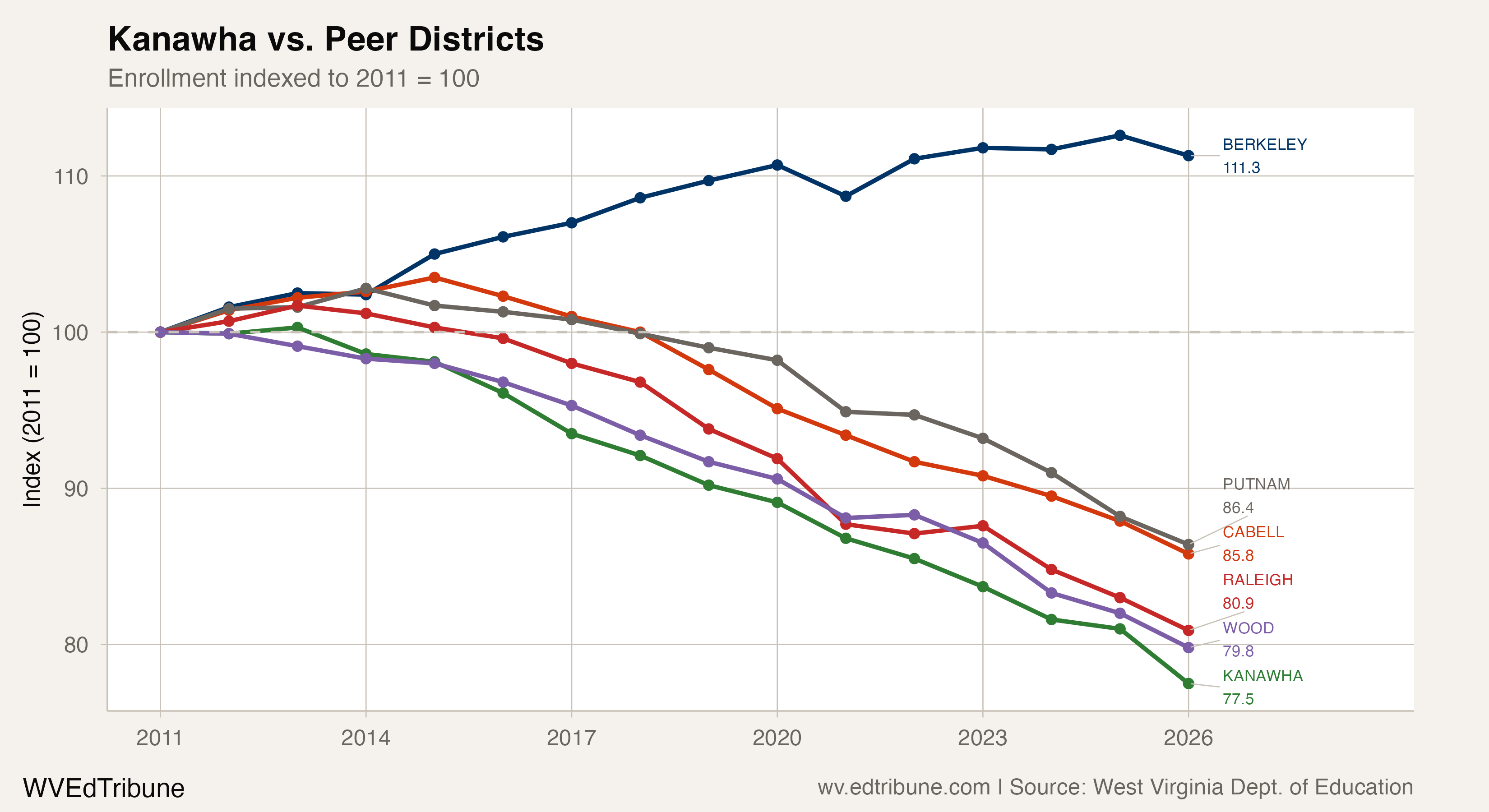
Among West Virginia's six largest districts, Kanawha's decline is the deepest in both absolute and relative terms. Indexed to 2011, Kanawha has retained 77.8% of its enrollment. Cabell County↗ET is at 86.3%, Raleigh County↗ET at 81.6%, Wood County↗ET at 80.4%.
Berkeley County↗ET, in the state's Eastern Panhandle near the Washington, D.C., commuter corridor, is the sole large district that has grown, adding 2,077 students (+11.7%) over the same period. Putnam County↗ET, Kanawha's suburban neighbor, has not been spared: it has lost 1,274 students (-13.2%) since 2011, ruling out a simple story of families moving to the suburbs.
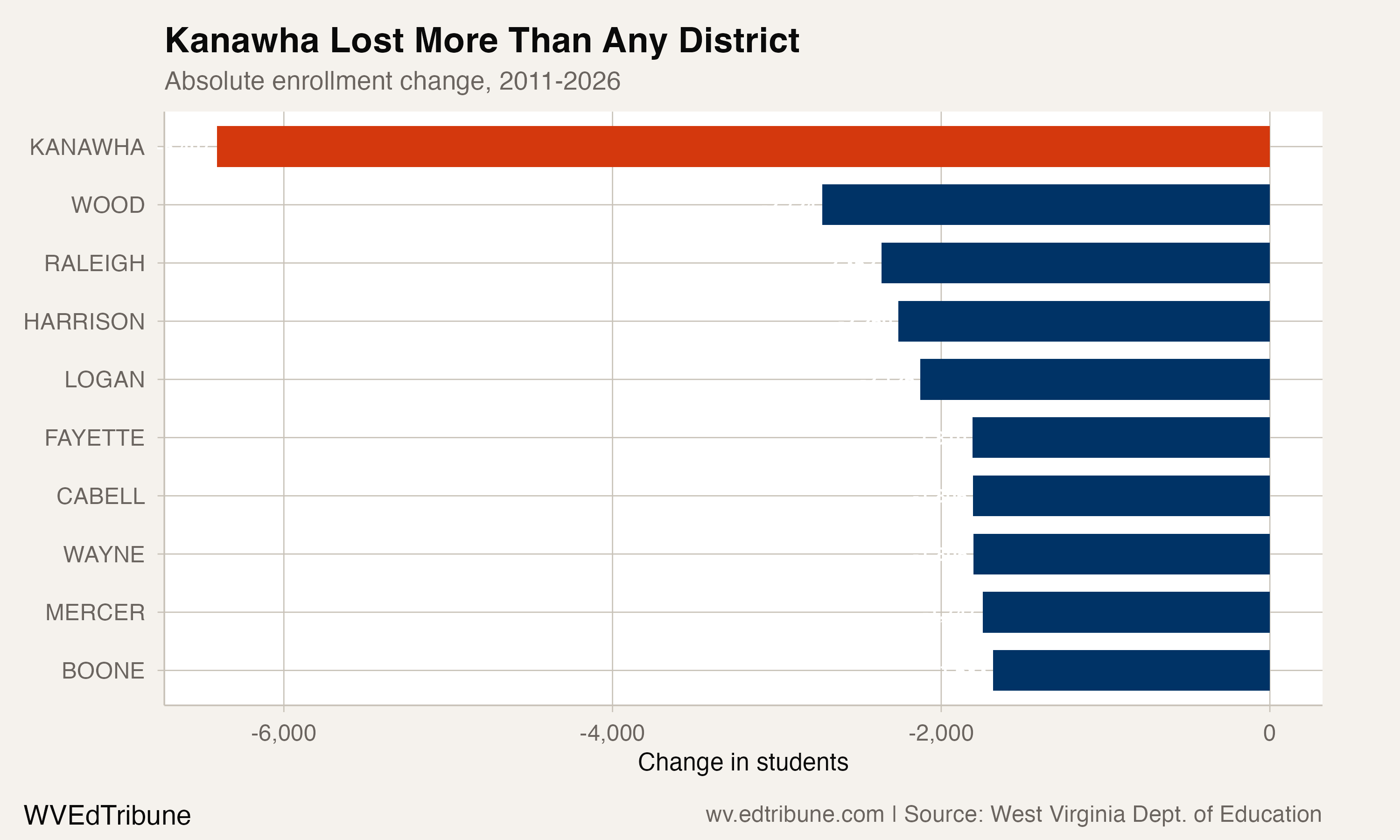
In absolute terms, no district in West Virginia has lost more students than Kanawha. Its 6,326-student decline is more than double the next-largest loser, Wood County at 2,643. Even coal counties with far steeper percentage losses, such as McDowell County↗ET (-41.3%) and Boone County↗ET (-36.9%), lost fewer students in raw numbers because they started smaller.
Three forces, layered
The most direct driver is demographic. West Virginia's population has been shrinking for years, with deaths outpacing births by more than 33,000 over the three years ending July 2023. Charleston's population has fallen 6.7% since the 2020 census. Fewer residents of child-bearing age means fewer kindergartners, and Kanawha's 30.9% kindergarten decline tracks roughly with the county's population trajectory.
Layered on top of that is the Hope Scholarship, West Virginia's education savings account program. Kanawha County had the most Hope Scholarship recipients of any county in 2023-24, with 720 students, more than double its participation from the prior year. The most recent reporting puts the county at roughly 1,300 recipients. Statewide, the program grew from $9.2 million in 2023 to $48.9 million in 2025, with projections to exceed $100 million in 2026.
The enrollment data cannot isolate how many of Kanawha's lost students went to Hope Scholarships versus those who simply left the county or aged out of smaller cohorts. But the timing of the program's acceleration, from roughly 350 Kanawha recipients in 2022-23 to 720 in 2023-24 to an estimated 1,300 now, overlaps with the district's sharpest enrollment drops. The WV Center on Budget and Policy has framed the dynamic bluntly:
"Every dollar that goes to the Hope Scholarship is a dollar that doesn't go to a public school." — WV Center on Budget and Policy, 2025
A third factor is the expiration of federal pandemic relief funding (ESSER), which padded school budgets through 2024. The loss of that funding did not cause enrollment to drop, but it means the district is absorbing enrollment losses without the financial cushion that softened earlier years.
Buildings close, positions disappear
The operational consequences are already visible. At the end of the 2024-25 school year, Kanawha closed East Bank Middle and McKinley Middle schools, merging their students into Dupont Middle and Hayes Middle. Four elementary schools, Midland Trail, Belle, Mary Ingles, and Rand, are planned to close once a new $30 million consolidated elementary school is built on the old Dupont Junior High site. The state School Building Authority approved $20 million for that project in late 2024, with the new school, named Country Roads Elementary, expected to open in fall 2028.
The district is also targeting approximately 140 positions for elimination by the start of the 2026-27 school year. The cuts span "schools, service personnel, professional staff and central office," according to the district. Title I funding is expected to decrease by roughly 20%.
West Virginia's funding formula ties state aid directly to enrollment. Each lost student reduces state allocations. The district approved a $337 million budget for 2025-26, absorbing a $721,000 reduction in state aid from a 336-student enrollment adjustment, while also facing a $2.2 million increase in PEIA (public employee insurance) costs.
A district managing its own contraction
Kanawha is not alone. Forty-eight of West Virginia's 55 county districts hit all-time enrollment lows in 2025-26. Statewide enrollment has fallen from 282,130 to 234,957 since 2011, a 16.7% decline. But Kanawha's position as the state capital district, the largest system, and the district with the highest absolute losses makes its trajectory a bellwether.
The current WVDE snapshot reports 4,446 students receiving special education services, or 20.1% of Kanawha's enrollment. The package does not publish a numeric 2018 district aggregate for this subgroup, so the available data do not support a comparable trend claim.
Superintendent Tom Williams retired at the end of the 2024-25 school year after 40 years. Dr. Paula Potter took over a district that will have fewer students, fewer buildings, fewer staff, and less state funding than any of her recent predecessors.
Dr. Potter inherits a district that has averaged a loss of 422 students per year since 2011. The voucher program is set to expand to all K-12 students in 2026-27, and the kindergarten classes feeding the pipeline keep getting smaller. Country Roads Elementary will open in 2028 to serve the students of four closing schools. The published enrollment trend points to continued pressure, but the size of any future loss is not yet measurable.
Detailed code that reproduces the analysis and figures in this article is available exclusively to EdTribune subscribers.
Discussion
Sign in to join the discussion.
Loading comments...