In this series: West Virginia Chronic Absenteeism.
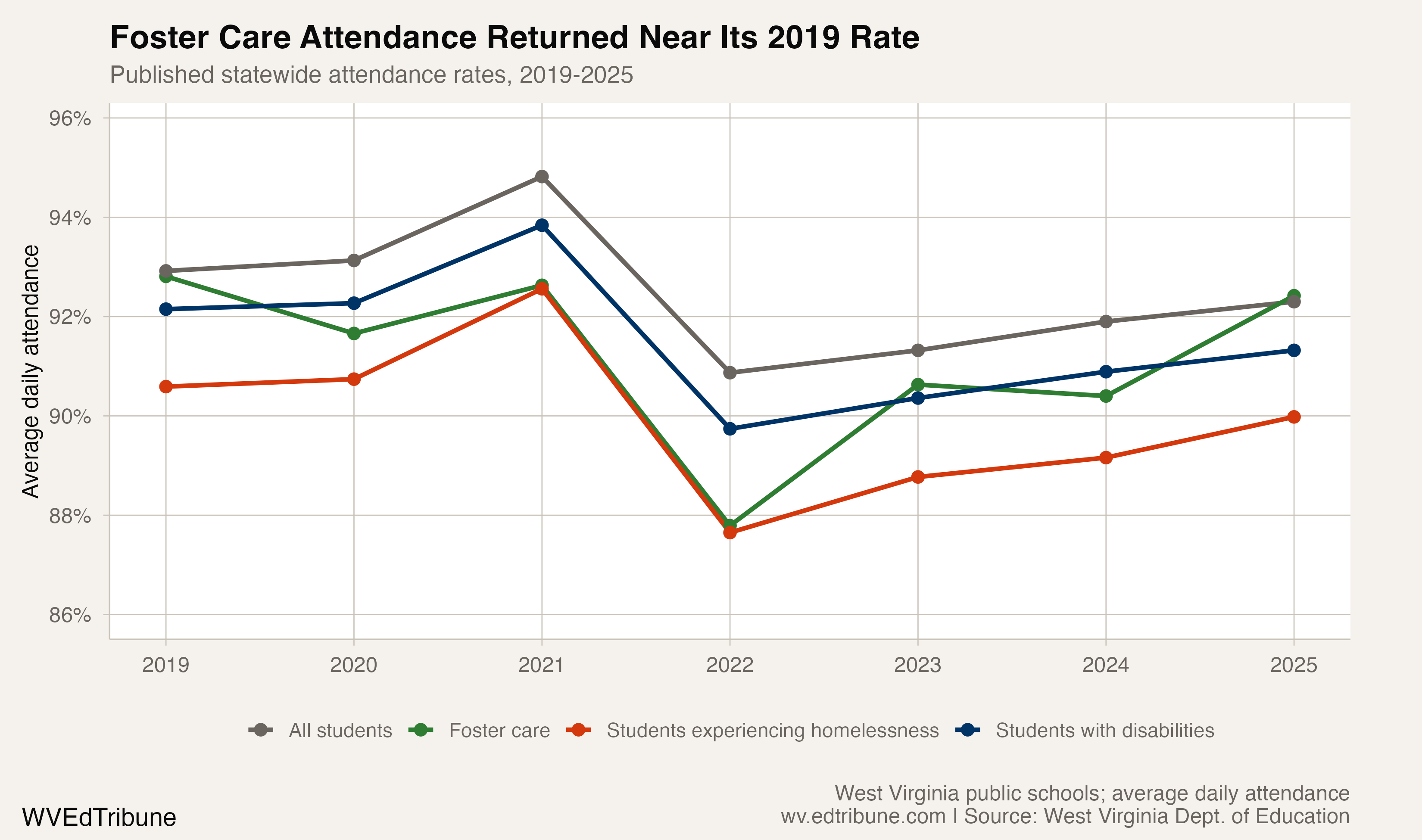
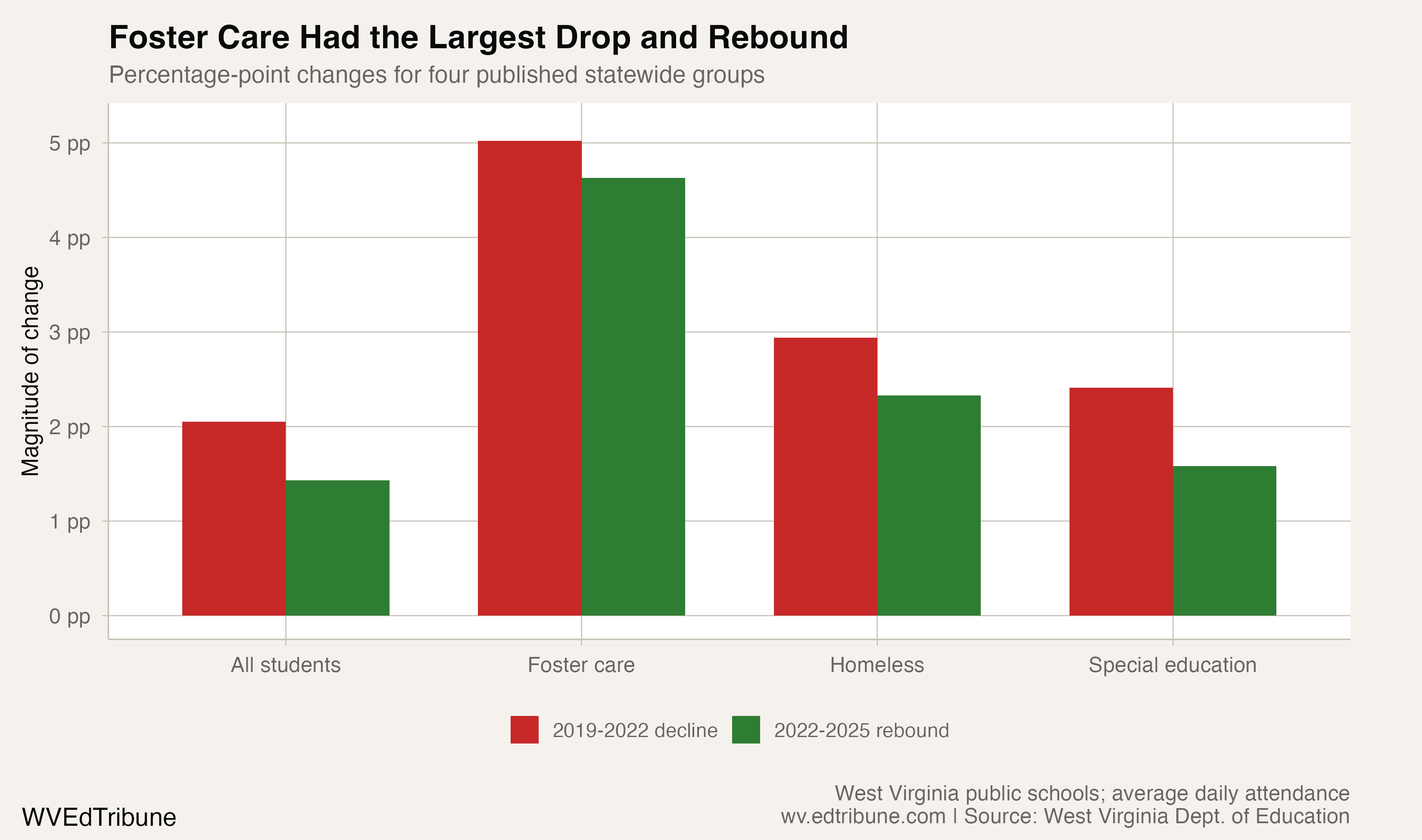
West Virginia's published attendance rate for foster care students fell from 92.8% in 2019 to 87.8% in 2022. The 5.0-percentage-point decline was the largest among the 12 state subgroups with published rates in 2019, 2022 and 2025.
The same subgroup then recorded the largest rebound. Its rate rose 4.6 points to 92.4% in 2025, recovering 92.2% of the earlier decline. The 2025 rate remained 0.4 points below its 2019 level.
Those rankings are comparisons of published state subgroup rates, not findings about why attendance changed. The source is an aggregate attendance file and does not measure caseworker activity, court involvement, housing supports or other mechanisms.
A larger swing than the statewide rate
The statewide all-students rate fell 2.05 points between 2019 and 2022. Foster care students' 5.0-point decline was more than twice as large. The comparison uses the source rates at their stored precision rather than subtracting the one-decimal labels shown in prose and charts.
By 2025, the statewide rate had reached 92.3%, while the foster care rate was 92.4%. That put foster care students 0.1 points above the statewide rate in the latest year, even though the subgroup had not quite returned to its own 2019 level.
The comparison uses average daily attendance rates. The West Virginia data do not report chronic-absenteeism rates in this file, so the two measures should not be treated as interchangeable.
Recovery depended on the measure
The foster care rebound restored 92.2% of the subgroup's 2019-to-2022 decline. Students experiencing homelessness recovered 79.3% of their decline, special education students recovered 65.6%, and the statewide all-students rate recovered 69.8%.
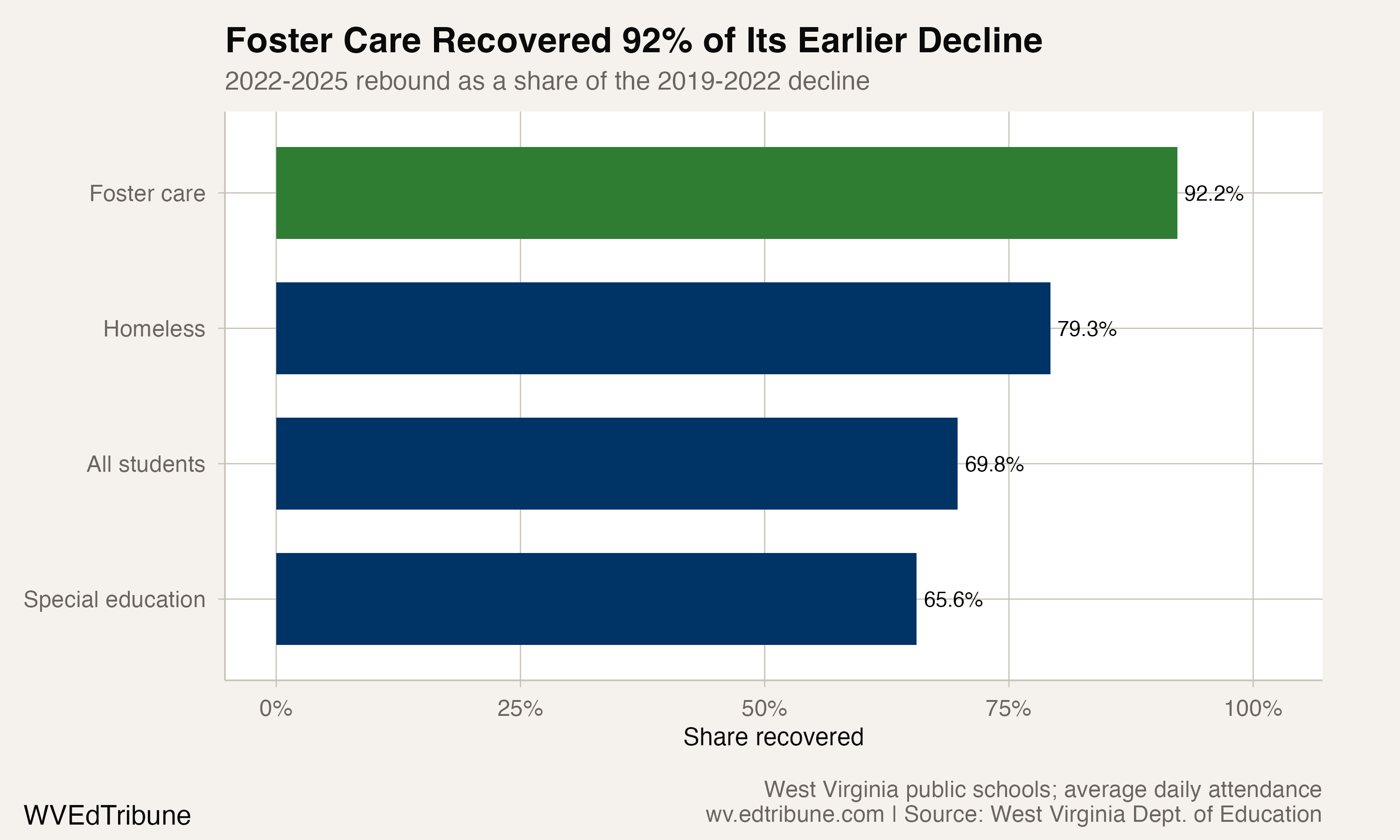
Foster care students ranked first on the absolute rebound of 4.6 points. They did not rank first on the percentage of the earlier decline recovered: that calculation also depends on how large each subgroup's original decline was. The article therefore uses the absolute percentage-point change for the “rebounded most” comparison and reports the recovery percentage separately.
County results need a published-rate universe
The 2025 file contains foster care rows for all 55 county school systems. Forty-nine systems had a published attendance denominator of at least 20 foster care students, but Kanawha County's rate was suppressed. That leaves 48 systems in the rate comparison.
Within that defined universe, Lewis County had the lowest published rate at 88.5%. Cabell County followed at 88.7%, and Boone County was third-lowest at 89.5%. Taylor County had the highest published rate at 94.9%.
Raleigh County had the largest foster care denominator among systems with a published rate: 216 students, with a 91.2% attendance rate. Kanawha County's published denominator was larger at 228, but its suppressed rate cannot be ranked or compared.
The statewide foster care denominator was 3,458 students in 2025. It is the ESSA full-academic-year attendance denominator published with the attendance rate, not the state's October enrollment count.
Detailed code that reproduces the analysis and figures in this article is available exclusively to EdTribune subscribers.
Discussion
Sign in to join the discussion.
Loading comments...