In this series: West Virginia Chronic Absenteeism.
In 2021-22, Tolsia High School in Fort Gay posted an attendance rate of 77.8%. Fewer than four in five students showed up on an average day. Three years later, the school is at 87.6% — still below the state average, but a 9.8-point improvement that represents one of the most dramatic single-school turnarounds in West Virginia.
Tolsia is the most visible piece of a broader story in Wayne County↗ET. The county's attendance rate climbed from 86.0% in 2021-22 to 91.0% in 2024-25, a 5.1-point gain across three consecutive years of improvement. No other county in the state has recovered as much ground.
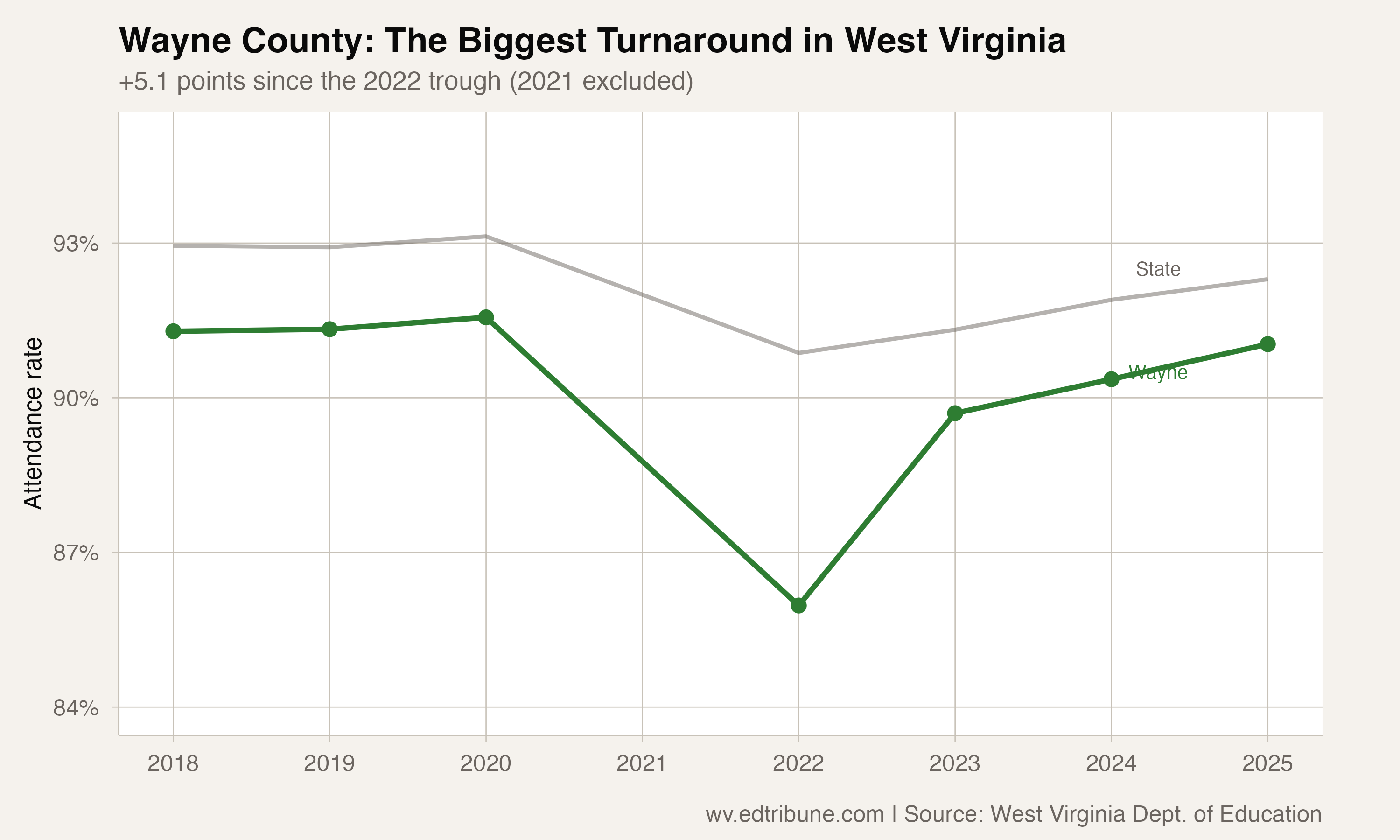
Every school improved
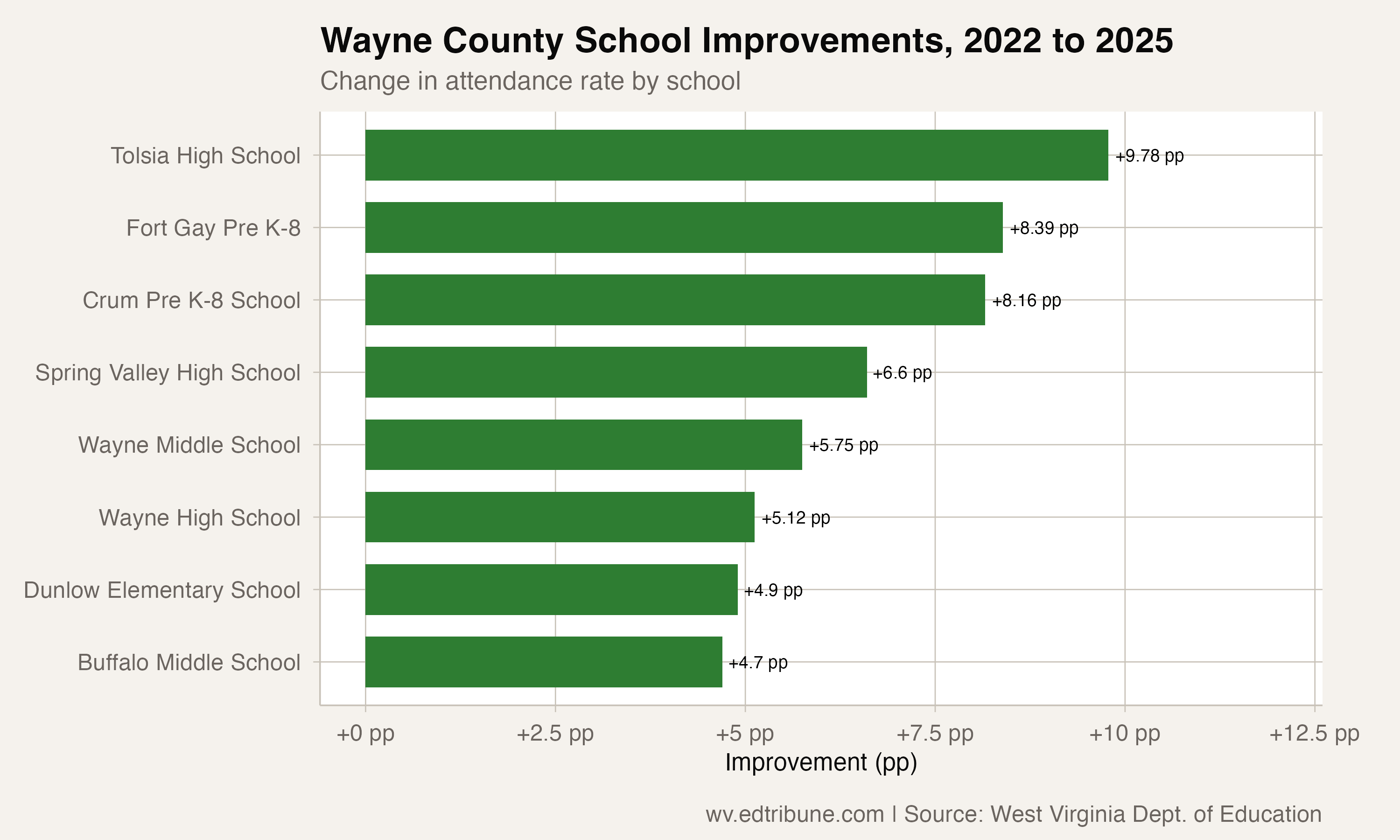
All 18 schools in Wayne County improved their attendance between the 2022 trough and 2024-25. Every one. The smallest gain was 0.5 points at Buffalo Elementary, which was already above 91%. The largest was Tolsia's 9.8 points. Fort Gay Pre K-8 gained 8.4 points. Crum Pre K-8 gained 8.2 points. Spring Valley High School, the county's largest at 876 students, gained 6.6 points.
The breadth matters as much as the magnitude. A county-level turnaround driven by one or two schools would suggest a building-level intervention. When all 18 schools move in the same direction, the cause is almost certainly systemic — a county-level decision, a district-wide initiative, or a community-level shift in engagement.
Wayne County is not affluent. It sits along the Kentucky border in the heart of the region this series has described as coal country's periphery. The county lost 891 students between 2017-18 and 2024-25, a 14.5% enrollment decline. Homeless students number 180, attending at 87.8%.
Where Wayne stands in context
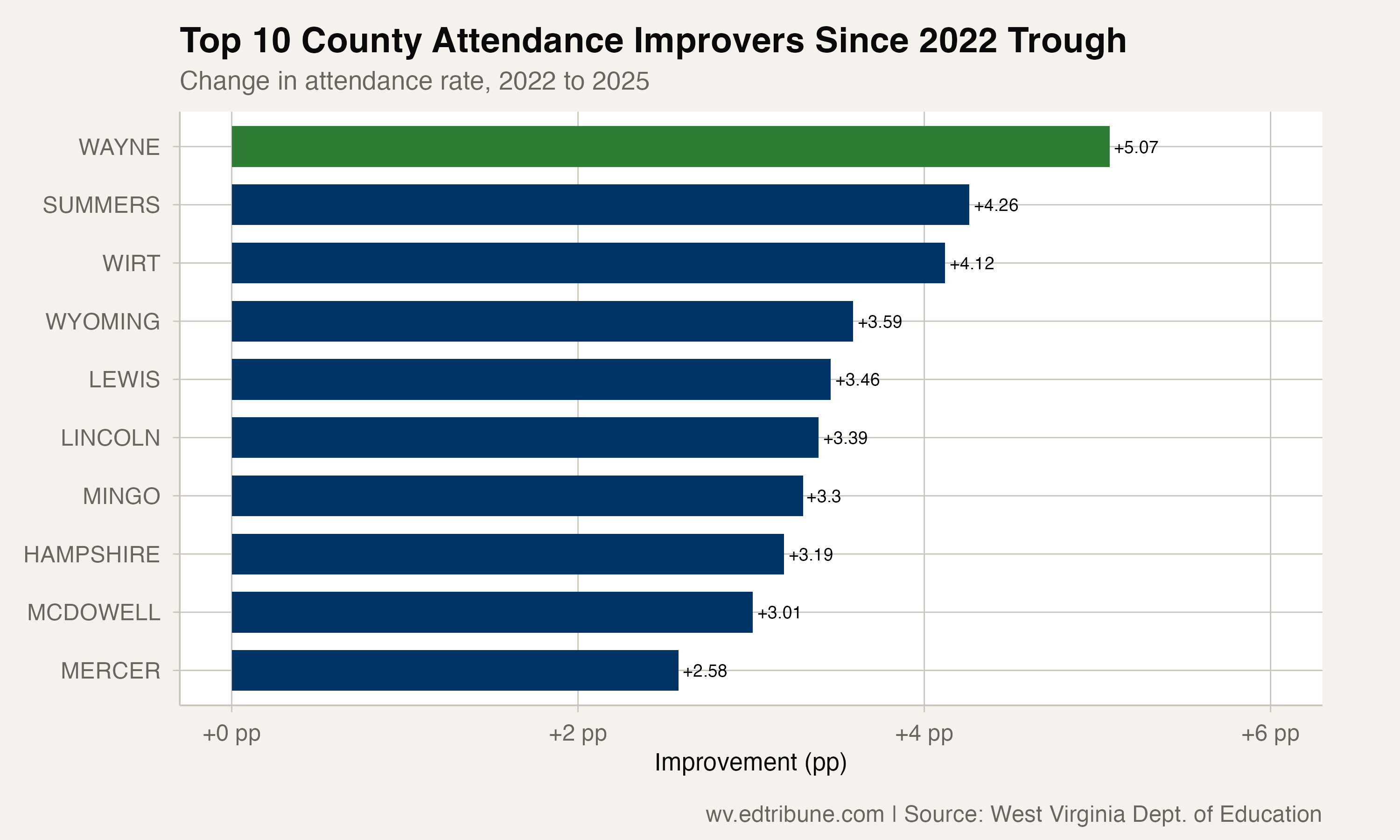
Wayne's 5.1-point gain leads the state. Summers County↗ET is second at 4.3 points. Wirt County gained 4.1 points. Wyoming County↗ET gained 3.6 points. The pattern is notable: four of the top five improvers are in economically distressed, rural, predominantly white counties in southern West Virginia — the same region that includes the state's worst-performing counties.
Wayne's 91.0% rate in 2024-25 is still below the 92.3% state average and below the county's own pre-COVID level of 91.3%. The turnaround recaptured most of the pandemic loss, but not all of it. Three high schools — Tolsia (87.6%), Wayne High (88.1%), and Spring Valley (90.5%) — remain below or near 90%.
The gap between "dramatic improvement" and "full recovery" is the space where the harder work lives. Going from 86% to 91% captures the students who were reachable. Getting from 91% to 93% requires reaching the students who are not.
What Wayne means for coal country
The data confirms that something changed in Wayne County between 2022 and 2025. It does not confirm what. SB 568, enacted in 2024, shifted West Virginia attendance policy toward a multi-tiered system of support for absences, and the state says Truancy Diversion Specialist grants have reached 27 local education agencies. Those are suggestive context, not direct evidence that Wayne adopted the programs earlier or more aggressively than peers.
But the result is hard to dismiss. Wayne and its coal country neighbors share demographics, geography, and economic constraints. If Wayne can gain 5 points, the structural argument that attendance rates in Appalachian counties are immovable weakens. The statewide deceleration curve (+0.45 then +0.58 then +0.40) would predict slowing here too. Wayne has already defied that prediction once.
Detailed code that reproduces the analysis and figures in this article is available exclusively to EdTribune subscribers.
Discussion
Sign in to join the discussion.
Loading comments...