In this series: West Virginia Chronic Absenteeism.
Correction (May 29, 2026): An earlier version of this article overstated several figures. There are 16 schools statewide below 88% attendance (not 14), two of them outside the coal corridor. The five counties have lost about 3,950 students since 2017-18 (a 21% decline, not 3,521 / 19%). McDowell cleared 90% once (2020-21) and Boone cleared it twice (2019-20 and 2020-21). The region sits about 0.9 points below its pre-COVID average of 89.9%. The school-level breakdown and high-school counts have also been corrected.
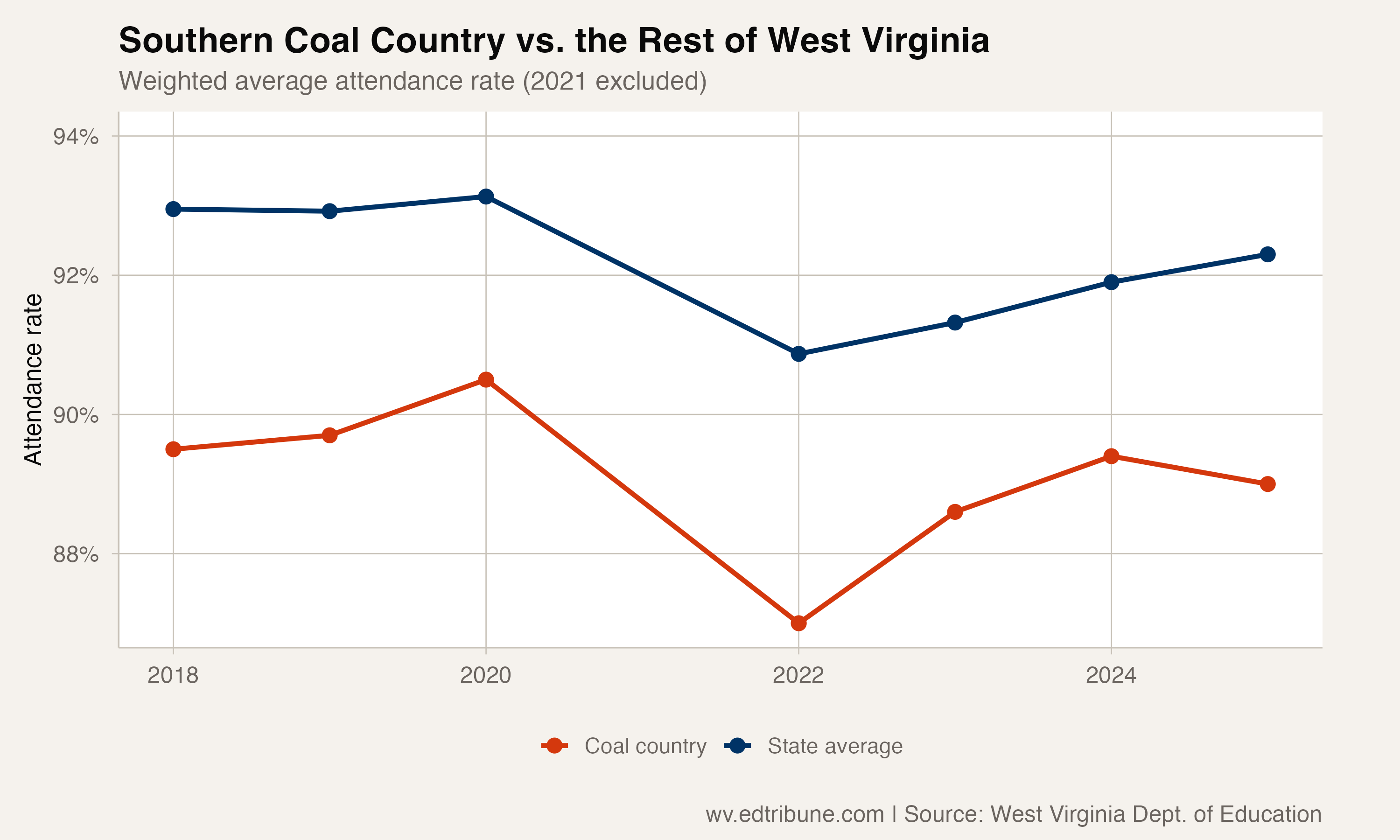
Draw a line across southern West Virginia from Boone County↗ET to McDowell County↗ET. Everything along that line (the old coal counties of Boone, Logan, Mingo, McDowell, and Wyoming) sits below the state attendance average. Four of the five are below 90%. The one exception is Mingo County↗ET, which climbed back above 90% in 2023-24 and held there, proof that coal country attendance is not structurally locked below the line. Of the 16 schools statewide with attendance rates below 88% in 2024-25, 14 are in this corridor; the other two are Independence Middle School in Raleigh County (87.1%) and Tolsia High School in Wayne County (87.6%).
This is not a story the pandemic wrote. In 2017-18, before anyone had heard of COVID-19, these five counties averaged 89.5% attendance against a 93.0% state average, a 3.5-point gap. The pandemic made it worse, pushing the regional average to 87.0% while the state fell to 90.9%. But the pre-existing gap never closed, and in 2024-25 it stands at 3.3 points.
Five counties, five trajectories
The five coal counties are not all moving in the same direction, even though they share a geography.
McDowell County, the state's poorest, with 2,032 students, had the worst attendance in 2024-25 at 87.6%. The county briefly improved to 89.2% in 2023-24 before sliding back. In eight years of data, McDowell has cleared 90% only once, during the anomalous 2020-21 virtual year (90.9%); in every normal year it has stayed below the line.
Logan County↗ET fell to 87.9%, its lowest on record, after briefly recovering to 89.3% in 2023-24. The reversal is driven partly by Man Senior High School (84.7%) and Logan Senior High (85.3%), two of the state's worst.
Boone County has cleared 90% in only two of the past eight years: 2019-20 (90.9%) and the anomalous 2020-21 virtual year (when remote attendance inflated rates statewide). At 88.7% in 2024-25, it is marginally better than the year before but still below the line.
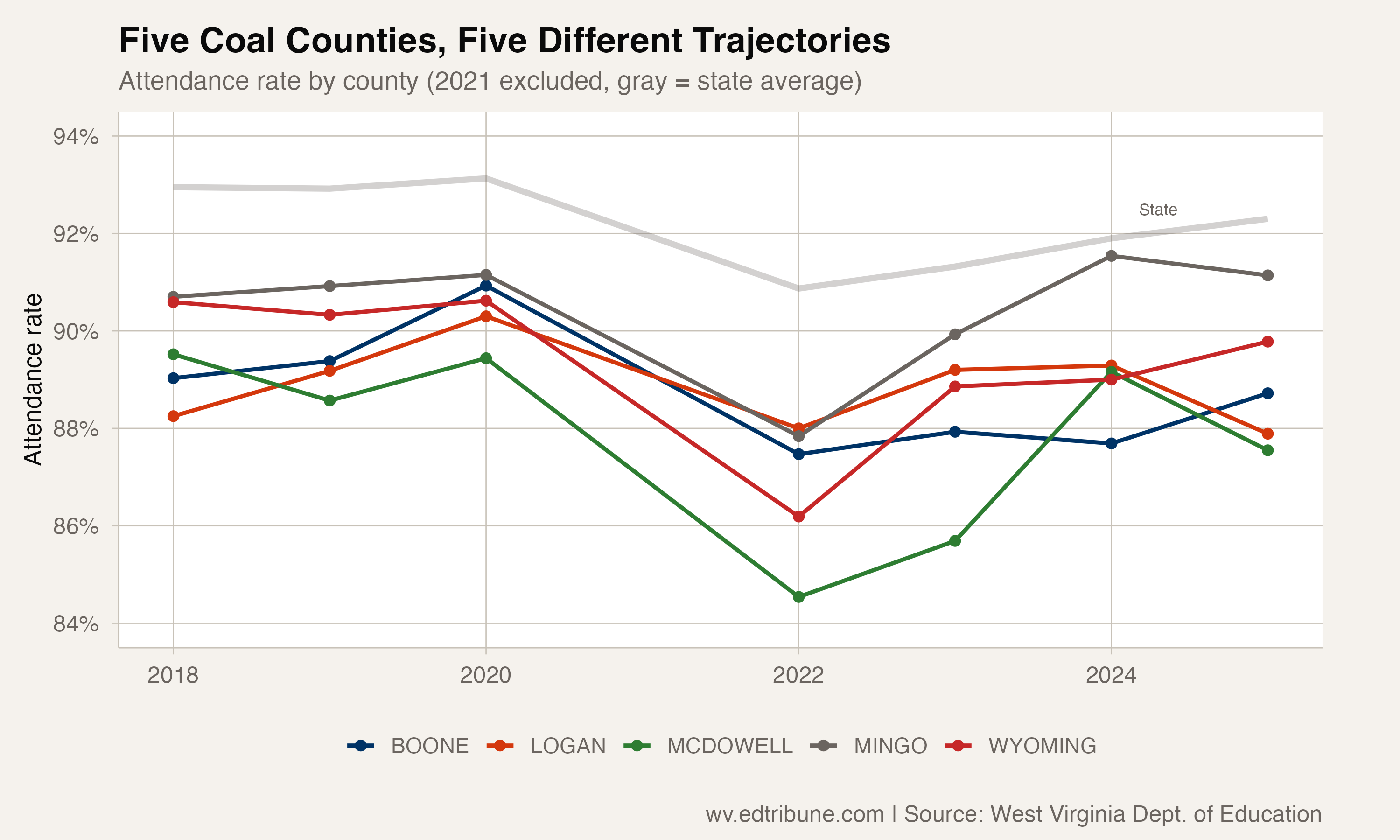
Wyoming County↗ET tells a slightly more encouraging story: 89.8% in 2024-25, up 3.6 points from the trough, on a three-year improvement streak. It is the only coal county that has recovered more than half of its pandemic loss.
Mingo County is the example the others are chasing. At 91.1%, it cleared 90% in 2023-24 and held above it, the only one of the five to do so. Mingo's recovery from the 87.8% trough, 3.3 points in three years, shows that coal country attendance is not structurally locked below 90%.
The school-level crisis
Fourteen schools across these five counties posted attendance rates below 88% in 2024-25. By the state's structural classification, the list includes nine high schools, three middle schools, one primary school, and one elementary school.
The concentration at the secondary level is striking: every high school in McDowell, Boone, and Logan counties, eight schools total, is below 90%. At Man Senior High (84.7%), River View High (85.2%), and Logan Senior High (85.3%), the average student misses 27 or more days per year. At a 180-day school year, that is nearly a month and a half of instruction.
Bradshaw Elementary in McDowell County, at 88.0%, is the only elementary school on the list, notable because elementary attendance statewide averaged 93.2%. When the crisis reaches elementary schools, the underlying conditions have overwhelmed the structural advantages that keep younger students in seats.
The gap narrowed, then didn't
The coal country attendance gap widened during the pandemic crash, reaching 3.9 points in 2021-22. It then narrowed as the region's recovery outpaced the state's. From the 2021-22 trough to 2023-24, the coal counties gained 2.4 points while the state gained about 1.0 point over the same window, driven by the fast recoveries in Mingo and Wyoming counties.
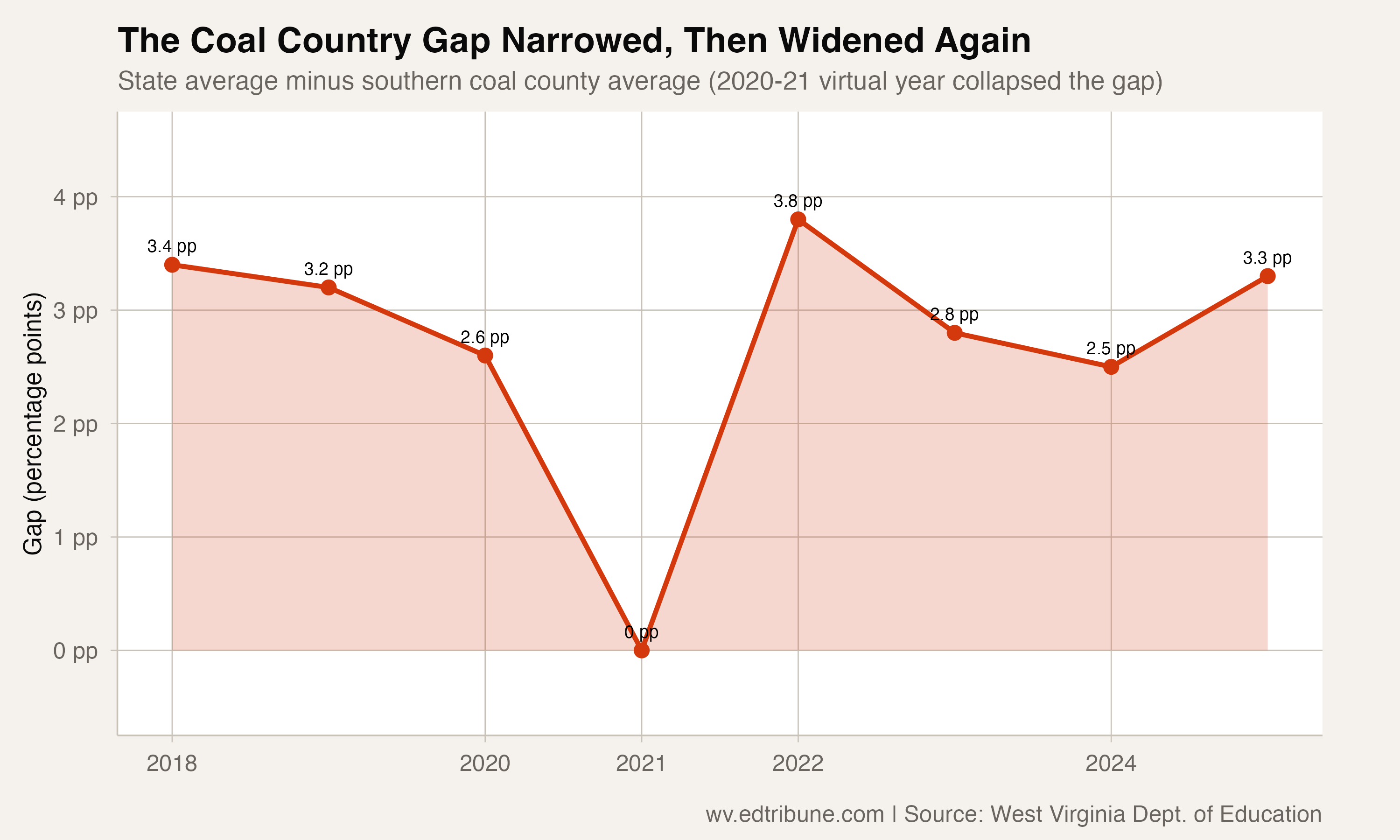
But in 2024-25, the gap widened again to 3.3 points, largely because Logan and McDowell reversed course. The region remains 3.3 points below the state average and about 0.9 points below its own pre-COVID average of 89.9%.
This is a region that was already losing students before the pandemic. The five counties have shed about 3,950 students since 2017-18, a 21% decline, and the students who remain are attending less consistently. Lower attendance drives lower state funding through the ADA formula. Less funding means fewer staff, fewer programs, and longer bus routes. Longer bus routes mean more transportation barriers. The cycle runs in one direction.
The five coal counties together enroll 14,671 students, roughly 6.9% of the state total. Their attendance picture is geographically concentrated and structurally persistent, but Mingo County's climb back above 90% shows the trend can be reversed.
Detailed code that reproduces the analysis and figures in this article is available exclusively to EdTribune subscribers.
Discussion
Sign in to join the discussion.
Loading comments...